



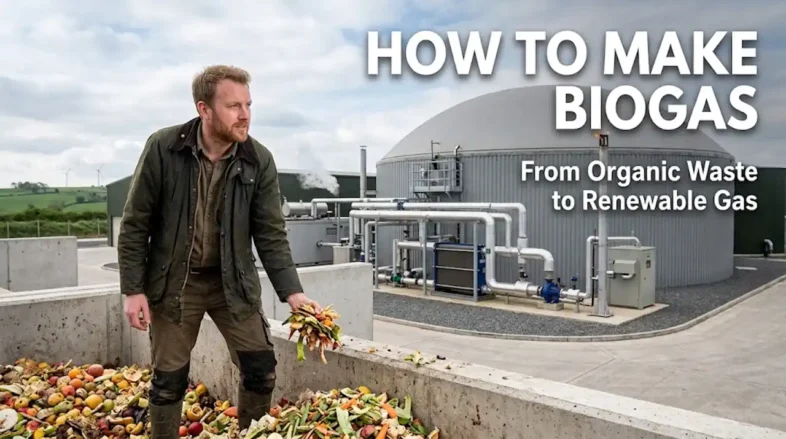
Biogas is made when microorganisms break down biodegradable organic material in the absence of oxygen. The controlled process is called anaerobic digestion, and it can convert food waste, animal manure, sewage sludge, crop residues and many other organic materials into a useful renewable gas.
The principle sounds simple: place biodegradable material in an airtight digester and allow naturally occurring microorganisms to convert part of it into methane-rich gas.
 In practice, however, reliable biogas production depends on much more than putting waste into a sealed tank. Feedstock composition, temperature, pH, organic loading, retention time, mixing, inhibition, gas handling and digestate management can all determine whether an anaerobic digester performs well or fails.
This guide explains how biogas is made from organic material, the biological stages involved, the equipment normally required, what affects methane yield, and how raw biogas can be used or upgraded to biomethane.
Key Takeaways
- Biogas is produced by anaerobic digestion when microorganisms break down biodegradable material without oxygen.
- Suitable feedstocks include food waste, livestock manure and slurry, sewage sludge, crop residues and many industrial organic wastes.
- The biological process is commonly described as four stages: hydrolysis, acidogenesis, acetogenesis and methanogenesis.
- Raw biogas consists mainly of methane and carbon dioxide, together with smaller quantities of water vapour and other gases.
- Methane is the useful energy component of biogas.
- Biogas can be used in boilers and combined heat and power systems or upgraded to biomethane for grid injection or other uses.
- The other major product is digestate, which can retain valuable plant nutrients when appropriately managed.
- More feedstock does not automatically mean more useful gas. Overloading a digester can destabilise the biological process.
- Biogas contains flammable methane and may contain toxic hydrogen sulphide, so gas production, storage and use require proper engineering and safety controls.
What Is Biogas?
Biogas is a combustible gas produced by the biological decomposition of organic material under oxygen-free conditions.
Raw biogas normally consists predominantly of:
- methane (CH4);
- carbon dioxide (CO2);
- water vapour; and
- smaller concentrations of gases and contaminants which can include hydrogen sulphide.
The exact composition depends on the feedstock, digestion process and operating conditions.
Methane is the component that gives biogas its energy value. The more methane the gas contains, the greater its potential energy content.
Biogas should not be confused with biomethane. Biomethane is biogas that has been cleaned and upgraded, principally by removing carbon dioxide and contaminants, until the methane concentration and gas quality meet the specification required for its intended use.
How Is Biogas Made?
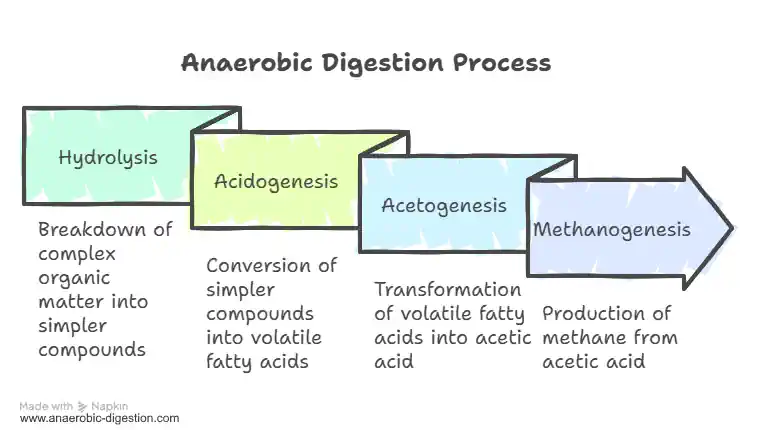
The basic sequence is:
- Collect a suitable biodegradable feedstock.
- Prepare and, where necessary, blend the material.
- Feed it into an oxygen-free anaerobic digester.
- Maintain suitable biological conditions.
- Allow microorganisms to convert organic material into biogas.
- Collect the gas from the digester headspace or gas holder.
- Clean or upgrade the gas according to its intended use.
- Remove and appropriately use or manage the digestate.
All anaerobic digestion systems follow broadly this biological principle, although the engineering configuration varies enormously between a small manure digester, a municipal food-waste plant, a wastewater sludge digester and a large biomethane facility.
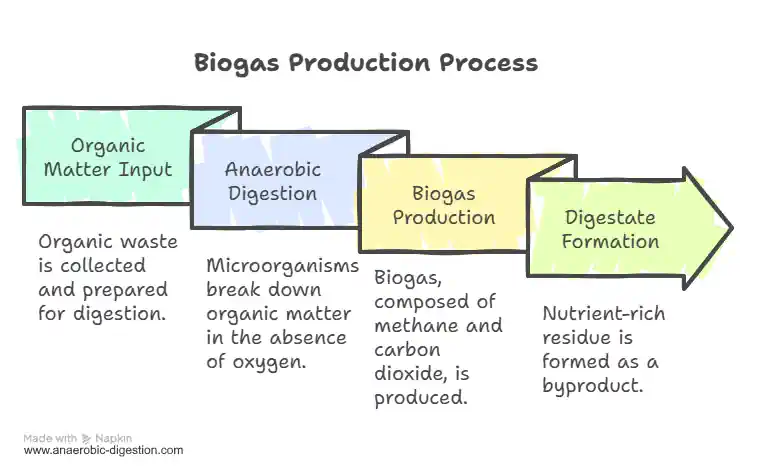
The Four Main Biological Stages of Biogas Production
Anaerobic digestion is not performed by one organism or one chemical reaction. It relies on communities of microorganisms working through a sequence of interconnected biological processes.
1. Hydrolysis
Large organic molecules cannot normally be used directly by the microorganisms responsible for producing methane.
During hydrolysis, complex materials such as carbohydrates, proteins and fats are broken into smaller soluble compounds.
Examples include:
- complex carbohydrates becoming simpler sugars;
- proteins becoming amino acids; and
- lipids becoming fatty acids and glycerol.
For some fibrous materials, hydrolysis can be one of the rate-limiting stages of anaerobic digestion.
2. Acidogenesis
During acidogenesis, another group of microorganisms converts soluble organic compounds into products that include volatile fatty acids, alcohols, hydrogen and carbon dioxide.
This stage can proceed relatively quickly.
If acid production becomes faster than the downstream microorganisms can consume those acids, volatile fatty acids may accumulate and digester pH can fall.
3. Acetogenesis
During acetogenesis, intermediate products are further converted into compounds suitable for methane formation, particularly acetate, hydrogen and carbon dioxide.
4. Methanogenesis
The final major biological stage is methanogenesis.
Methanogenic microorganisms produce methane mainly from:
- acetate; and
- hydrogen and carbon dioxide.
Methanogens are particularly important because they tend to be more sensitive to adverse conditions than some of the organisms operating earlier in the digestion process.
This is one reason why a digester can continue producing acids while methane production deteriorates — potentially resulting in process instability.
What Materials Can Be Used to Make Biogas?
Many biodegradable organic materials can potentially produce biogas, but being biodegradable does not automatically make a material a good digester feedstock.
Common feedstocks include:
Food Waste
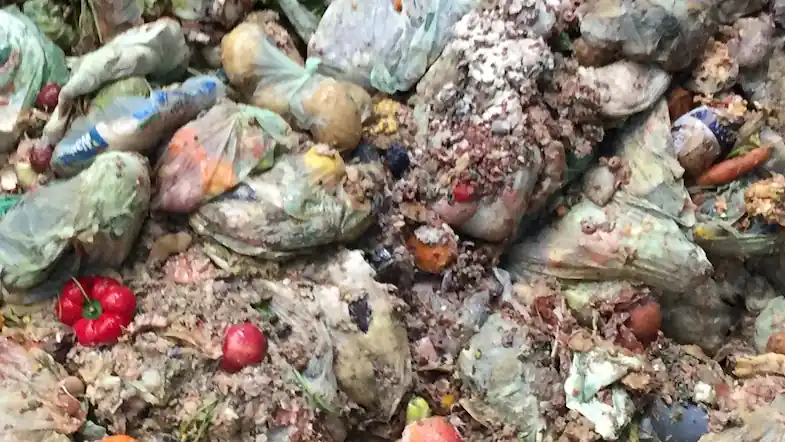
Food waste can have a high methane-production potential because it often contains readily biodegradable carbohydrates, proteins and fats.
Sources include:
- household food waste;
- restaurants and catering establishments;
- supermarkets;
- food manufacturing;
- commercial kitchens; and
- food distribution operations.
Food waste may require depackaging, contaminant removal, pulping or other preparation before digestion.
For more detail see our guide to how to make biogas from food waste.
Animal Manure and Slurry
Cattle slurry, pig manure and other livestock wastes are widely used for anaerobic digestion.
Manure often produces less methane per tonne than high-energy food wastes or fats, but it offers other benefits including:
- regular availability;
- existing collection systems on many farms;
- useful moisture content;
- microbial buffering capacity; and
- improved management of manure-derived methane emissions.
Crop Materials
Crop residues and, at some plants, purpose-grown energy crops can also be digested.
Where crops such as maize are used, they are normally harvested seasonally and ensiled in substantial silage clamps. The stored silage can then be fed to the digester throughout the year.
A crop-based digester therefore does not normally depend on continuously receiving freshly harvested crop material.
Sewage Sludge
Anaerobic digestion of sewage sludge has been practised for many decades at wastewater treatment works.
The process stabilises organic solids while producing biogas that can be used for heat and electricity or upgraded to biomethane.
Industrial Organic Residues
Breweries, distilleries, dairy processors, food manufacturers and many other industries generate biodegradable residues that may be suitable for anaerobic digestion.
The suitability of any particular industrial material depends upon composition, biodegradability, contaminants, nutrient balance and possible inhibitors.
Co-Digestion: Making Biogas from Several Feedstocks
Co-digestion means digesting two or more different biodegradable feedstocks together.
This can be advantageous because one feedstock may compensate for weaknesses in another.
For example, appropriate combinations may improve:
- nutrient balance;
- moisture content;
- buffering capacity;
- organic loading;
- feedstock security; and
- overall methane production.
However, a plant operator must not simply add a new feedstock because it appears biologically attractive.
The site’s environmental permit or other applicable authorisation must allow the material to be accepted.
This distinction can be especially important when a farm digester originally designed for agricultural materials considers accepting commercial food waste or another material legally classified as waste.
For a detailed explanation see our guide to anaerobic co-digestion, feedstocks and benefits.
How a Typical Biogas Plant Works
A commercial biogas installation normally involves considerably more than the digester vessel itself.
1. Feedstock Reception
Incoming material is received, inspected and stored.
Waste-fed plants may also require:
- weighing;
- sampling;
- contaminant inspection;
- segregated reception areas; and
- record keeping.
2. Feedstock Preparation
Depending on the material, preparation can include:
- depackaging;
- screening;
- removal of grit and contaminants;
- size reduction;
- mixing;
- dilution;
- blending; and
- pasteurisation where required.
Good feedstock preparation protects pumps, pipework and mixers as well as the biology.
3. Feeding the Digester
Prepared feedstock is introduced into the anaerobic digester at a controlled rate.
Stable feeding is generally preferable to large irregular load changes because the microbial population needs time to respond.
4. Anaerobic Digestion
The material remains in the digester under controlled oxygen-free conditions.
Common operating regimes include:
- mesophilic digestion, normally around the mid-30s °C range; and
- thermophilic digestion, operating at a higher temperature.
Temperature stability is normally more important than chasing a theoretically perfect temperature.
5. Mixing
Many digesters are mixed to:
- distribute incoming feedstock;
- maintain contact between microorganisms and substrate;
- reduce settling;
- limit floating layers; and
- maintain more uniform temperature and concentration.
More mixing is not automatically better. Mixing consumes energy and inappropriate mixing can sometimes reduce performance rather than improve it.
6. Gas Collection
Biogas rises from the digesting material and is collected in a gas-tight headspace or gas holder.
From there it passes through the site’s gas-management system.
7. Digestate Removal
Digested material is removed to make room for new feedstock.
The resulting digestate may be stored as whole digestate or separated into liquid and fibrous fractions depending upon the plant and intended use.
What Controls How Much Biogas Is Produced?
Biogas yield depends on both the feedstock and the way the digester is operated.
Feedstock Biodegradability
Readily biodegradable food wastes and fats can produce substantial quantities of methane, whereas woody or highly lignified materials may degrade poorly without pretreatment.
Organic Loading Rate
Increasing feed rate can increase gas production — but only while the microbial community can process the additional material.
Overloading is a classic cause of digester instability.
Acids can accumulate faster than methanogens consume them, eventually reducing pH and methane production.
Hydraulic and Solids Retention Time
The microorganisms need sufficient time to degrade the feedstock.
If material passes through too rapidly, potential methane production can leave the digester in partially digested material.
Temperature
Anaerobic microorganisms respond strongly to temperature.
Rapid or excessive temperature changes can disturb the microbial community.
pH and Alkalinity
Methanogens normally require a relatively stable environment.
Monitoring pH alone may provide warning only after instability has developed, so many operators also monitor alkalinity and volatile fatty acids.
Nutrients and Trace Elements
Anaerobic microorganisms require nutrients and trace elements for growth.
Deficiency can limit biological performance even where plenty of organic substrate is available.
Inhibitors
Potential inhibitors can include:
- excess ammonia;
- high concentrations of volatile fatty acids;
- salts;
- cleaning chemicals;
- antibiotics;
- heavy metals; and
- other toxic compounds.
This is another reason why changes in feedstock should be evaluated carefully rather than made simply because additional organic material is available.
What Happens to the Raw Biogas?
The answer depends on how the plant intends to use it.
Boilers
Biogas can be burned to produce heat, although gas cleaning may still be required to protect equipment.
Combined Heat and Power
Biogas can fuel an engine or other CHP unit that produces electricity and useful heat simultaneously.
For more detail see our guide to biogas CHP systems.
Biomethane Production
Raw biogas can be upgraded by removing most of its carbon dioxide together with contaminants and moisture.
The resulting biomethane can potentially be:
- injected into a gas distribution network;
- compressed for suitable vehicle-fuel applications;
- used as an industrial fuel; or
- used elsewhere as a substitute for fossil natural gas where applicable specifications are met.
Modern upgrading technologies include:
- membrane separation;
- pressure swing adsorption;
- water scrubbing; and
- chemical absorption.
Biogas Cleaning Is Different from Biogas Upgrading
These terms are sometimes used interchangeably, but they are not quite the same.
Biogas cleaning generally refers to removing contaminants that might damage equipment or create emissions problems.
These may include:
- hydrogen sulphide;
- moisture;
- particulates; and
- other trace contaminants.
Biogas upgrading goes further by removing much of the carbon dioxide so that methane becomes a much larger proportion of the gas.
What Is Digestate?
Making biogas does not make the original feedstock disappear.
The material remaining after digestion is called digestate.
A substantial proportion of the original nutrients remain in that digestate, including:
- nitrogen;
- phosphorus;
- potassium; and
- organic matter.
Where digestate is suitable and properly managed, these nutrients can be returned to agricultural land.
Digestate management should therefore be designed as part of the AD project from the beginning, not treated as an afterthought once the digester is operating.
Storage capacity, spreading land, nutrient demand, transport distance, regulatory status and seasonal application constraints can all affect project viability.
Can You Make Biogas at Home?
Small-scale digesters are used in many parts of the world, particularly where livestock manure and kitchen residues are readily available and conventional fuels are expensive or difficult to obtain.
The biological principle is the same as in a commercial anaerobic digestion plant.
However, making methane-containing gas is not equivalent to an ordinary home fermentation project.
Raw biogas may contain:
- flammable methane;
- toxic hydrogen sulphide;
- carbon dioxide;
- water vapour; and
- other contaminants.
Gas leakage can create fire, explosion, toxicity and asphyxiation hazards.
For that reason, improvised pressure vessels, unsuitable gas storage, indoor gas accumulation and unapproved burners should not be regarded as safe ways to experiment with biogas.
Anyone considering small-scale biogas production should use purpose-designed equipment, appropriate ventilation, gas-tight components, pressure protection and competent safety advice.
Why Biogas Safety Matters
Biogas production involves both biological and process-safety hazards.
Methane is flammable, while hydrogen sulphide can be highly toxic. Carbon dioxide and methane can also displace oxygen in confined or poorly ventilated spaces.
Commercial plants therefore require appropriate consideration of:
- hazardous-area classification;
- gas detection;
- ventilation;
- pressure protection;
- emergency flaring;
- confined spaces;
- fire and explosion risk;
- maintenance procedures; and
- operator competence.
In the UK, relevant health and safety requirements can include DSEAR, COSHH, the Confined Spaces Regulations and other legislation depending upon the installation.
A successful digester is not merely one that produces a lot of methane. It must produce, capture and use that methane safely.
Environmental Permitting and Feedstock Rules
Commercial anaerobic digestion is also a regulated activity in many jurisdictions.
In England, the Environment Agency maintains specific standard rules permits for several types of anaerobic digestion activity, including waste-fed and on-farm installations.
The feedstocks a plant is permitted to accept matter.
An operator should never assume that because a new organic material can physically be pumped into the digester it can legally be accepted.
A change in feedstock may require a permit variation or a materially different regulatory regime.
This is particularly important for agricultural digesters contemplating the acceptance of food waste or other materials legally classified as waste.
How Long Does It Take to Make Biogas?
There is no single answer.
The appropriate retention time depends upon:
- feedstock characteristics;
- digester design;
- temperature;
- organic loading;
- solids concentration; and
- the degree of degradation required.
Anaerobic digestion is a continuous biological process at most commercial plants rather than a simple batch in which operators wait a fixed number of days and then remove everything.
Fresh feedstock may be added regularly while an approximately corresponding volume of digestate leaves the system.
Does More Feedstock Always Produce More Biogas?
No.
This is one of the most important principles in anaerobic digestion.
Gas production may initially rise when organic loading increases, but only while the biological population can process the additional substrate.
Beyond that point, increasing the feed can result in:
- VFA accumulation;
- falling alkalinity;
- pH reduction;
- lower methane concentration;
- foaming;
- reduced solids destruction; and
- eventual process failure.
The objective is therefore not maximum feeding. It is maximum stable conversion.
How Can Biogas Production Be Increased?
There is no universal additive or adjustment that maximises biogas production at every plant.
The correct approach is usually to identify the actual process limitation.
Potential opportunities can include:
- improving feedstock consistency;
- optimising co-digestion;
- improving mixing;
- correcting nutrient or trace-element deficiencies;
- reducing inhibitors;
- improving feedstock preparation;
- optimising retention time;
- maintaining stable temperature;
- reducing biological overload; and
- minimising methane leakage.
Biogas optimisation should therefore begin with measurement and diagnosis rather than assumptions.
From Biogas Production to Energy Security
Biogas was once discussed primarily as an alternative method of waste treatment and renewable electricity generation.
Its role is now broader.
Organic wastes and agricultural materials arise locally. Converting suitable fractions into useful methane means that part of a country’s gas demand can be supplied from domestically arising biological resources rather than internationally traded fossil fuels.
This does not mean that biogas can replace all natural gas consumption.
It does mean that anaerobic digestion can simultaneously contribute to:
- organic waste recycling;
- renewable energy;
- methane-emission reduction;
- nutrient recovery;
- fertiliser substitution;
- local energy production; and
- energy resilience.
How to Make Biogas Successfully
The biological principle behind making biogas is straightforward:
provide suitable biodegradable organic material to the right microorganisms under stable, oxygen-free conditions.
The engineering challenge is maintaining those conditions reliably.
A successful anaerobic digestion project needs to match:
- the feedstock;
- digester design;
- loading rate;
- temperature;
- mixing;
- retention time;
- gas utilisation;
- digestate management; and
- regulatory requirements.
When those elements are properly integrated, anaerobic digestion can turn materials previously regarded as wastes into renewable methane, useful heat and power, recovered nutrients and potentially valuable biomethane.
Want the Biogas Production Process in More Detail?
If you want a more detailed explanation of the stages, equipment and practical steps involved in producing biogas, see our Biogas Production Process Steps PDF.
It expands on the process described here for readers who want a more structured technical reference.
Frequently Asked Questions About Making Biogas
What is needed to make biogas?
At its simplest, biogas production requires biodegradable organic material, anaerobic microorganisms, an oxygen-free environment and suitable temperature, moisture and pH conditions. Practical systems also require safe feedstock handling, gas collection and digestate management.
What is the best material for making biogas?
There is no single best feedstock. Food waste, manure, slurry, sewage sludge and suitable industrial residues can all be effective. The best choice depends on availability, composition, methane potential, cost, contaminants, permitting and how the digestate will be managed.
Can food waste be turned into biogas?
Yes. Food waste can be an excellent anaerobic digestion feedstock because much of it is readily biodegradable. However, packaged food may require depackaging and some food wastes can be too rich to feed at high rates without appropriate blending and process control.
Can animal manure make biogas?
Yes. Cattle slurry, pig manure and other livestock wastes are widely digested. Their methane yield per tonne may be lower than some food wastes, but regular availability and useful buffering characteristics can make them valuable AD feedstocks.
Can you make biogas from grass?
Grass and other plant materials can produce biogas, although fibrous lignocellulosic material can digest more slowly than readily degradable food wastes. Preparation, harvesting method, ensiling and retention time can all influence performance.
What percentage of biogas is methane?
Raw biogas is normally composed mainly of methane and carbon dioxide. The exact methane percentage varies according to feedstock and process conditions, so a single value should not be assumed for every digester.
What is the difference between biogas and biomethane?
Biogas is the raw gas produced by anaerobic digestion. Biomethane is produced when biogas is upgraded by removing most of the carbon dioxide and unwanted contaminants so that the resulting methane-rich gas meets the specification required for its intended use.
Can biogas be used to generate electricity?
Yes. Biogas is commonly used in combined heat and power units that generate electricity while recovering useful heat from the engine and exhaust system.
Is making biogas dangerous?
It can be if the process and gas are not handled correctly. Methane is flammable, hydrogen sulphide can be toxic, and methane and carbon dioxide can create asphyxiation hazards in confined spaces. Biogas systems therefore require appropriate engineering and safety controls.
Why does an anaerobic digester stop producing methane?
Possible causes include overloading, feedstock changes, temperature disturbance, inhibition, nutrient deficiencies, excessive acids, poor mixing or other biological and mechanical problems. Diagnosis should be based on plant data rather than simply increasing feed rate.
Does anaerobic digestion remove all the organic material?
No. Only part of the biodegradable material is converted into biogas. The remaining material leaves as digestate, containing water, residual organic matter, microbial biomass and much of the original nutrient content.
Authoritative Sources and Further Reading
- US Environmental Protection Agency – Basic Information about Anaerobic Digestion
- UK Health and Safety Executive – Anaerobic Digestion and Waste Processing Safety Guidance
- Environment Agency – Waste Environmental Permits
- Environment Agency – Standard Rules for Anaerobic Digestion Facilities
This article was originally published as an early guide to making biogas and was completely rewritten in September 2026 to reflect modern anaerobic digestion practice, current UK regulation, biomethane production and contemporary search intent.
[Published November 2014. Rewritten September 2026.]


making biogas is really simple. It is nothing else than easy, as I proved to myself by trial and error over many years. however it is simply a fact that they demand attention daily. People find that hard to believe, but the wise person never stops taking note of biogas plant changes, and fiddling with dosing rates.