A practical 36-page biogas guide
How to Increase Biogas Production and Improve Digester Performance
Discover established methods for improving feedstock selection, process stability, methane yield and the overall performance of an anaerobic digester.
Instant PDF download – $17
Get the Biogas Production Guide
Secure payment and immediate digital delivery through Gumroad.
Start with the anaerobic digestion fundamentals—the biological stages, suitable feedstocks, operating conditions and principal outputs—before attempting to increase gas yield.
Anaerobic digestion plants do not always produce the quantity or quality of biogas expected from their feedstocks and installed equipment.
Gas production can be reduced by inconsistent feeding, unsuitable feedstock combinations, poor mixing, temperature variation, nutrient imbalance, excessive organic loading, ammonia inhibition or insufficient process monitoring.
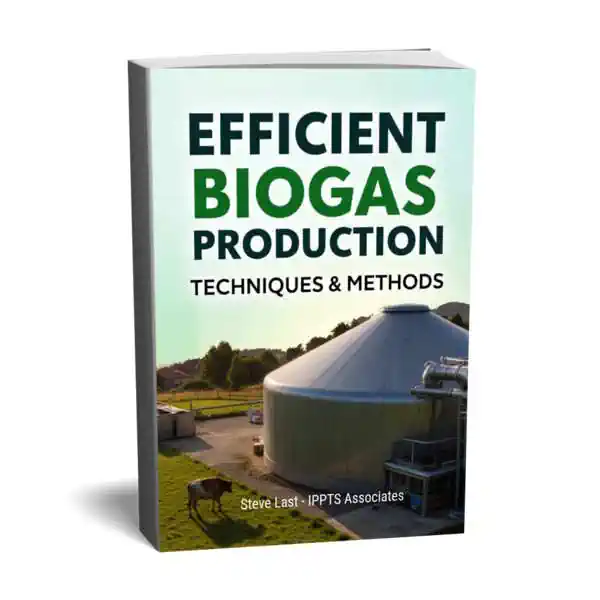
Efficient Biogas Production Techniques & Methods brings together the principal factors that influence digester performance in one concise and accessible guide.
It is intended to help readers understand where avoidable production losses may occur and which areas should be investigated before expensive plant modifications are considered.
This guide will help you:
- understand the main biological and operational factors controlling biogas yield;
- compare feedstocks using realistic methane-potential information;
- recognise the importance of carbon-to-nitrogen balance;
- identify common causes of unstable digester operation;
- understand the benefits and limitations of feedstock pretreatment;
- compare common anaerobic digester configurations;
- use co-digestion more effectively and safely;
- monitor warning signs before a serious process failure develops;
- and understand the principal options for upgrading biogas to biomethane.
Why Biogas Production Falls Below Expectations
Anaerobic digestion is a biological process. It cannot be optimised simply by adding more feedstock or increasing the loading rate.
The microorganisms responsible for producing methane need a stable environment. Sudden changes in feed composition, temperature, pH, alkalinity or organic loading can upset the balance between the different stages of digestion.
The consequences may include:
- falling gas production;
- reduced methane concentration;
- volatile fatty acid accumulation;
- foaming;
- poor mixing;
- ammonia inhibition;
- increased hydrogen sulphide;
- and, in severe cases, complete process failure.
The guide explains these relationships in practical language and shows why good process control is more important than chasing a single theoretical maximum yield.
What You Will Learn
Feedstock selection and methane potential
Learn why different organic materials produce very different quantities of biogas and why laboratory methane-potential figures must be interpreted carefully before being applied to a full-scale plant.
Carbon-to-nitrogen balance
Understand the role of the carbon-to-nitrogen ratio and how an unsuitable feedstock mixture can contribute to nutrient deficiency, ammonia inhibition or unstable digestion.
Feedstock pretreatment
Compare mechanical, thermal, chemical and biological pretreatment methods, together with the need to assess their energy use, operating cost and effect on downstream digestion.
Digester configuration
Review continuously stirred tank reactors, plug-flow systems, two-stage digesters and other configurations so that performance claims can be considered in the context of feedstock type and operating conditions.
Co-digestion
See how complementary feedstocks may improve nutrient balance, moisture content and methane production, while avoiding incompatible mixtures and excessive loading.
Process monitoring
Understand the value of monitoring pH, alkalinity, volatile fatty acids, FOS/TAC, temperature, gas composition and other indicators as part of an early-warning system.
Biogas upgrading
Gain an introduction to water scrubbing, pressure swing adsorption, membrane separation and other methods used to remove carbon dioxide and contaminants from raw biogas.
Download the complete 36-page guide for $17
Your PDF is supplied immediately after purchase.
Inside the Guide
1. Biogas Production Fundamentals
The biological stages of anaerobic digestion and the main factors governing methane formation.
2. Feedstock Optimisation
Feedstock characteristics, methane potential, moisture, volatile solids and carbon-to-nitrogen balance.
3. Pretreatment Technologies
Mechanical, thermal, chemical and biological preparation methods and their potential applications.
4. Digester Design and Configuration
A comparison of common digester types and the importance of matching the system to the feedstock.
5. Co-Digestion Strategies
Combining substrates to improve process balance without introducing new inhibition or contamination risks.
6. Process Control and Monitoring
Practical operating indicators and early warning signs that can help prevent declining performance.
7. Biogas Cleaning and Upgrading
The principal methods used to remove moisture, hydrogen sulphide, carbon dioxide and other contaminants.
Who Is This Guide For?
The publication has been written for:
- anaerobic digestion plant operators;
- farmers operating or considering a farm digester;
- biogas project developers;
- environmental and process engineers;
- consultants and technical advisers;
- students studying renewable energy or waste management;
- food-waste and organic-waste professionals;
- and anyone seeking a practical introduction to improving biogas production.
The guide does not assume that every reader is a specialist microbiologist. Technical concepts are explained in accessible language while retaining the detail needed to understand why a digester may be underperforming.
Frequently Asked Questions
What format will I receive?
You will receive the guide as a downloadable PDF. Gumroad provides access immediately after successful payment.
How long is the guide?
The guide contains 36 pages of focused information covering feedstocks, process control, pretreatment, digester configurations, co-digestion and biogas upgrading.
Is it suitable for small anaerobic digesters?
The biological and operational principles apply across a range of plant sizes. However, financial viability depends on feedstock availability, capital cost, labour, energy use, gas utilisation and local conditions.
Which feedstocks produce the most biogas?
Some fats, food-processing residues and energy-rich organic materials have high methane potential. Suitability cannot be judged by gas yield alone. Moisture, biodegradability, nutrient balance, contaminants, handling requirements and the risk of inhibition must also be considered.
How quickly can operational changes improve gas production?
Some changes may produce measurable effects within days or weeks. Biological acclimatisation and confirmation of a reliable trend may take considerably longer. Changes should normally be introduced gradually and supported by monitoring.
Does the guide guarantee higher biogas production?
No publication can guarantee a particular result because every plant has different feedstocks, equipment, operating conditions and constraints. The guide provides established principles and practical information to help readers identify opportunities and avoid common mistakes.
Does it cover biomethane upgrading?
Yes. The guide introduces the main technologies used to clean raw biogas and remove carbon dioxide before biomethane use or injection. It is an overview rather than a detailed upgrading-system design manual.
30-Day Money-Back Guarantee

We take great care in preparing our ebooks. If you experience a problem or are not completely satisfied, contact steve.last@ippts.com within 30 days and describe the issue.
We will refund your purchase in full. Contacting us directly is the quickest way to resolve any problem.
Improve Your Understanding of Biogas Production
Download the practical guide and explore the factors that control methane yield, process stability and digester performance.
Instant PDF download – $17
Important: This guide is provided for educational and general informational purposes. Anaerobic digestion plants involve biological, mechanical, electrical, chemical, fire, explosion and confined-space hazards. Site-specific changes should be assessed by suitably qualified professionals and implemented in accordance with applicable permits, regulations, equipment instructions and safety procedures.
© 2026 IPPTS Associates. All rights reserved.