
“`
30 Practical Pages
Focused decision support
Focused decision support
Farmer Focused
Not a supplier brochure
Not a supplier brochure
Immediate Access
Download through Gumroad
Download through Gumroad
30-Day Guarantee
Full refund without quibble
Full refund without quibble
“`
“`
The Problem
Digester Selection Often Begins With the Wrong Question
Farmers are frequently encouraged to ask which system is cheapest or which produces the most gas.
The more important question is: Which process can reliably digest the manure my farm actually produces?
Wrong Manure Consistency
A plug flow digester depends on thick, high-solids manure. Diluted flush manure may make the process unsuitable.
Wrong Climate Assumptions
An ambient-temperature lagoon may produce useful gas in warm weather but decline sharply when temperatures fall.
Wrong Financial Comparison
A lower construction quotation can conceal reduced output, sludge removal and future operating costs.
“`
“`
Why This Matters
A Process Mismatch Does Not Disappear After Construction
Once the lagoon, tank, gas equipment and manure-handling infrastructure are built, changing direction becomes difficult and expensive.
Underperforming Gas Output
The farm may produce materially less usable biogas than its financial forecast assumed.
Seasonal Revenue
Cold-weather production may be unreliable when energy demand is highest.
Accumulating Sludge
Settled solids can reduce lagoon capacity and create a costly cleanout requirement.
Unplanned Modifications
Separators, heating systems or manure collection methods may require alteration.
Missed Byproduct Value
Digestate, fibre and nutrient recovery may be less useful than expected.
Long-Term Frustration
The farm remains committed to underperforming infrastructure for many years.
The biggest risk is not necessarily paying too much. It is spending heavily on a process that was never well matched to the farm.
“`
“`
The Solution
Start With Farm Conditions—Then Compare the Technologies
The guide gives you a structured four-factor method for assessing the choice before detailed design or supplier selection.
1
Manure Solids
Determine whether the feedstock is thick enough for plug flow digestion.
2
Climate
Assess whether ambient temperatures can support dependable lagoon performance.
3
Herd Size
Consider whether daily manure volume supports the proposed investment.
4
Farm Objectives
Clarify whether the priority is gas, electricity, odour, nutrients or income.
“`
“`
The Essential Comparison
Covered Lagoon and Plug Flow Systems Solve Different Problems
Both capture biogas, but their feed requirements, temperature behaviour and operating characteristics are not interchangeable.
“`
“`
Before You Accept a Supplier Recommendation
Understand the Selection Logic for Yourself
Use the guide to recognise obvious mismatches, question optimistic projections and prepare more effectively for professional feasibility work.
Immediate PDF access · No subscription · 30-day guarantee
“`
“`
The Four-Factor Selection Method
A Simpler Way to Narrow the Choice
Instead of comparing equipment brochures first, begin with the farm conditions that cannot easily be changed.
Begin With the Farm’s Fixed Realities
Every farm has constraints: manure consistency, collection method, climate, herd size, land availability and energy objectives.
Those conditions determine what is technically realistic before supplier preference or headline price is considered.
This prevents the technology from driving the decision when the farm should drive it.
The Selection Sequence
Step 1: Establish Manure Characteristics
Identify solids concentration, dilution and collection method.
Identify solids concentration, dilution and collection method.
Step 2: Test Climate Assumptions
Consider seasonal temperature and likely gas output.
Consider seasonal temperature and likely gas output.
Step 3: Define Required Outputs
Clarify expectations for gas, heat, digestate and nutrients.
Clarify expectations for gas, heat, digestate and nutrients.
Step 4: Compare Lifetime Consequences
Look beyond capital cost to maintenance, output and risk.
Look beyond capital cost to maintenance, output and risk.
“`
“`
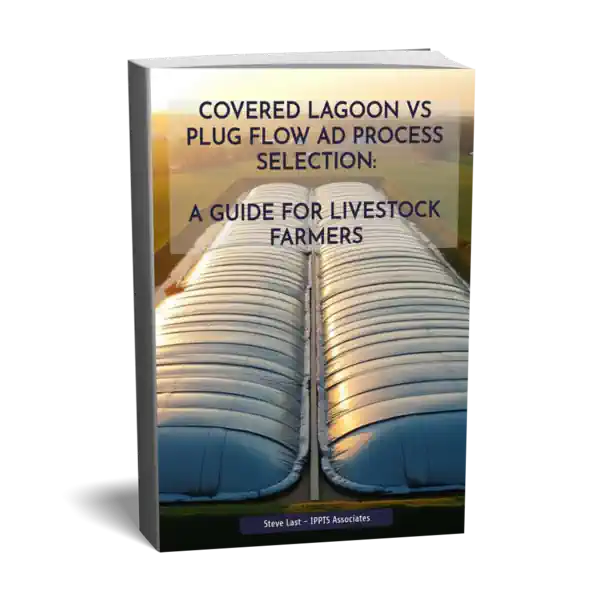
Inside the 30-Page Ebook
Everything Needed for a Better-Informed First Comparison
The guide explains the technical and commercial differences in accessible language for livestock farmers and their advisers.
✓
How livestock AD works
How livestock AD works
✓
Manure solids requirements
Manure solids requirements
✓
Covered lagoon operation
Covered lagoon operation
✓
Cold-weather performance
Cold-weather performance
✓
Plug flow operation
Plug flow operation
✓
Sludge and cleanout implications
Sludge and cleanout implications
✓
Digestate and nutrients
Digestate and nutrients
✓
Lifetime cost comparison
Lifetime cost comparison
What You Receive
✓
30-page downloadable PDF ebook
30-page downloadable PDF ebook
✓
Covered lagoon and plug flow comparison
Covered lagoon and plug flow comparison
✓
Four-factor selection framework
Four-factor selection framework
✓
Immediate access through Gumroad
Immediate access through Gumroad
✓
30-day no-quibble guarantee
30-day no-quibble guarantee
“`
“`
Common Questions Before Buying
Is This Guide Right for You?
“Can’t a supplier advise me?”
Yes, but suppliers usually specialise in particular systems. This guide helps you evaluate their recommendation.
“Does this replace a feasibility study?”
No. It helps you prepare for one and identify assumptions requiring professional investigation.
“Is it too technical?”
The guide explains technical differences in practical language and relates them directly to farm conditions.
“Why pay $27 for an ebook?”
Because one overlooked process constraint may have consequences worth many times the purchase price.
“`
“`
30-DAY
NO-QUIBBLE
GUARANTEE
NO-QUIBBLE
GUARANTEE
Remove the Risk
Read the Guide and Decide for Yourself
We take every reasonable care to produce practical and useful ebooks.
If you experience a problem or are not completely satisfied, email steve.last@ippts.com and describe the issue.
Contact us within 30 days of purchase and we will provide a full refund without quibble.
“`
“`
Published by Anaerobic Digestion News and Insight
Practical Guidance Grounded in Environmental Engineering Experience
The guide is published by Steve Last, a Chartered Civil and Environmental Engineer, Chartered Waste Manager and Chartered Environmentalist with decades of experience in environmental engineering, waste management and anaerobic digestion.
For more technical articles and industry updates, visit
Anaerobic Digestion News and Insight
.
Anaerobic Digestion News and Insight
.
“`
“`
Before You Choose a Process
Make Sure the Digester Fits the Farm
Understand how manure solids, collection method, climate, herd size and revenue goals influence the choice between covered lagoon and plug flow digestion.
$27
Secure Gumroad checkout · Immediate access · 30-day no-quibble guarantee
“`
Important: This ebook provides general educational information for preliminary comparison and decision-making. It does not replace a farm-specific feasibility study, representative manure analysis, engineering design, financial appraisal, environmental permitting advice, planning advice or other professional services. Digester performance varies according to feedstock, farm conditions, climate, design, operation, regulation and market conditions.