



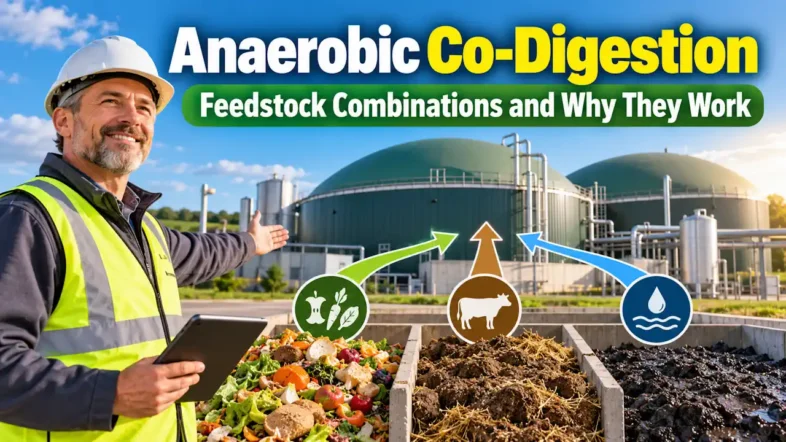
Anaerobic co-digestion is the simultaneous digestion of two or more different biodegradable feedstocks in the same anaerobic digester. Typical combinations include food waste with manure or slurry, food waste with sewage sludge, and agricultural residues with animal manures.
The idea sounds simple: mix organic materials together and produce biogas. But successful co-digestion is much more than disposing of several wastes in the same tank.
The real opportunity comes from choosing feedstocks whose characteristics complement one another. One material may provide readily degradable carbon and high methane potential, while another supplies buffering capacity, moisture, nitrogen, trace nutrients or a more stable physical consistency.
When the combination is well chosen and properly controlled, co-digestion can improve process stability, make better use of existing digester capacity and, in some cases, increase methane production. When the combination is poorly chosen, however, it can cause acidification, ammonia inhibition, foaming, excessive sulphur, contamination or even biological process failure.
This article explains what anaerobic co-digestion means, why certain feedstock combinations can work particularly well, and why feedstock compatibility matters more than simply adding another waste stream.
For readers new to the subject, see our main guide: What Is Anaerobic Digestion?
What Is Anaerobic Co-Digestion?
The US Environmental Protection Agency defines co-digestion as the simultaneous anaerobic digestion of multiple organic materials in one digester. The EPA gives food waste and manure as a straightforward example.
That definition reflects the way the term is now used throughout the anaerobic digestion industry and scientific literature.
In a conventional single-feedstock or mono-digestion plant, the digester may primarily receive one material such as:
- cattle slurry or manure;
- sewage sludge;
- source-separated food waste;
- maize or another energy crop using silage in winter*;
- food-processing residues; or
- another relatively consistent organic feedstock.
*The energy crop is ensiled and stored in large silage clamps, allowing year-round feeding outside the harvest season.
In co-digestion, a second or several additional feedstocks are deliberately introduced into the same biological process.
This may be done because additional organic waste is locally available, because spare digester capacity exists, because a higher-energy feedstock can increase gas production, or because the characteristics of one substrate help compensate for weaknesses in another.
It is this last point – feedstock synergy – that makes anaerobic co-digestion particularly interesting.
Why Co-Digest Different Feedstocks?
No organic feedstock is automatically ideal for anaerobic digestion.
A material may have excellent methane potential but ferment so rapidly that volatile fatty acids accumulate. Another may be naturally well buffered but have relatively low energy content. Some contain too much nitrogen, while others contain relatively little. Some are pumpable and easy to mix; others contain difficult fibres or solids.
By combining suitable materials, operators can sometimes create a feed mixture that is biologically and physically easier to digest than either feedstock would be on its own.
A major scientific review of anaerobic co-digestion published in Bioresource Technology identified potential advantages including improved nutrient balance, greater buffering capacity, dilution of inhibitory compounds, improved digestibility and better process stability.
But none of these benefits is guaranteed simply because two wastes have been mixed together.
Successful co-digestion is an exercise in feedstock selection and process control.
Examples of Anaerobic Co-Digestion Feedstock Combinations
1. Food Waste and Animal Manure or Slurry
This is probably the easiest example with which to understand the principle.
Food waste can contain large quantities of readily biodegradable organic matter and therefore has potentially high methane production. However, rapidly fermentable food waste can also cause rapid volatile fatty acid production if the organic loading rate exceeds the ability of methanogenic microorganisms to convert those intermediate products into methane.
Animal manure or slurry generally has a different biological and physical character. Depending on the manure and farming system, it can contribute water, alkalinity, nutrients and an established anaerobic microbial population.
Combining energy-rich food waste with a more stable manure or slurry base feedstock can therefore be advantageous.
A meta-analysis of published manure co-digestion studies found that methane yields were, on average, higher for the co-digestion systems examined than for manure mono-digestion, although performance varied considerably according to substrate type, dose and operating conditions.
2. Food Waste and Sewage Sludge
Wastewater treatment works with existing anaerobic sludge digesters can be attractive locations for co-digestion because the principal digestion infrastructure may already exist.
Waste activated sludge and primary sludge have lower readily biodegradable energy content than many food wastes. Introducing an appropriately prepared food-waste feedstock can therefore increase the amount of biodegradable organic matter entering the digesters and potentially increase biogas production.
The sludge can, in turn, provide an established digestion environment and buffering capacity.
This is an important enough combination to have generated a large body of research and a growing number of practical applications.
See our separate article: Co-Digestion of Food Waste and Sewage Sludge.
3. Agricultural Residues and Manure
Crop residues may contain substantial quantities of carbon but can be relatively resistant to biological degradation because much of that carbon is locked into cellulose, hemicellulose and lignin structures.
Animal manure provides a wetter base substrate and may improve handling, inoculation and nutrient balance.
However, this does not mean that every fibrous agricultural residue will become readily digestible simply because manure has been added. Particle size, lignin content, retention time and any required pre-treatment remain important.
4. Food-Processing Wastes with Established Digester Feedstocks
Food and beverage industries can produce highly biodegradable residues including sugars, starches, fats and process sludges.
These materials can be valuable co-substrates, particularly when added to an established manure, sludge or food-waste digestion process.
However, high methane potential can also mean high biological loading.
A tanker of high-strength liquid organic waste can contain far more biodegradable load than its volume might suggest.
Operators therefore need to assess chemical oxygen demand, volatile solids, fat content, pH, nutrient composition and potential inhibitors rather than accepting material simply because it is described as an organic liquid.
5. Fats, Oils and Grease with Lower-Energy Feedstocks
Fats, oils and greases can have very high theoretical methane potential and can therefore be attractive additions to an anaerobic digester.
But they require particular care.
Excessive lipid loading can contribute to long-chain fatty acid inhibition, flotation, scum formation and operational difficulties. A high-energy feedstock is not necessarily an easy feedstock.
This is a recurring lesson in co-digestion: the substrate with the highest methane potential is not necessarily the substrate that should be added at the highest rate.
Note: Before introducing any new co-feedstock to an existing biogas plant, operators must confirm that their environmental permit or other applicable authorisation allows that material and activity. In the UK especially, moving from for example, a farm-based agricultural AD operation into accepting food waste or other controlled wastes can involve a substantial regulatory step-up, not just a feedstock change.
The Importance of Feedstock Synergy
The word synergy is frequently used when discussing anaerobic co-digestion.
Strictly speaking, a synergistic response means that the performance of the mixture exceeds what would reasonably be expected from simply combining the individual feedstocks.
In practice, several different mechanisms can contribute to improved co-digestion performance.
Balancing Carbon and Nitrogen
Microorganisms require both carbon and nitrogen, and combining carbon-rich and nitrogen-rich materials can create a more favourable nutrient balance.
For example, some crop and food residues can provide abundant biodegradable carbon, while animal manures or sewage sludge may contribute nitrogen and other nutrients.
However, the often-quoted carbon-to-nitrogen ratio should not be treated as a magic design number.
C:N ratio is a useful screening indicator, but it does not by itself predict whether a co-digestion mixture will be stable. The biodegradability of the carbon, the form in which nitrogen occurs, ammonia concentration, temperature, pH, retention time and loading rate all influence the actual biological response.
This distinction is important. Two mixtures with apparently identical C:N ratios may behave very differently in a digester.
Improving Buffering Capacity
Anaerobic digestion depends on different microbial groups working together.
Acid-forming organisms can respond quickly to an easily degradable feedstock and produce volatile fatty acids. Methanogens grow more slowly and may be unable to consume those intermediates quickly enough if the loading rate rises suddenly.
A feedstock with useful alkalinity and buffering characteristics can make the combined process more resistant to falling pH.
But buffering should never be regarded as permission to overload a digester.
Diluting Potential Inhibitors
Some feedstocks contain substances that become inhibitory above particular concentrations.
These may include:
- ammonia;
- sulphide;
- salts;
- certain metals;
- cleaning chemicals;
- antibiotics or biocides;
- long-chain fatty acids; and
- other industrial contaminants.
Blending can sometimes reduce the concentration of an inhibitor in the combined feed.
However, dilution is not a substitute for proper feedstock acceptance testing. A waste containing substances unsuitable for biological treatment should not be accepted merely because it can be diluted with another feedstock.
Making Better Use of Digester Capacity
Some digesters, particularly those originally designed for sewage sludge or livestock manures, may have spare hydraulic, solids or gas-production capacity.
Adding a suitable high-strength organic co-feedstock can potentially make better use of that installed infrastructure.
But capacity must be assessed across the whole plant.
The biological digester volume may not be the limiting factor. Additional gas production can expose limitations in:
- feedstock reception and storage;
- pasteurisation;
- mixing;
- heating;
- gas holders;
- gas cleaning;
- CHP engines or biomethane upgrading equipment;
- digestate storage;
- dewatering equipment; and
- digestate outlets.
An apparently simple co-digestion project can therefore require a whole-plant capacity assessment.
Co-Digestion Does Not Always Increase Methane Yield
One of the most dangerous assumptions is that adding a high-biogas-potential co-substrate will automatically increase useful methane production.
It may do so, but only within an operating regime that the biology and plant can tolerate.
Research repeatedly shows that feedstock proportion matters.
For example, a 2026 study investigating food waste and green waste found that an appropriate proportion of green waste improved stability, whereas increasing the green-waste proportion too far reduced methane yield.
This illustrates the broader principle nicely: a co-feedstock can be beneficial at one concentration and counterproductive at another.
The relevant question is therefore not:
“Is this a good AD feedstock?”
but:
“At what loading rate, in combination with our existing feedstock and operating conditions, can this material be accepted without compromising process stability or digestate quality?”
What Should Be Checked Before Adding a New Co-Feedstock?
Before routinely accepting a new material, an AD operator should understand much more than its name and estimated tonnage.
Important characteristics can include:
- dry matter and volatile solids;
- biochemical or biomethane potential;
- chemical oxygen demand;
- pH and alkalinity;
- nitrogen and ammoniacal nitrogen;
- carbon availability;
- sulphur;
- fats, oils and grease;
- salinity;
- trace nutrients;
- potential toxic or inhibitory substances;
- physical contaminants such as plastic, glass, grit and metal;
- particle size and pumpability;
- pathogen and animal-by-product considerations;
- seasonal variability; and
- likely effects on digestate quality and permitted outlets.
See also our guide to Anaerobic Digestion Feedstocks and Feed Materials.
Commercial pressure should never override technical feedstock acceptance.
An attractive gate fee can quickly become insignificant if the new material causes biological inhibition, excessive foaming, blocked pumps, contamination, additional digestate disposal costs or prolonged loss of gas production.
Introducing a New Co-Feedstock Gradually
A well-operated digester should not normally be subjected to an abrupt large change in organic loading merely because a new waste contract begins.
Subject to the characteristics of the material and plant, the safer approach is usually progressive introduction accompanied by close monitoring.
Parameters commonly watched include:
- daily gas production;
- methane concentration;
- volatile fatty acids;
- alkalinity;
- pH;
- ammonia;
- hydrogen sulphide;
- organic loading rate;
- digestate characteristics;
- mixing performance; and
- visual indicators such as foaming or scum formation.
The objective is not merely to prove that the digester continues producing gas. It is to establish whether the new combined feed can be operated reliably and sustainably over the long term.
Anaerobic Co-Digestion Is Not the Same as AD Plus Composting
This distinction is worth making because the terminology has not always been used consistently.
Co-digestion refers to different feedstocks being digested together within the anaerobic process.
Composting is an aerobic biological process. Oxygen is deliberately supplied so that aerobic microorganisms break down organic material.
Nevertheless, anaerobic digestion and composting can be highly complementary technologies.
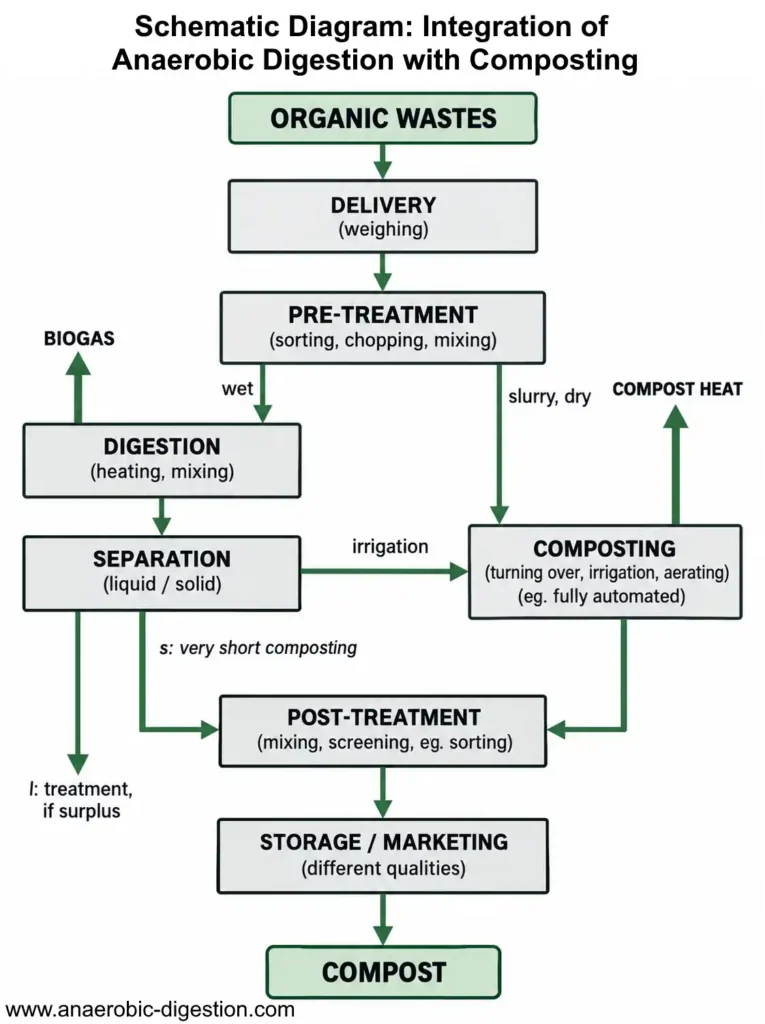
For example, an organic-waste facility may:
- receive and prepare biodegradable wastes;
- anaerobically digest the readily degradable fraction;
- recover biogas for energy or biomethane;
- separate the digestate into liquid and fibre fractions; and
- subject suitable digestate fibre or other organic material to an aerobic composting or maturation stage.
This can be described as an integrated anaerobic digestion and composting system, but it should not be confused with anaerobic co-digestion.
Combined AD and Composting – An Integrated Anaerobic Digestion and Composting System Flow Chart
The image below shows how an integrated anaerobic digestion and composting system might work.
Why the Distinction Matters
Correct terminology is more than an academic issue.
When an engineer, researcher, regulator or plant operator refers to anaerobic co-digestion today, the normal meaning is the simultaneous anaerobic digestion of multiple organic substrates.
Clear terminology makes it easier to compare plant performance, research findings, feedstock specifications and operating experience.
Co-Digestion and Digestate Quality
The effect of a co-feedstock does not end when biogas leaves the digester.
Anything introduced into the plant that is not converted to gas will largely remain within the digestate or another residual stream.
That makes digestate quality a fundamental feedstock-selection issue.
A material that increases biogas output but introduces unwanted physical contaminants, metals, salts or persistent chemicals may reduce the value or usability of the digestate.
Operators therefore need to consider the entire material cycle: feedstock in, biogas out, and digestate back to land or onward treatment.
Is Co-Digestion Better Than Mono-Digestion?
Neither process is automatically better.
Mono-digestion has important advantages when a consistent, suitable feedstock is available. Simpler feedstock management can make process control easier and reduce the risk of contaminants or unexpected changes.
Co-digestion becomes attractive when compatible feedstocks can improve the biological, operational or economic performance of the system.
The best solution depends on:
- feedstock availability;
- feedstock composition and variability;
- digester design;
- retention time;
- organic loading rate;
- mixing;
- temperature;
- pre-treatment;
- gas utilisation capacity;
- digestate outlets;
- regulatory requirements; and
- project economics.
It is therefore better to think of co-digestion as another tool available to the anaerobic digestion designer and operator, rather than an inherently superior form of AD.
Frequently Asked Questions About Anaerobic Co-Digestion
What is anaerobic co-digestion in simple terms?
Anaerobic co-digestion means processing two or more different organic feedstocks together in the same anaerobic digester. An example is adding food waste to a digester that already treats animal manure.
Why mix different anaerobic digestion feedstocks?
Suitable feedstocks can complement each other. One may provide high methane potential while another contributes buffering, nutrients, moisture or other characteristics that improve process stability.
Does co-digestion always produce more biogas?
No. Additional biodegradable material can increase gas production, but inappropriate feedstock combinations or excessive loading can cause inhibition and reduce performance. Feedstock type, proportion and loading rate all matter.
What are common co-digestion combinations?
Examples include food waste with manure, food waste with sewage sludge, crop residues with manure, and appropriate food-processing or industrial organic residues added to an established digester feedstock.
Is carbon-to-nitrogen ratio the most important factor?
No. C:N ratio is useful, but it is only one indicator. Carbon biodegradability, ammonia concentration, pH, buffering, temperature, loading rate, retention time, trace nutrients and inhibitors can all influence digester performance.
Is co-digestion the same as anaerobic digestion followed by composting?
No. Co-digestion means digesting different feedstocks together anaerobically. Composting is a separate aerobic process, although digestate fibre can subsequently be composted in an integrated treatment facility.
Conclusion: Good Co-Digestion Starts with Feedstock Compatibility
Anaerobic co-digestion can make excellent use of complementary organic wastes and residues.
The most successful combinations do more than increase the quantity of material entering a digester. They bring together feedstocks whose properties complement one another while remaining compatible with the plant’s biological and mechanical capacity.
Food waste can add readily biodegradable energy. Manure and sewage sludge can provide different nutrient and buffering characteristics. Agricultural and industrial residues can create further opportunities – but every additional feedstock changes the biological system.
That is why co-digestion should be approached as an engineering and biological optimisation problem rather than simply a waste-disposal opportunity.
Start with feedstock characterisation, consider the whole plant rather than the digester alone, introduce significant changes cautiously, and monitor the biological response.
For the wider process, return to our main guide: What Is Anaerobic Digestion? The Biogas and Biomethane Process Explained.
Sources and Further Reading
- US EPA – Basic Information about Anaerobic Digestion – includes the EPA definition of anaerobic co-digestion and examples of suitable organic feedstocks.
- US EPA – Frequent Questions about Anaerobic Digestion – explains co-digestion using the example of food waste being added to a manure digester.
- Karki et al. (2021) – Anaerobic co-digestion: Current status and perspectives, Bioresource Technology – major review of feedstock synergy, nutrient balance, buffering and process stability.
- Habiba et al. (2020) – Methane yields during anaerobic co-digestion of animal manure with other feedstocks: A meta-analysis – comparison of manure mono-digestion and co-digestion performance.
- Anaerobic Co-Digestion of Wastewater Sludge: A Review of Potential Co-Substrates and Operating Factors for Improved Methane Yield.
- Enhancing Methane Yield in Anaerobic Co-Digestion of Sewage Sludge and Other Organic Wastes (2026) – recent review linking feedstock characteristics, engineering controls and methane performance.
- Reassessing the Carbon to Nitrogen Ratio in Anaerobic Digestion of Organic Wastes (2026) – explains why C:N ratio should be treated as a conditional indicator rather than a universal predictor of process stability.
Article originally published in an earlier form many years ago (Circa: 2004). Completely rewritten and updated in September 2026 to reflect the now-established technical meaning of anaerobic co-digestion and current understanding of complementary feedstock combinations.
Download your printer friendly version of this co digestion article here.
Note; If links have a line through them it normally simply means that you will need to show that you are human before the website will allow you to visit.
[Published in 2004, Updated 2014. Rewritten and fully updated 25 September 2026.]



Thanks for your marvelous posting! I seriously enjoyed reading it, you’re a great author.
I’ll make sure to bookmark your blog and may come back.
I want to encourage you to go on doing
your great posts, have a nice evening!
Can I let you know that current Queensland Uni. AWMC research is enhancing the understanding of co-digestion risks and drivers for the benefit of municipal and agri-industries. Experiments are being conducted at laboratory-scale to characterise the degradation properties of different wastes under different process conditions and leading to a comprehensive modal and co-digestion manual. Results are being validated at full-scale with the support of industry partners. I added the link in the url box.
I always was interested in this subject and still am. So anaerobic co-digestion is simply using more than one different feedstocks so that together they balance each other out, and provide a better methane yield than with just one of the feed materials? Thanks for putting up.
Awesome potential exists in anaerobic Co-digestion. I am really delighted to read this weblog posts which contains
lots of helpful facts, and thanks for providing these data.