



The anaerobic digestion process is a controlled sequence of microbial reactions that converts biodegradable material into raw biogas and digestate without oxygen. In a working plant, success depends on much more than putting organic waste into a sealed tank. Feedstock preparation, loading rate, temperature, pH, mixing, retention time, gas handling and digestate management must all be matched very specifically to the site and its available organic material supply.
This page concentrates on how the process works and how it is controlled. For a broader beginner’s explanation covering the meaning, benefits and applications of AD, start with our cornerstone guide: What is anaerobic digestion?
Process inputs: suitable organic feedstocks, water where dilution is required, heat and a viable microbial population.
Main process outputs: raw biogas—principally methane and carbon dioxide—and digestate containing water, fibre, microbial biomass and most of the incoming plant nutrients.
Raw biogas commonly contains about 45% to 75% methane by volume, with much of the balance being biogenic carbon dioxide and smaller quantities of water vapour and trace gases. Its exact composition depends on the feedstock and process conditions. The carbon dioxide is increasingly important: it may be separated during biomethane upgrading and used or permanently stored in future bioenergy with carbon capture and storage projects.

The Anaerobic digestion process at a glance
- Receive and inspect the feedstock. Confirm that it matches the plant’s permitted and technically acceptable inputs.
- Remove contaminants and prepare the material. Depending on the feed, this can include depackaging, screening, maceration, grit removal, blending, dilution or thermal pre-treatment.
- Feed the digester at a controlled rate. Sudden changes in organic loading, composition or temperature can destabilise the microbial community.
- Maintain oxygen-free biological conversion. Several groups of microorganisms work together through hydrolysis, acidogenesis, acetogenesis and methanogenesis.
- Collect and treat the raw biogas. Water, hydrogen sulphide and other contaminants are removed as required for the chosen use.
- Store, separate and use the digestate responsibly. Its quality and legal status depend on the inputs, treatment process and intended outlet.
The digester tank is the biological heart of the plant, but it is only one part of a complete process. Reception, pre-treatment, pumps, heat exchangers, mixers, gas storage, gas cleaning, energy recovery, pasteurisation and digestate storage can be equally important to reliable operation.
Steve Last explains the process in this short video, produced for this page:

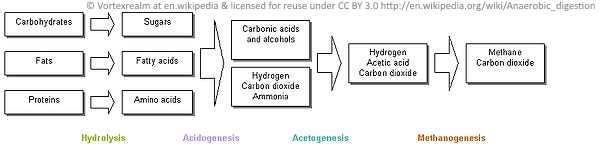
The four biological stages of anaerobic digestion
Anaerobic digestion is often shown as four consecutive stages. In most single-tank digesters they overlap and occur at the same time. Each microbial group depends on the products and waste removal provided by the others, so the process behaves as a linked ecosystem rather than four isolated reactions.
1. Hydrolysis
Large, insoluble organic molecules are too big to pass through microbial cell walls. Hydrolytic microorganisms release enzymes that break carbohydrates, proteins and fats into smaller soluble compounds such as sugars, amino acids and long-chain fatty acids.
Hydrolysis can become the rate-limiting stage when a feedstock contains resistant fibres, lignocellulose, fats or large particles. Size reduction, pulping, thermal hydrolysis and other pre-treatments may increase the accessible surface area, but every added process consumes energy and introduces operating cost.
2. Acidogenesis
Acid-forming organisms ferment the soluble products of hydrolysis into volatile fatty acids, alcohols, hydrogen, carbon dioxide, ammonia and other compounds. Acidogens grow relatively quickly. If the plant is overloaded, acids can therefore be produced faster than the slower-growing methanogens can consume them.
A rising volatile fatty acid concentration, falling alkalinity or falling pH can be an early warning that the biological stages are becoming unbalanced.
3. Acetogenesis
Acetogenic and syntrophic organisms convert longer-chain volatile fatty acids and alcohols into mainly acetate, hydrogen and carbon dioxide. Some of these reactions proceed efficiently only when hydrogen-consuming microorganisms keep the hydrogen partial pressure sufficiently low. This close cooperation is one reason why apparently small changes in operating conditions can affect the whole digester.
4. Methanogenesis
Methanogenic archaea form methane mainly through two pathways: conversion of acetate, and reduction of carbon dioxide using hydrogen. Methanogens reproduce more slowly than many acid-forming organisms and are sensitive to abrupt changes, toxic compounds, excessive ammonia and unfavourable pH or temperature.
Stable methane production is therefore the result of balanced activity across the entire microbial community—not simply the presence of “methane bacteria”.
Simplified chemical reactions
No single chemical equation describes anaerobic digestion because the feedstock contains many compounds and the microbial community carries out a network of reactions. Two simplified methanogenic pathways are nevertheless useful:
Hydrogenotrophic methanogenesis:
CO2 + 4H2 → CH4 + 2H2O
Acetoclastic methanogenesis:
CH3COOH → CH4 + CO2
These reactions show why both methane and carbon dioxide are fundamental gaseous products. They do not, however, predict the biogas yield of a real feedstock. Yield depends on biodegradability, composition, retention time, temperature, inhibition, microbial adaptation and how much volatile solids destruction is achieved.
What happens in a working anaerobic digestion plant?
1. Feedstock reception and acceptance
The operator first confirms the identity, source and condition of the incoming material. A commercial gate fee must never be allowed to outweigh process compatibility. If a feedstock cannot be stored, prepared, pumped, mixed, digested and discharged reliably—or if its contaminants cannot be controlled—it should be refused until a dependable handling route exists.
Acceptance procedures should consider:
- biodegradable organic content and expected methane potential;
- dry solids, particle size, viscosity and pumpability;
- carbon-to-nitrogen balance and nutrient availability;
- ammonia, sulphur, salts, cleaning chemicals, antibiotics and other inhibitors;
- plastics, metals, glass, grit, stones and persistent physical contaminants;
- seasonal variability and security of supply;
- permit, animal by-product and digestate outlet requirements.
2. Pre-treatment and depackaging
Source-separated slurry or manure may need relatively little preparation. Packaged food waste and mixed municipal material can require screening, metal removal, depackaging, pulping and grit separation before entering the digester. Good pre-treatment protects pumps and mixers and helps prevent plastic fragments, sediment and floating layers from accumulating in the plant.
See our technical comparison of food-waste depackaging equipment and our guide to food-waste separators designed to reduce destructive packaging fragmentation.
3. Blending and controlled feeding
Feedstocks may be blended in reception or buffer tanks to reduce short-term variation. Pumps or conveyors then meter the prepared material into the digester. A uniform daily loading pattern is usually easier for the biology to tolerate than intermittent high loads.
Co-digestion can improve moisture, nutrient balance and methane yield, but a mixture is not automatically beneficial. Laboratory testing, biochemical methane potential tests and a controlled plant trial can reveal compatibility problems before a full commercial commitment is made.
4. Digestion, heating and mixing
Inside the sealed reactor, heating maintains the selected biological temperature range while mixing distributes fresh substrate, microorganisms and heat. Mixing also limits sedimentation and scum formation. Excessive mixing can waste electricity and may disrupt microbial aggregates; inadequate mixing can create dead zones and reduce effective volume.
A conventional continuously stirred tank reactor (CSTR) receives feed and discharges digestate at broadly the same rate. In a plug-flow reactor, a relatively thick feed moves progressively from inlet to outlet with limited longitudinal mixing—as though successive “plugs” of material pass through the vessel. Real plants depart from ideal flow patterns, so tracer studies and operating evidence can be valuable.
5. Biogas collection and treatment
Gas rises into the headspace and passes to storage and treatment equipment. Raw biogas contains methane and carbon dioxide plus water vapour and potentially hydrogen sulphide, ammonia, particulates and siloxanes. The required cleaning depends on whether the gas will fuel a boiler, combined heat and power engine, upgrading plant or another process.
Read more about biogas composition, the uses of biogas and upgrading biogas to biomethane for gas-to-grid use.
Gas systems must be kept gas-tight and maintained. Methane lost through pressure relief valves, seals, tanks or upgrading equipment damages the climate performance and loses saleable energy. See our guide to reducing fugitive methane emissions and avoidable biogas venting.
6. Digestate discharge and separation
Digestate leaves as a slurry containing water, microbial biomass, mineralised nutrients and organic or inert material that was not degraded. If fresh whole digestate is dropped onto a floor, its fibres may form a heap while liquid drains away. A screw press or centrifuge can deliberately separate liquid and fibre fractions.
AD transfers a significant part of the degradable carbon into biogas, but almost all the important crop nutrients remain in the digestate. Small quantities of nitrogen may leave in gaseous forms, while phosphorus and potassium are largely retained; nutrient form and plant availability can change.
Digestate quality varies with the feedstock, pre-treatment, reactor type and operating conditions. Learn more in our dedicated guide: What is digestate?
The operating variables that control the process
Temperature
Most engineered digesters operate in either the mesophilic or thermophilic range. Mesophilic plants commonly work near 35°C to 40°C and are generally valued for stability and moderate heat demand. Thermophilic plants commonly operate near 50°C to 57°C, allowing faster reactions and potentially shorter retention, but they usually demand tighter control and more heat.
A stable temperature is often more important than chasing an exact optimum. Sudden changes can disturb the adapted microbial community. See the detailed guides to mesophilic anaerobic digestion and thermophilic anaerobic digestion.
pH, alkalinity and volatile fatty acids
Methanogens generally perform best near neutral pH. Operators should not rely on pH alone because buffering can hide a developing acid accumulation. Trends in volatile fatty acids, alkalinity and their ratio can provide earlier warning when interpreted alongside gas flow, methane concentration and loading history.
Organic loading rate
The organic loading rate expresses how much biodegradable material is applied per unit of active digester volume over time. Loading too quickly can produce acids faster than the methanogenic population can convert them. Loading too lightly underuses installed capacity. The safe operating range is plant- and feedstock-specific.
Hydraulic and solids retention time
Hydraulic retention time is the average time the liquid remains in the reactor. Solids retention time is the average time particulate biomass and microorganisms remain. In a simple mixed tank they may be similar; in fixed-film, sludge-blanket, membrane or solids-recycling systems the solids can be retained much longer than the liquid.
Retention must be long enough for the slower biological conversions and the required stabilisation. It is not a universal number: temperature, feedstock biodegradability and reactor design all matter.
Mixing and effective volume
A nominal tank volume is not necessarily the volume doing useful biological work. Grit, settled fibre, floating crusts and poor flow patterns can reduce effective capacity. Mixing design should provide heat and substrate distribution while allowing maintenance and removal of accumulated material.
Nutrients, trace elements and inhibitors
Microorganisms require an appropriate supply of macro- and micronutrients. Mono-digestion of a consistent industrial residue can create deficiencies, while high-protein feeds may release inhibitory ammonia. Sulphide, salts, heavy metals, disinfectants and other chemicals may also inhibit the process. Supplementation should follow analysis and professional assessment, not guesswork.
Process configurations and digester types
No digester design is best for every feedstock. Selection must start with the physical and biochemical characteristics of the material, the site constraints, the required output quality and the operator’s ability to run and maintain the equipment. For the broader engineering context, see our anaerobic digestion plant design guide.
Wet and dry digestion
Wet digestion handles a pumpable slurry and commonly uses mixed tanks. Dry or high-solids digestion handles stackable or paste-like material and may use batch tunnels or plug-flow arrangements. Dry systems reduce dilution-water demand but require equipment designed for higher-solids handling. See our guide to dry anaerobic digestion.
Continuous, plug-flow and batch operation
- Continuous or semi-continuous CSTR: prepared feed enters regularly while a similar volume of digestate leaves; extensive mixing aims for uniform conditions.
- Plug-flow: thick material moves along an elongated reactor with limited mixing in the direction of travel.
- Batch dry digestion: a chamber is filled, sealed and percolated for a digestion cycle before being opened and emptied.
- Covered lagoon: dilute material is retained beneath a gas-tight cover, usually with less heating and mixing than a tank digester.
Single-stage and multi-stage digestion
A single-stage plant carries out the microbial stages in one reactor. A multi-stage plant separates hydrolysis and acid formation from methanogenesis, allowing different conditions in each vessel. Separation may improve control for difficult feeds, but adds tanks, pumps, instrumentation and operational complexity.
Manure, wastewater and municipal organic waste
The same biology can be applied through very different process arrangements. Explore the specialist pages on anaerobic digestion of manure and anaerobic digestion in wastewater treatment.
At a sewage treatment works, AD normally treats the concentrated sludge removed from the wastewater—not the entire incoming sewage flow. Holding the full works flow in a heated digester for several weeks would require an impracticably large reactor. This differs from some small household systems, where toilet waste may form part of a much smaller combined feed.
Specialised high-rate and attached-growth processes
The following process families remain important, especially for industrial effluents and wastewater. They deserve specialist treatment, so this overview defines their place without trying to replace detailed design guidance.
Anaerobic suspended-growth processes
Microorganisms remain suspended in the liquid. Examples include complete-mix digesters, anaerobic contact processes and anaerobic sequencing batch reactors (ASBRs). An ASBR fills, reacts, settles and decants in repeated cycles.
Sludge-blanket processes
In an upflow anaerobic sludge blanket (UASB) reactor, wastewater passes upwards through a dense blanket of biologically active granular or flocculent sludge. The solids retention time can be much longer than the hydraulic retention time, allowing a compact high-rate process for suitable soluble wastewaters.
Related configurations include anaerobic baffled reactors, anaerobic migrating blanket reactors and expanded granular sludge bed reactors. Download Steve Last’s free UASB anaerobic digestion process ebook.
Attached-growth, fluidised-bed and downflow processes
Attached-growth reactors retain microorganisms on packing or carrier material. Anaerobic expanded-bed and fluidised-bed reactors use upward liquid flow to expand or suspend media. Downflow anaerobic filters pass wastewater through packed media supporting a biofilm. These systems can retain slow-growing biomass effectively, but media selection, hydraulic distribution, solids control and the risk of blockage require careful engineering.
Anaerobic membrane bioreactors
Anaerobic membrane bioreactors use membranes to retain solids and produce a clarified effluent. They can decouple solids and hydraulic retention times, but membrane fouling, energy consumption, dissolved methane and cleaning requirements must be addressed.
Pasteurisation, animal by-products and process validation
Thermophilic digestion should not automatically be described as sterilisation. Where feedstocks include relevant animal by-products or catering waste, the plant may require an approved pasteurisation or alternative transformation process, validation, sampling and controls. The required combination of particle size, temperature and holding time depends on the material, jurisdiction and approved process.
Operators in Great Britain should consult the current government guidance on using animal by-products at compost and biogas sites. EU operators should consult the European Commission animal by-products rules. Site-specific approval and professional regulatory advice take precedence over general web guidance.
How operators recognise a stable—or failing—process
A stable digester normally shows consistent gas flow and methane concentration, controlled temperature, manageable VFA and alkalinity trends, predictable digestate characteristics and no progressive accumulation of grit, scum or foam. Operators should interpret trends together rather than react to a single isolated reading.
Common warning signs include:
- falling methane concentration or gas production;
- rising volatile fatty acids and declining buffering capacity;
- rapid pH or temperature change;
- foaming, crust formation, blocked gas lines or increasing tank pressure;
- unusual odour, hydrogen sulphide or ammonia levels;
- poor pumping, mixing or heat transfer;
- a new feedstock coinciding with instability;
- unexpected changes in digestate solids or residual gas production.
The first response should be controlled diagnosis, not indiscriminate chemical addition. Review recent feed deliveries, loading, temperature, mixing, gas data and laboratory trends; reduce or stop the suspected load where necessary; protect gas-management capacity; and follow the plant’s operating and contingency procedures.
For optimisation ideas, see how to increase biogas production without sacrificing process stability.
Environmental performance depends on process control
AD can recover energy and nutrients while avoiding uncontrolled decomposition of suitable organic wastes. The carbon dioxide produced and released when biogas is used is biogenic carbon that originated in recently grown material, unlike fossil carbon brought back into the active atmosphere after millions of years underground.
That does not make every project automatically climate-positive. Feedstock production, transport, parasitic energy, methane leakage, digestate storage and land application all affect the result. Capturing methane that would otherwise escape and replacing fossil energy can deliver a strong benefit; poor gas containment can erode it rapidly.
The Environment Agency’s current guidance requires permitted plants to define and monitor operational limits, control mixing and temperature, manage excess gas and prevent uncontrolled biogas releases. The practical lesson is simple: good environmental performance is inseparable from good process engineering and operation.
Frequently asked questions
What is the anaerobic digestion process?
It is a linked series of microbial reactions that breaks down biodegradable organic material without oxygen, producing methane- and carbon-dioxide-rich biogas plus digestate.
How long does anaerobic digestion take?
There is no universal retention time. Many heated tank systems retain material for several weeks, while high-rate wastewater reactors can have much shorter hydraulic retention and longer solids retention. Feedstock, temperature, reactor design and the required stabilisation determine the correct value.
Why must oxygen be excluded?
The microorganisms responsible for methanogenesis operate under anaerobic conditions. Air entering the gas system also creates safety risks because methane-air mixtures can be explosive within a defined concentration range.
What temperature is best?
Most plants operate in an established mesophilic or thermophilic range. The best choice depends on the feedstock, heat balance, required throughput, pathogen controls and the operator’s ability to maintain stable conditions.
What pH does a digester need?
Methanogenesis normally favours near-neutral conditions, but operators should assess pH with alkalinity, volatile fatty acids and process trends. A normal-looking pH can persist temporarily while buffering masks an accumulating imbalance.
Does a sewage works pass all sewage through an anaerobic digester?
No. Conventional municipal treatment normally concentrates solids into sludge and digests that smaller sludge flow. The main liquid flow is treated by other processes such as settlement and biological aeration.
Can any organic waste be fed to an AD plant?
No. A feedstock must be legally acceptable and compatible with the reception equipment, pumps, mixers, biology, gas system and digestate outlet. An attractive gate fee cannot make an unmanageable feedstock suitable.
Authoritative references and further reading
- US EPA AgSTAR Anaerobic Digester Project Development Handbook
- US EPA Anaerobic Digester/Biogas System Operator Guidebook
- Environment Agency: biological waste treatment and AD process-control measures
- Environment Agency anaerobic digestate resource framework
- UK guidance on animal by-products at compost and biogas sites
- International Energy Agency: introduction to biogas and biomethane
- IEA Bioenergy Task 37 report on methane emissions from biogas plants
Need help with an anaerobic digestion process?
Steve Last, CEng, MICE, MCWIM, has over 25 years’ experience in anaerobic digestion, biogas, landfill gas and waste management projects. If you need an independent view of a proposed feedstock, process design, operating problem or plant improvement, please contact Steve Last.
You can also continue with our anaerobic digestion ebooks and technical downloads.
First published 4 November 2014. Substantially rewritten and technically reviewed by Steve Last, CEng, MICE, MCWIM, August 2026.




Has the carbon conserving case for this modern technology been confirmed?
Very good writing. Keep on with it. I did notice that you didn’t mention bacteria called “archaea”. Others have said those bacteria hold a leading part in the anaerobic digestion process.
We recommend that first step toward a viable anaerobic digestion plant consists of identifying on a large scale the potential of the territories to accommodate a biomethane injection unit. The main criteria which should be considered are the deposit of substrates, the potential outlets for energy and digestates, the possibilities of implantation. Cost all these and then you will have an idea of how much you can obtain to fund the biogas process improvements you seek.
Trying to get my head around you excellent website. Anaerobic digestion is just fermentation for things that are unpleasant. Am I right or not?
Ha ha!
I never thought of it like that!
Yes. Absolutely!
You are correct!
You seem to know a fair deal about this, it’s like you wrote the book in it or something. I think that you should add some better pics to drive the message home a bit, but I am quibbling, this is magnificent blog. A fantastic read. I will definitely be back.
I was curious. Did you ever thought of changing the layout of your site? Its very well written – I love what you’ve got to say. Most pages have got an awful lot of text for only having 1 or two pictures. Maybe you could arrange it better?
Not really a process more an art, this is a misnaming? I agree chemical process, but biology is bugs. How to control?
I just a with the explanation, but my i be able to know if facultative respiration is also included hear?
I am not a microbiologist. Engineering is my background, so I hope someone else will answer your question. My guess is that facultative respiration will be present to a degree, but I think that I have been told that the facultative organisms tend to get out-competed in a fully anaerobic system like a digester by the methanogens. Don’t quote me on that! But, I suspect that’s what happens. Meaning that after starting up a digester the methanogens grow in number and take over the digestion process from any facultative bacteria.