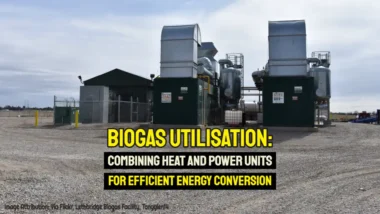



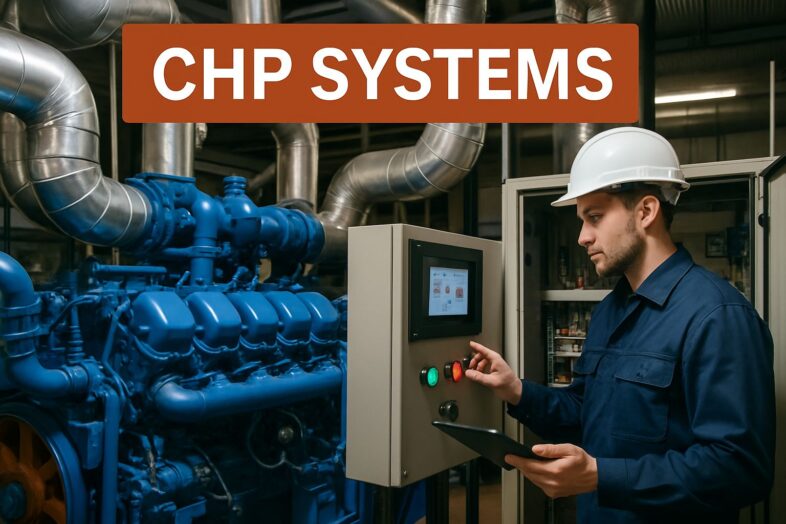
Biogas CHP systems convert methane-rich biogas into electricity while recovering heat from the engine and exhaust gases for useful purposes.
This process is known as combined heat and power (CHP), or cogeneration.
For many anaerobic digestion plants, CHP provides a practical way to use biogas because the AD process itself requires electricity and usually needs heat to maintain digester temperature.
A well-designed biogas CHP system can therefore create a useful energy loop:
organic feedstock → anaerobic digestion → biogas → CHP → electricity + useful heat.
However, CHP is not automatically the best use of biogas at every site.
Its success depends on realistic gas production, methane content, gas quality, electrical demand, genuinely useful heat demand, engine availability, emissions limits, grid connection and whole-life economics.
This guide explains how biogas CHP systems work, their main benefits and limitations, how their efficiency should be assessed, what they cost in principle, and what developers should consider before selecting a CHP unit for an anaerobic digestion plant.
Key Takeaways About Biogas CHP Systems
- Biogas CHP generates electricity and heat from the same fuel. A gas engine normally drives an electrical generator while thermal energy is recovered from the engine and exhaust.
- Total CHP efficiency can exceed 80% where recovered heat is genuinely useful. Heat that is technically recoverable but ultimately rejected should not be treated as having the same value as heat that displaces another energy source.
- AD plants have a natural use for some CHP heat. Digester heating, pasteurisation and other process loads may provide valuable thermal demand.
- Methane content matters as much as biogas volume. The energy available to the CHP engine depends on the quantity of methane supplied, not merely the total gas flow.
- Biogas usually needs conditioning before entering a CHP engine. Hydrogen sulphide, moisture, siloxanes and other contaminants can damage engines and exhaust-treatment equipment.
- CHP engines require planned maintenance and eventual major overhaul. The plant must have a strategy for managing biogas during engine downtime.
- Combustion produces emissions. NOx, carbon monoxide and other pollutants may require monitoring and, in some installations, secondary treatment such as SCR.
- CHP economics are site-specific. Generic claims about payback periods or percentage savings should not replace a project-specific feasibility assessment.
- Biomethane upgrading is an important alternative. CHP should be compared with other gas-utilisation routes before a final investment decision is made.
What Is a Biogas CHP System?
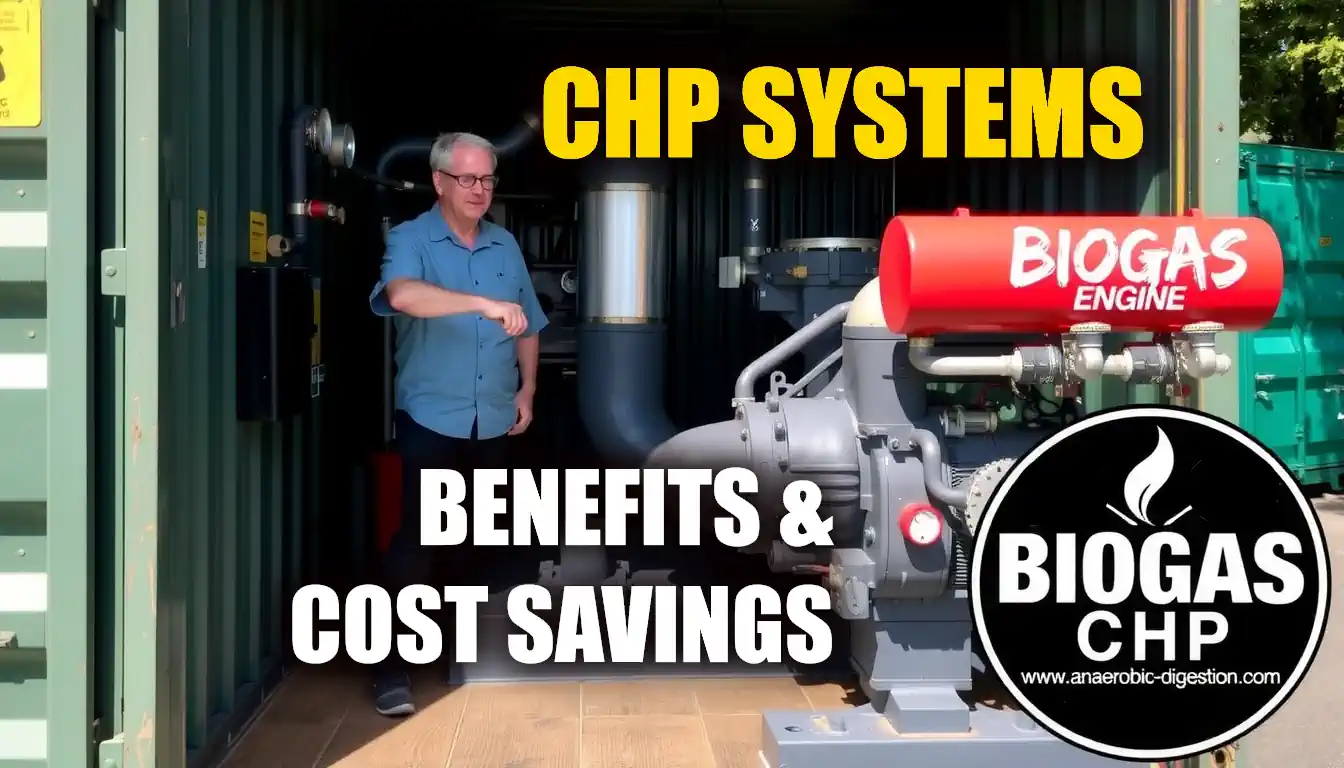
A biogas CHP system normally consists of a reciprocating gas engine connected to an electrical generator together with heat-recovery equipment.
The engine burns conditioned biogas and converts part of the fuel energy into mechanical power.
The generator converts that mechanical power into electricity.
At the same time, heat can be recovered from:
- engine jacket cooling water;
- lubricating-oil cooling;
- charge-air cooling; and
- hot exhaust gases.
The recovered thermal energy can then be used for digester heating, pasteurisation, hot water, process heat, drying, buildings or an external heat customer.
The defining feature of CHP is therefore not simply electricity generation.
It is the simultaneous production of power and useful heat from the same fuel input.
How Does Biogas CHP Work at an Anaerobic Digestion Plant?
The process normally involves six principal stages.
1. Anaerobic Digestion Produces Biogas
Biodegradable organic materials are broken down by microorganisms in the absence of oxygen.
Suitable feedstocks may include:
- food waste;
- food and drink processing residues;
- animal manure and slurry;
- sewage sludge;
- agricultural residues;
- industrial organic effluents; and
- other suitable biodegradable wastes and by-products.
The resulting biogas normally contains methane and carbon dioxide together with water vapour and smaller quantities of other gases and contaminants.
2. Biogas Is Stored and Balanced
Many AD plants incorporate a gas holder.
This provides short-term storage and helps smooth fluctuations between biological gas production and CHP consumption.
However, storage does not correct a fundamentally oversized or undersized CHP unit.
If average gas production exceeds CHP consumption, the gas holder will eventually fill. If the engine consumes gas faster than the digester produces it, the holder will eventually empty.
3. The Biogas Is Cleaned and Conditioned
Raw biogas may require treatment before it reaches the engine.
Depending on gas composition and the engine manufacturer’s requirements, this may include:
- hydrogen sulphide removal;
- cooling and condensate removal;
- filtration;
- siloxane removal;
- gas pressure regulation; and
- gas boosting.
The required treatment should be based on actual or reasonably predicted gas composition and the CHP manufacturer’s warranty limits.
4. The Gas Engine Burns the Biogas
The methane-rich gas is burned in the engine cylinders.
The combustion process drives the pistons and crankshaft.
This converts chemical energy in the fuel into mechanical power.
5. The Generator Produces Electricity
The engine drives an electrical generator.
The electricity may then be:
- used by the AD plant itself;
- used elsewhere on the same site;
- supplied to a nearby user; or
- exported to the electricity grid where appropriate arrangements exist.
6. Heat Is Recovered
A substantial proportion of the fuel energy does not become electricity.
Instead, it appears as heat in the cooling systems and exhaust gases.
CHP equipment recovers part of this thermal energy for useful purposes.
Why Biogas CHP Can Be Highly Efficient
Conventional electricity generation discards a large proportion of fuel energy as heat.
CHP improves total fuel utilisation by capturing some of that thermal energy.
UK Government guidance states that CHP typically achieves efficiencies above 80% where heat is supplied to an appropriately matched demand.
This does not mean that every CHP installation automatically achieves an 80% useful energy yield.
The distinction between recoverable heat and useful heat is critical.
For example, assume 100 units of fuel energy enter a CHP engine.
The engine might produce:
- around 40 units of electricity;
- around 40 units of potentially recoverable heat; and
- around 20 units of unavoidable losses.
If all 40 thermal units perform a useful function, total useful energy utilisation could approach 80 units.
But if the site can beneficially use only 15 units of the recovered heat, the practical result is very different.
The remaining heat ultimately still has to be rejected.
Useful Heat Is the Key to Good CHP
The value of biogas CHP depends heavily on what happens to the recovered thermal energy.
UK Combined Heat and Power Quality Assurance (CHPQA) guidance requires qualifying useful heat to be quantified and justified.
This reflects an important engineering principle:
heat does not become useful merely because it has been recovered.
A useful heat load should perform a genuine function and, in many cases, displace heat that would otherwise need to be supplied from another energy source.
Examples include:
- maintaining digester temperature;
- pasteurising feedstock or digestate;
- providing industrial process heat;
- replacing boiler heat;
- heating greenhouses;
- supplying a district heating system; or
- providing another demonstrable thermal service.
This is one reason CHP feasibility studies should include a realistic heat balance rather than simply quoting the manufacturer’s maximum recoverable thermal output.
For a detailed discussion of this issue, see our guide to the advantages and disadvantages of combined heat and power.
How Is CHP Heat Used at an AD Plant?
Digester Heating
Most commercial anaerobic digesters operate within controlled temperature ranges.
Recovered CHP heat can be circulated through heat exchangers or internal heating systems to maintain the required digester temperature.
This provides a valuable base thermal load.
Feedstock Preheating
Incoming feedstock can impose a substantial thermal load, particularly during cold weather.
Recovered CHP heat may be used to raise feedstock temperature before digestion.
Pasteurisation
Where pasteurisation or hygienisation is required, CHP heat may contribute to the necessary thermal input.
Digestate Processing
Some plants use surplus heat for digestate concentration, drying or other processing.
The technical and economic value depends on the process used and the amount of surplus heat available.
Nearby Heat Users
Potential external users may include:
- food and drink factories;
- greenhouses;
- industrial plants;
- district heating schemes;
- leisure facilities;
- workshops; and
- commercial buildings.
However, heat is considerably more expensive to transport than electricity.
Long pipe runs, pumping costs and heat losses can significantly weaken the business case.
Where Does the Electricity Go?
AD plants themselves consume significant electrical power.
Loads can include:
- feedstock reception;
- depackaging equipment;
- pumps;
- mixers;
- maceration equipment;
- gas blowers;
- ventilation;
- digestate processing;
- control systems; and
- other site services.
Using CHP electricity behind the meter can therefore reduce electricity imported from the grid.
Surplus electricity may also be exported, subject to grid capacity and commercial arrangements.
The relative value of imported electricity displaced and exported electricity sold should be considered carefully in the financial model.
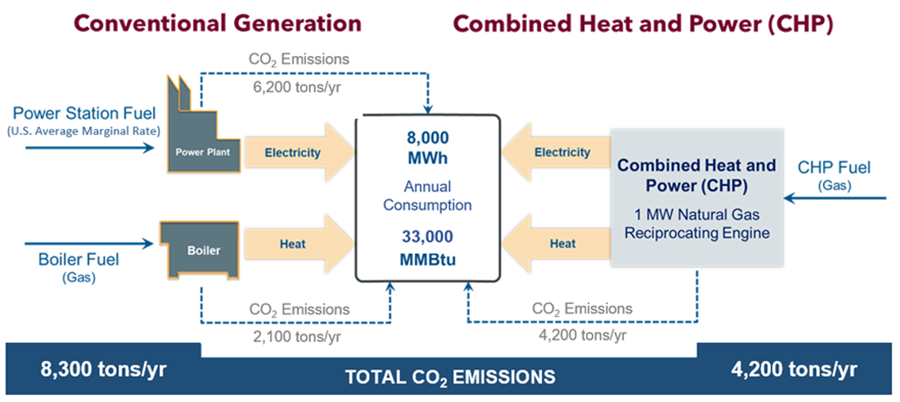
“CHP Benefits | US EPA” from www.epa.gov and used with no modifications.
The Main Benefits of Biogas CHP Systems
1. Better Use of the Energy in Biogas
The principal advantage of CHP is that it extracts both electrical and thermal value from the gas.
Where both outputs are useful, a much greater proportion of the fuel energy can be utilised than through electricity generation alone.
2. On-Site Renewable Electricity
Electricity generated from biogas can reduce the amount purchased from the grid.
This can be particularly valuable at AD plants, wastewater treatment works and industrial facilities with substantial continuous loads.
3. Useful Process Heat
The recovered heat can supply energy that the AD process already needs.
This makes CHP naturally compatible with many digesters.
4. Reduced Transmission Losses
Electricity used close to the point of generation avoids some of the transmission and distribution losses associated with remote power generation.
5. Potential Energy-Cost Savings
CHP may reduce energy expenditure where generated electricity replaces purchased electricity and recovered heat replaces another fuel or energy source.
However, savings should be calculated for the individual project rather than expressed as a universal percentage.
6. Productive Use of Waste-Derived Gas
Biogas produced from organic wastes, sewage sludge and suitable residues can be converted into useful energy instead of being flared.
7. Mature Technology
Reciprocating-engine CHP is an established technology with a long history of operation on biogas at wastewater treatment plants, agricultural digesters and waste-processing facilities.
8. Reduced Vulnerability to Fluctuating Energy Prices
One of the lesser-known benefits of biogas CHP is the protection it offers against the unpredictability of energy markets. Facilities that depend solely on grid electricity are at the mercy of rate hikes, demand charges, and supply interruptions. A biogas CHP system greatly alters this scenario.
The fuel, biogas, is produced on-site from organic waste, so its cost is primarily based on the operating costs of the digestion system instead of fluctuating commodity prices. This predictability allows for more stable long-term energy budgeting.
CHP systems have the ability to operate on a variety of fuel types, such as natural gas, biogas, coal, and biomass. This ability to switch fuels provides facilities with an extra level of protection against price increases in any single energy market. This is a strategic advantage that operations that are solely dependent on the grid do not have.
| Energy Approach | Fuel Cost Exposure | System Efficiency | On-Site Heat Recovery |
|---|---|---|---|
| Grid Electricity + On-Site Boiler | High (market rates) | ~50% | None |
| Biogas CHP System | Low (waste-derived fuel) | 65–80%+ | Yes |
| Biogas CHP (Advanced Config) | Low | Up to ~90% | Yes (maximized) |
Limitations and Disadvantages of Biogas CHP
CHP also has important limitations.
These include:
- substantial capital cost;
- gas-cleaning requirements;
- regular engine servicing;
- major overhaul requirements;
- downtime;
- noise;
- air emissions;
- grid-connection constraints;
- possible poor utilisation of surplus heat;
- the need to manage gas during engine outages; and
- competition from biomethane upgrading and other gas uses.
These issues are examined in more detail in our article on combined heat and power advantages and disadvantages.
Biogas Quality and CHP Engine Reliability
Raw biogas is more demanding than clean pipeline natural gas.
Gas quality can materially affect engine life, lubricant condition, maintenance frequency and emissions performance.
Hydrogen Sulphide
Hydrogen sulphide (H2S) is corrosive and can contribute to engine wear, deposits and lubricant deterioration.
H2S concentrations should be reduced where necessary to meet the engine manufacturer’s specification.
Moisture
Biogas leaving a digester normally contains substantial water vapour.
Cooling can cause condensation.
Pipework should therefore incorporate suitable gradients, condensate traps and drainage.
Siloxanes
Siloxanes can occur particularly in sewage sludge gas and some waste-derived biogas streams.
During combustion they can form hard silica-containing deposits on engine components and downstream equipment.
Particulates and Other Contaminants
Other contaminants may also require control depending on the feedstock and digestion process.
Gas analysis should therefore form part of CHP selection and design.
How Should a Biogas CHP System Be Sized?
CHP sizing should be based on realistic methane production and energy demand rather than simply the maximum theoretical biogas output.
Important considerations include:
- expected annual biogas production;
- seasonal gas-production variation;
- methane concentration;
- gas-holder capacity;
- electrical load;
- electricity-export capacity;
- useful heat demand;
- engine part-load efficiency;
- maintenance downtime; and
- future changes in feedstock or plant operation.
The optimum CHP size is not necessarily the largest engine that the peak gas production can support.
A smaller unit operating consistently at a good load may perform better than an oversized engine that repeatedly cycles or operates inefficiently.
For a detailed engineering treatment, see Biogas CHP Design: Selecting and Sizing a CHP System.
One Large CHP Engine or Two Smaller Units?
Some projects use one large CHP engine.
Others use two or more smaller units.
One larger engine may offer:
- lower capital cost per installed kilowatt;
- simpler controls;
- fewer engines to maintain; and
- potentially higher electrical efficiency.
Multiple smaller engines may provide:
- better redundancy;
- greater operating flexibility;
- improved turndown;
- continued generation while one unit is serviced; and
- better matching to variable gas production.
The correct choice depends on site-specific reliability, maintenance and energy requirements.
What Happens When the CHP Engine Is Down?
This is a critical design question at any anaerobic digestion plant.
Biogas production continues even when a CHP engine requires servicing.
Possible gas-management options include:
- short-term storage;
- a second CHP unit;
- a biogas boiler;
- another authorised gas user;
- biomethane upgrading where installed; and
- an emergency flare.
Annual energy forecasts should therefore allow realistically for scheduled and unscheduled downtime.
Biogas CHP Emissions
Renewable fuel does not mean emission-free combustion.
A gas engine can produce:
- nitrogen oxides (NOx);
- carbon monoxide;
- unburned hydrocarbons;
- methane slip;
- sulphur compounds; and
- other trace pollutants.
Emission requirements can influence:
- engine selection;
- combustion settings;
- gas cleaning;
- oxidation catalysts;
- Selective Catalytic Reduction (SCR);
- stack design; and
- monitoring arrangements.
For detailed guidance, see our specialist article on Biogas CHP Emissions: SCR Systems for NOx Control in Gas Engines.
Does Biogas CHP Reduce Carbon Emissions?
CHP can reduce fuel use compared with generating the same useful heat and electricity separately.
Government guidance recognises that efficient CHP can reduce emissions where the recovered heat replaces heat that would otherwise require additional fuel.
However, the carbon performance of biogas CHP should be considered on a whole-system basis.
Important factors include:
- feedstock source;
- methane leakage;
- CHP electrical efficiency;
- the amount of heat actually used;
- the energy source displaced by that heat;
- the electricity displaced;
- digestate management; and
- alternative uses for the biogas.
For this reason, it is generally too simplistic to describe biogas itself as automatically “carbon neutral”.
The environmental outcome depends on the complete system.
Who Uses Biogas CHP Systems?
Agricultural AD Plants
Farm digesters can use CHP electricity for both the digester and wider farm operations.
Recovered heat can be returned to the digester and potentially used for buildings, crop drying, greenhouses or other agricultural processes.
Food-Waste AD Plants
Food-waste plants often have substantial electrical loads from reception, depackaging, pumping, mixing and digestate treatment.
Heat can be used for digestion and, where required, pasteurisation.
Wastewater Treatment Works
Sewage sludge digestion and CHP have been used together for many decades.
Wastewater treatment plants usually have substantial continuous electrical demand and a reliable requirement for digester heating.
Food and Drink Processing
Industrial sites generating organic effluents or residues may be particularly attractive for CHP where the site also has continuous electricity and process-heat demand.
Other Organic-Waste Facilities
Any facility producing a reliable biogas stream may potentially use CHP where electricity and useful heat have sufficient value.
What Does a Biogas CHP System Cost?
There is no meaningful universal cost for a biogas CHP installation.
Project expenditure depends on much more than engine size.
Capital costs can include:
- CHP engine-generator package;
- biogas cleaning;
- gas boosting;
- heat-recovery equipment;
- hot-water or steam distribution;
- electrical switchgear;
- transformers;
- grid connection;
- exhaust treatment;
- stack;
- acoustic treatment;
- building or container;
- civil works;
- controls and monitoring;
- professional design; and
- permitting costs.
Operating costs can include:
- routine servicing;
- lubricating oil;
- spark plugs and consumables;
- gas-treatment media;
- SCR reagent where required;
- replacement catalysts;
- major overhaul;
- monitoring;
- insurance; and
- operator time.
This is why CHP cost comparisons should use total whole-life cost rather than engine purchase price alone.
How Does Biogas CHP Save Money?
The economic value of CHP can come from several sources.
Displacing Imported Electricity
Electricity generated on-site can replace electricity that would otherwise have been purchased from the grid.
Displacing Purchased Heat
Useful recovered heat can replace boiler fuel or another source of thermal energy.
Exporting Surplus Electricity
Where permitted and commercially worthwhile, surplus electricity may be sold to the grid.
Using an Existing Waste-Derived Fuel
Where biogas is already being produced as part of a waste-treatment process, CHP may allow additional value to be recovered from that gas.
Reducing Dependence on External Energy
On-site generation can reduce exposure to some external electricity costs.
However, the scale of savings depends entirely on the individual site’s energy balance and commercial arrangements.
Why Generic CHP Payback Claims Can Be Misleading
Claims that a CHP system will pay for itself in a fixed number of years should be treated cautiously.
Project economics depend on:
- actual gas production;
- methane content;
- engine efficiency;
- operating hours;
- electricity import price;
- electricity export value;
- useful heat value;
- maintenance cost;
- overhaul cost;
- gas-treatment cost;
- grid costs;
- capital finance;
- support mechanisms; and
- alternative uses for the biogas.
A proper feasibility study should therefore use sensitivity analysis.
For example, it should test what happens if:
- biogas production is 10% or 20% below forecast;
- methane concentration is lower than expected;
- engine availability is lower;
- electricity prices change;
- maintenance costs rise; or
- less heat is used than originally predicted.
CHP or Biomethane Upgrading?
Biogas CHP is not the only way to obtain value from biogas.
Biogas can instead be upgraded by removing carbon dioxide and contaminants to produce biomethane.
Biomethane may then be injected into the gas grid or used in another suitable renewable-gas application.
Current UK energy policy recognises both routes: raw biogas can be used directly in CHP for heat and power, while upgraded biomethane can displace fossil methane in the gas system.
CHP may be especially attractive where:
- the site has a strong electricity demand;
- recovered heat has a valuable year-round use;
- electricity export is practical;
- the project scale suits reciprocating-engine CHP; or
- existing infrastructure already favours CHP.
Biomethane upgrading may deserve closer attention where:
- there is little use for surplus CHP heat;
- a gas-grid connection is available;
- electricity export is constrained;
- the plant is large enough to justify upgrading equipment; or
- biomethane has a stronger long-term value.
This broader question of how best to use the gas is covered separately in our guide to biogas utilisation.
Biogas CHP and CHPQA
In the UK, the Combined Heat and Power Quality Assurance programme provides a formal method for assessing CHP performance.
CHPQA considers fuel input, power output and useful heat output and uses a Quality Index to assess scheme quality.
This provides an important reminder that good CHP is not simply a generator fitted with a heat exchanger.
A good CHP scheme must convert fuel efficiently into genuinely useful energy outputs.
Current CHPQA guidance places particular emphasis on the need to quantify and justify useful heat.
Official guidance is available from the UK Government CHPQA guidance collection.
Questions to Ask Before Buying a Biogas CHP System
A developer should be able to answer the following questions before selecting equipment:
- How much biogas will the plant realistically produce?
- What methane concentration is expected?
- How much will gas production vary?
- What contaminants are present?
- What gas treatment will the engine require?
- How much electricity does the site consume?
- How much electricity can be exported?
- What is imported electricity worth?
- What is exported electricity worth?
- How much useful heat is required?
- At what temperature is the heat needed?
- How much recovered heat will genuinely displace another source?
- What happens to surplus heat?
- What happens to the biogas during CHP maintenance?
- What emissions limits apply?
- What maintenance contract is proposed?
- When will major overhaul be required?
- What engine availability is realistic?
- Would two smaller units be better than one large unit?
- Would biomethane upgrading provide a better use of the gas?
Common Biogas CHP Mistakes
- sizing the engine from maximum theoretical gas production;
- ignoring methane concentration;
- assuming constant biogas output;
- valuing all recoverable heat as useful heat;
- ignoring seasonal thermal demand;
- underestimating H2S or siloxane treatment;
- assuming near-100% engine availability;
- failing to plan for downtime;
- overestimating electricity export value;
- ignoring grid constraints;
- considering emissions control too late;
- using generic cost-saving claims;
- using generic payback periods; and
- failing to compare CHP with biomethane.
As a reader of this article, you may find the following articles useful:
- Biogas Engines and Generators: How They Turn Biogas into Electricity – engine operation, electrical efficiency, gas quality, maintenance and overhaul.
- Biogas Generator Manufacturers: How to Compare Engines and CHP Suppliers – selecting manufacturers, integrators and long-term service support.
- Anaerobic Digestion Heat Exchangers – recovering and transferring useful CHP heat.
Frequently Asked Questions About Biogas CHP Systems
What does CHP mean in a biogas plant?
CHP means combined heat and power. The biogas is burned in an engine to generate electricity while heat from the engine and exhaust is recovered for useful purposes.
What is the main advantage of biogas CHP?
The main advantage is that both electricity and useful heat can be obtained from the same biogas fuel. Where both outputs are genuinely needed, total energy utilisation can be very high.
How efficient is a biogas CHP system?
Well-designed CHP systems can achieve overall efficiencies above 80% when both electrical output and recovered heat are beneficially used. Electrical efficiency alone is significantly lower.
Does biogas need cleaning before it enters a CHP engine?
Usually, yes. Moisture and hydrogen sulphide commonly require control, and siloxane removal may be needed in some applications. The required treatment should meet the CHP manufacturer’s gas-quality specification.
Can CHP heat be used to heat the digester?
Yes. Maintaining digester temperature is one of the most common and valuable uses of CHP heat at an AD plant.
Does a CHP engine run continuously?
No engine is continuously available. Routine servicing and major overhaul require downtime, and unplanned outages can also occur. Annual energy models should allow for realistic availability.
What happens to biogas when a CHP engine stops?
The plant needs an alternative gas-management route. This may include gas storage, a second CHP unit, a biogas boiler, another gas user or an emergency flare.
Does a CHP engine produce emissions?
Yes. Combustion can produce NOx, carbon monoxide, unburned hydrocarbons and other pollutants. Environmental permit requirements may require emissions monitoring or exhaust treatment.
Is biogas CHP carbon neutral?
It should not automatically be described that way. The greenhouse-gas performance depends on feedstock, methane leakage, efficiency, useful heat utilisation, displaced energy sources and other lifecycle factors.
Is biogas CHP better than biomethane upgrading?
Neither route is universally better. CHP may suit sites with strong electricity and heat demand, while biomethane may be more attractive where there is limited useful heat or a strong renewable-gas market.
How much does a biogas CHP system cost?
There is no universal cost. The final investment depends on engine size, gas cleaning, electrical connection, heat recovery, exhaust treatment, buildings, civil works, controls and many other project-specific factors.
How quickly does biogas CHP pay back?
There is no reliable generic payback period. Project economics depend on energy prices, gas production, useful heat, operating hours, maintenance, capital cost, support mechanisms and the alternative value of the biogas.
Conclusion: Biogas CHP Works Best as Part of a Complete Energy System
Biogas CHP is a mature and effective way to turn anaerobic-digestion gas into useful electricity and heat.
Its strongest applications are those where the CHP unit is designed around the realities of the AD plant rather than treated as a standalone generator.
The amount of methane available must be realistic.
The biogas must be cleaned to an appropriate quality.
The engine capacity must match the gas supply and electrical demand.
The recovered heat must have a genuine use.
Maintenance and downtime must be planned for.
Emissions must comply with applicable requirements.
And the whole project should be compared with alternative uses for the gas.
The key measure of a successful biogas CHP system is therefore not simply its electrical output or the headline efficiency on a manufacturer’s data sheet.
It is how effectively the complete system converts biogas into electricity and heat that the site actually needs and can use economically.
Biogas CHP Technical Guides
- Biogas CHP Design: 7 Factors for Selecting and Sizing a CHP System – detailed guidance on methane flow, engine sizing, electrical load, useful heat, gas cleaning and redundancy.
- Combined Heat and Power Advantages and Disadvantages – a detailed assessment of efficiency, useful heat, capital cost, maintenance and the situations in which CHP may not be appropriate.
- Biogas CHP Emissions: SCR Systems for NOx Control in Gas Engines – NOx emissions, biogas quality, catalyst operation, SCR and emissions control.
- Biogas Utilisation – the wider question of how best to use biogas, including CHP and biomethane upgrading.
- Biogas Engines and Generators: How They Turn Biogas into Electricity – engine operation, electrical efficiency, gas quality, maintenance and overhaul.
- Biogas Generator Manufacturers: How to Compare Engines and CHP Suppliers – selecting manufacturers, integrators and long-term service support.
- Anaerobic Digestion Heat Exchangers: Types, Uses, Fouling and Heat Recovery – recovering and transferring useful CHP heat.
Biogas CHP performance and economics are site-specific. Equipment should be selected using realistic gas production, gas analysis, energy demands, environmental requirements and whole-life financial assessment for the individual project.
[Published March 2026. Rewritten August 2026.]