


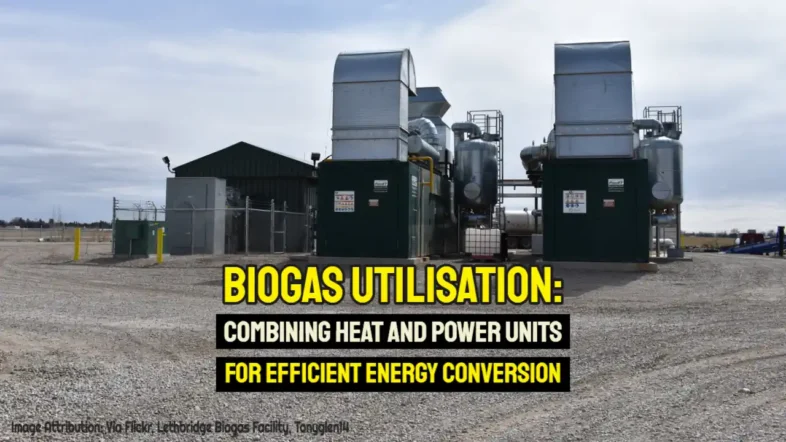
Biogas utilisation is the process of turning the methane-rich gas produced by anaerobic digestion into useful energy rather than simply disposing of it by flaring.
There is no single best use for biogas at every anaerobic digestion plant.
Depending on the quantity and quality of the gas, site energy demands, available infrastructure and local energy markets, biogas can be:
- burned in a combined heat and power (CHP) system to generate electricity and useful heat;
- upgraded to biomethane for injection into the gas grid;
- upgraded and compressed or liquefied for use as a vehicle fuel;
- burned directly in a boiler or industrial heating process;
- supplied to a nearby gas user where appropriate infrastructure exists; or
- used in other specialist energy or industrial applications.
The best option is therefore not necessarily the technology that produces the greatest headline efficiency.
It is the option that makes the most useful, reliable and economically viable use of the available biogas while meeting environmental and regulatory requirements.
This guide compares the principal biogas utilisation routes and explains the factors that should determine which route is selected.
Key Takeaways
- Biogas is an energy carrier, not the final product. Once produced by anaerobic digestion, it must be used, stored, upgraded or safely disposed of.
- CHP remains an important biogas utilisation route. It can generate electricity while recovering heat for the digester or another genuine heat demand.
- Biomethane upgrading provides an increasingly important alternative. Removing carbon dioxide and contaminants creates a methane-rich gas capable of replacing fossil natural gas in suitable applications.
- Direct heat can be the simplest use of biogas. Where a substantial nearby thermal demand exists, burning biogas in a suitable boiler or process may avoid the complexity of electricity generation or biomethane upgrading.
- The best utilisation route depends on the site. Gas production, methane concentration, electricity value, useful heat demand, gas-grid proximity, upgrading scale and energy markets all matter.
- Do not confuse recoverable energy with useful energy. CHP heat has limited value if there is no genuine demand for it, just as biomethane has limited value without a viable market or connection.
- Methane leakage matters. Because methane is a powerful greenhouse gas, leakage from digestion, storage, upgrading and utilisation equipment can materially affect environmental performance.
- Flaring is an essential safety and backup function, not normally the preferred utilisation route. Routine avoidable flaring wastes renewable energy and should be minimised.
What Is Biogas?
Biogas is produced when microorganisms break down biodegradable organic material in the absence of oxygen through the process of anaerobic digestion.
Suitable feedstocks include:
- food waste;
- food and drink processing residues;
- animal manures and slurries;
- sewage sludge;
- agricultural residues;
- industrial organic effluents; and
- other suitable biodegradable wastes and by-products.
Raw biogas normally contains methane and carbon dioxide together with water vapour and smaller quantities of gases and contaminants such as hydrogen sulphide.
The methane provides most of the usable fuel energy.
This means that two AD plants producing the same volume of biogas may not produce the same amount of energy if their methane concentrations differ.
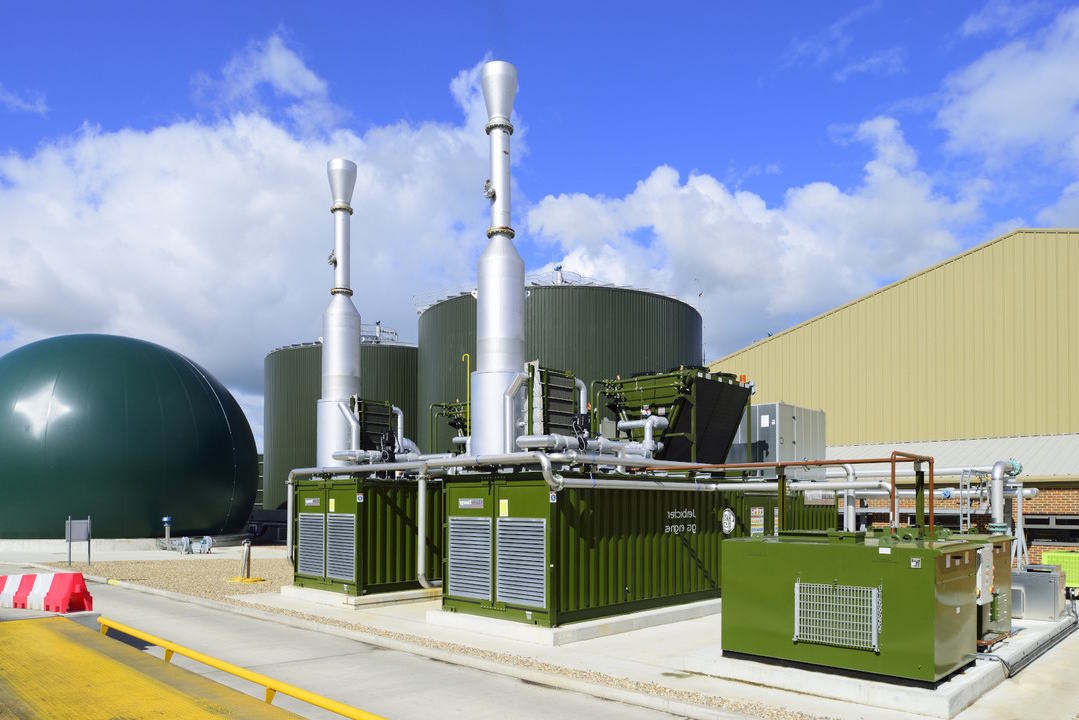
“Powering Ahead – Biogas CHP” – Optimised Biogas Utilisation from www.linkedin.com and used with no modifications. Visit the Starry Oil Website.
Why Biogas Utilisation Matters
Producing biogas is only part of the purpose of an anaerobic digestion plant.
The gas must then be managed.
Biogas contains methane that can replace other energy sources when it is used effectively.
If the gas is simply flared, much of that potential energy value is lost.
If methane escapes unburned, the consequences can be more serious because methane is a powerful greenhouse gas.
A good AD project therefore considers biogas utilisation from the beginning of project development rather than treating it as an equipment choice to be made after the digester has been designed.
The utilisation route can influence:
- digester scale;
- gas storage;
- gas cleaning;
- site layout;
- grid connections;
- heat distribution;
- environmental permitting;
- project revenue;
- maintenance requirements; and
- overall greenhouse-gas performance.
Main Biogas Utilisation Options
The principal routes can be summarised as follows:
| Biogas utilisation route | Main energy product | Particularly attractive where | Key limitation |
|---|---|---|---|
| CHP | Electricity + useful heat | Both electricity and heat have good local uses | Poor heat utilisation can weaken efficiency and economics |
| Biomethane grid injection | Renewable methane | A suitable gas-grid connection and sufficient scale exist | Upgrading and grid connection add cost and complexity |
| Biomethane vehicle fuel | Compressed or liquefied renewable gas | A reliable vehicle-fuel market exists | Requires upgrading, compression/liquefaction and fuelling infrastructure |
| Direct heat | Thermal energy | A large nearby heat demand exists | Heat is difficult and costly to transport over distance |
| Direct gas supply | Fuel gas | A suitable nearby industrial user exists | Requires appropriate gas quality, infrastructure and commercial arrangements |
| Flaring | No useful energy product | Safety, commissioning, maintenance or emergency conditions | Destroys useful energy value |
Option 1: Biogas Combined Heat and Power
Combined heat and power has historically been one of the most widely used biogas utilisation technologies.
A reciprocating gas engine burns conditioned biogas and drives an electrical generator.
Heat is recovered from the engine cooling system and exhaust gases.
The resulting energy products are therefore:
electricity + useful heat.
Why CHP Works Well with Anaerobic Digestion
An AD plant normally requires both electricity and heat.
Electricity is needed for pumps, mixers, feedstock preparation, gas handling, controls and other equipment.
Heat is needed to maintain digester temperature and may also be required for pasteurisation and other processes.
This creates a natural opportunity to use both CHP outputs on site.
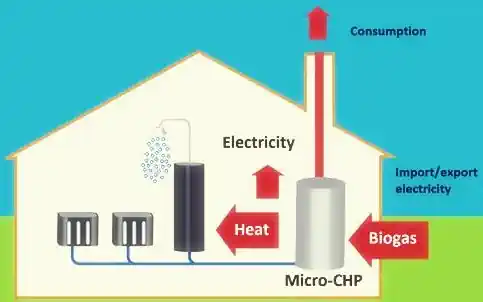
“Micro Combined Heat and Power Market …” from www.openpr.com and used with no modifications.
The Main Limitation of CHP
The principal limitation is that the recovered heat must have a genuine use.
A CHP engine may be capable of recovering substantial thermal energy, but if that heat cannot be used it must ultimately be rejected.
Headline CHP efficiencies above 80% therefore depend on useful heat utilisation rather than simply the presence of heat-recovery equipment.
For a comprehensive treatment of this technology, see our Biogas CHP Systems: Benefits, Efficiency, Costs and Design pillar guide.
Option 2: Upgrade Biogas to Biomethane
Instead of burning raw biogas at the AD plant, it can be purified to produce biomethane.
Raw biogas contains substantial carbon dioxide as well as methane. Upgrading removes most of the carbon dioxide together with contaminants and moisture to produce a gas with a much higher methane concentration.
Depending on the required specification, upgrading technologies can include:
- membrane separation;
- pressure swing adsorption;
- water scrubbing;
- chemical scrubbing; and
- other separation processes.
The resulting biomethane can potentially replace fossil natural gas.
Biomethane Grid Injection
Where an appropriate gas distribution network is accessible, biomethane can be conditioned to the required specification and injected into the gas grid.
This allows the renewable gas to be transported through existing infrastructure to consumers elsewhere.
Grid injection can be attractive because the AD plant does not need to find a local user for all the energy contained in the gas.
However, the project must account for:
- upgrading equipment;
- gas-quality monitoring;
- compression;
- grid connection;
- metering;
- propane addition where required;
- odorisation arrangements where applicable;
- network capacity; and
- regulatory requirements.
Scale Matters
Biomethane upgrading involves significant capital equipment and auxiliary energy consumption.
Very small AD plants may therefore struggle to justify a conventional upgrading and grid-injection installation.
As plant scale increases, upgrading can become more attractive because capital and operating costs are spread over a larger gas output.
Option 3: Biomethane as a Vehicle Fuel
Upgraded biomethane can also be used as a transport fuel.
It may be compressed as bio-CNG or, at suitable scale and with additional processing, liquefied as bio-LNG.
Potential applications include:
- heavy goods vehicles;
- buses;
- refuse collection vehicles;
- commercial fleets; and
- other vehicles designed to operate on methane fuel.
This route can be attractive where a reliable fleet demand exists close to the production facility or where the fuel can enter an established distribution system.
However, it requires more than simply upgrading the gas.
Compression or liquefaction, storage, dispensing infrastructure, fuel-quality control and vehicle compatibility all need to be considered.
Option 4: Use Biogas Directly for Heat
Direct combustion for heat is one of the simplest ways to use biogas.
The gas can be burned in an appropriately designed boiler, furnace or process-heating system.
This avoids the mechanical complexity and maintenance requirements of a reciprocating CHP engine.
When Direct Heat Can Make Sense
Direct heat may be attractive where:
- there is a large and relatively continuous thermal demand;
- electricity generation has limited value;
- the heat user is close to the digester;
- the required heat temperature can be provided economically; and
- the gas can be treated to the standard required by the burner or process.
Potential users include industrial processes, food factories, drying operations and other facilities with substantial heat loads.
Heat Is Difficult to Transport
The major limitation is distance.
Supplying heat normally requires insulated pipework, pumping and heat exchangers.
Capital cost and thermal losses increase with distance.
Consequently, an excellent heat user several kilometres away may be less valuable than a moderate heat demand immediately adjacent to the AD plant.
Option 5: Supply Biogas Directly to a Nearby User
In some circumstances, biogas may be supplied directly to a neighbouring industrial or commercial user rather than converted into electricity at the AD site.
This requires careful consideration of:
- gas quality;
- pressure;
- pipeline design;
- metering;
- continuity of supply;
- the user’s burner or process requirements;
- safety;
- regulatory requirements; and
- commercial arrangements.
The opportunity is highly site-specific, but where a suitable energy user is immediately adjacent it may deserve consideration.
Option 6: Flaring Biogas
A flare safely burns biogas and converts methane principally into carbon dioxide and water.
Every properly designed AD facility needs an appropriate strategy for managing surplus gas and abnormal operating conditions.
Flaring may be necessary during:
- commissioning;
- CHP maintenance;
- upgrading-plant maintenance;
- equipment failure;
- temporary loss of an energy customer;
- gas-quality problems; or
- emergency conditions.
However, routine flaring is not normally an energy-utilisation strategy.
It destroys methane safely but obtains little or no useful energy from it.
Frequent flaring can therefore indicate poor matching between gas production, storage and utilisation capacity.
Biogas Utilisation Comparison: CHP or Biomethane?
For many modern AD projects, the central utilisation decision is between CHP and biomethane upgrading.
| Factor | CHP | Biomethane |
|---|---|---|
| Main product | Electricity + heat | Renewable methane |
| Useful local heat required? | Highly desirable | No |
| Electricity connection important? | Usually | Less important for gas export |
| Gas-grid connection required? | No | For grid injection, yes |
| Raw biogas usable? | After suitable conditioning | No – substantial upgrading required |
| Engine maintenance | Significant | No CHP engine, but upgrading plant requires maintenance |
| Surplus heat issue | Potentially important | Much less significant |
| Scale sensitivity | Can suit relatively small installations | Conventional upgrading generally benefits from scale |
| Best suited to | Strong electricity + heat demand | Strong renewable-gas market or grid opportunity |
This table should not be interpreted as proving that one technology is superior.
It shows why the answer changes from site to site.
What Determines the Best Use of Biogas?
1. How Much Biogas Is Produced?
Scale strongly affects technology selection.
A small agricultural digester may be well suited to a relatively simple CHP or heat application.
A much larger food-waste or agricultural AD facility may have sufficient gas production to justify sophisticated upgrading equipment.
2. What Is the Methane Concentration?
The energy content of biogas depends strongly on methane concentration.
Utilisation studies should therefore be based on methane flow rather than total biogas volume alone.
3. How Consistent Is Gas Production?
Feedstock changes and biological performance can alter both gas flow and composition.
The selected utilisation equipment must be able to accommodate realistic variation.
4. Is There a Good Electricity Demand?
CHP becomes more attractive where electricity can be used on site to displace grid imports.
A site exporting most of its electricity may face different economics.
5. Is There a Genuine Useful Heat Demand?
This is one of the most important CHP questions.
Digester heating provides a base demand, but it may use only part of the heat available from a CHP engine.
Surplus heat has value only if another genuine user exists.
6. How Close Is the Gas Grid?
A nearby suitable gas main can make biomethane injection attractive.
A technically suitable connection several kilometres away may require substantial pipeline expenditure.
Network capacity and injection conditions also need to be established.
7. Is There a Vehicle-Fuel Market?
A nearby fleet of suitable gas vehicles can change the economics of biomethane utilisation.
The assessment should be based on credible long-term fuel demand rather than merely the technical possibility of producing bio-CNG or bio-LNG.
8. What Existing Infrastructure Is Available?
An existing CHP engine, heat network, electrical connection, gas pipeline or industrial heat user can materially change the preferred option.
Greenfield and retrofit projects may therefore reach different conclusions even when producing similar quantities of biogas.
9. What Are the Maintenance Requirements?
Every utilisation technology requires maintenance.
CHP involves reciprocating-engine servicing and major overhaul.
Biomethane systems involve compressors, membranes or scrubbers, analysers and other gas-processing equipment.
The assessment should consider availability and whole-life cost rather than capital expenditure alone.
10. What Happens When the Main Utilisation Plant Is Unavailable?
Biological gas production continues during maintenance.
Every utilisation strategy therefore needs contingency arrangements.
These may include:
- gas storage;
- alternative gas users;
- backup boilers;
- multiple CHP engines;
- redundant upgrading equipment; and
- emergency flaring.
Biogas Cleaning Depends on the Final Use
The required level of gas treatment depends on what happens to the gas.
A CHP engine may tolerate carbon dioxide in the biogas but impose strict limits on hydrogen sulphide and siloxanes.
A biomethane grid-injection project requires much greater removal of carbon dioxide and must meet the relevant network gas-quality specification.
A direct-fired boiler may have different requirements again.
This means that gas cleaning should be designed from the utilisation requirement backwards.
The logical sequence is:
choose the required energy product → establish the required gas specification → design the gas treatment system.
Installing gas-cleaning equipment before the final utilisation route has been established risks either under-treating the gas or paying for unnecessary treatment.
Methane Leakage and Biogas Utilisation
Methane management deserves particular attention because unburned methane is a powerful greenhouse gas.
Potential leakage points can include:
- digester covers;
- gas holders;
- pressure-relief devices;
- pipework and valves;
- CHP engines;
- upgrading equipment;
- compressors;
- off-gas treatment; and
- maintenance activities.
Consequently, environmental comparisons between CHP and biomethane should consider actual methane losses as well as nominal energy efficiency.
A high-efficiency utilisation process can lose part of its climate advantage if significant methane escapes before or during utilisation.
Biogas Utilisation and Energy Efficiency
Energy efficiency should be assessed across the complete system.
For CHP, this means distinguishing between electricity and genuinely useful heat.
For biomethane, it means allowing for electricity and heat consumed by upgrading, compression and other processing.
For direct heat, it means considering boiler efficiency and heat-distribution losses.
The relevant question is not simply:
“Which machine has the highest efficiency?”
It is:
“Which route delivers the greatest useful value from the available biogas under the conditions at this site?”
Biogas Utilisation and Energy Storage
One advantage of methane is that, unlike electricity, it can be stored relatively readily as a gas.
AD plants normally use gas holders to provide short-term buffering.
Once upgraded to biomethane, the gas may also enter much larger gas-storage and distribution systems where the necessary infrastructure exists.
This can be important because biogas production is relatively continuous while electricity and heat demand vary.
However, on-site biogas storage is normally designed for operational balancing rather than long-term seasonal energy storage.
Should Biogas Be Converted to Electricity?
Electricity is a high-value and versatile energy carrier, but converting methane into electricity involves conversion losses.
CHP can recover some of the otherwise lost energy as useful heat.
Electricity generation may be particularly attractive where:
- the site has a large continuous electrical load;
- grid electricity is expensive;
- surplus electricity has a viable export route;
- there is also a good use for recovered heat; and
- engine maintenance can be effectively managed.
Where those conditions do not apply, preserving the methane as biomethane may deserve greater consideration.
Should Biogas Be Used for Heat?
Direct heat can sometimes be overlooked because electricity and biomethane appear more sophisticated.
But the simplest utilisation route can sometimes be the most rational.
If an industrial facility has a large, continuous heat demand immediately adjacent to an AD plant, directly substituting biogas for another boiler fuel may avoid:
- generator losses;
- engine maintenance;
- electricity grid connection;
- biomethane upgrading; and
- gas-grid connection.
The feasibility depends on the required heat temperature, gas quality, burner technology, continuity of supply and value of the displaced fuel.
Biogas Utilisation Should Be Decided Early
The intended gas use should be considered during the earliest stages of AD project development.
Leaving the decision until after the digester has been designed can create avoidable compromises.
For example:
- CHP may require electrical-export capacity and substantial heat-recovery infrastructure;
- biomethane may require space for upgrading, compression and grid-injection equipment;
- vehicle fuel requires storage and dispensing infrastructure;
- direct heat may require a pipeline to the heat user; and
- all options require appropriate gas storage and emergency management.
The utilisation route therefore belongs in the feasibility study, not merely in the final equipment procurement stage.
A Practical Biogas Utilisation Decision Sequence
- Establish realistic annual and seasonal biogas production.
- Establish methane concentration and fuel-energy content.
- Analyse expected contaminants and gas-treatment requirements.
- Measure or estimate on-site electricity demand.
- Quantify genuinely useful heat demand.
- Investigate electricity-grid capacity and export value.
- Investigate gas-grid proximity, capacity and injection requirements.
- Identify credible industrial, heat or vehicle-fuel customers.
- Compare CHP, biomethane and direct-use capital costs.
- Compare maintenance, auxiliary energy and whole-life costs.
- Assess methane leakage and environmental performance.
- Determine how gas will be managed during outages.
- Test the economics against lower gas production and changing energy prices.
- Select the route that provides the strongest whole-system outcome.
Common Biogas Utilisation Mistakes
- assuming CHP is automatically the normal destination for biogas;
- assuming biomethane is automatically more valuable because it is more highly processed;
- using theoretical rather than realistic gas yields;
- ignoring methane concentration;
- valuing all CHP heat as useful heat;
- underestimating gas-grid connection costs;
- assuming an electricity export connection will be available;
- selecting gas-cleaning equipment before defining the final gas specification;
- ignoring methane leakage;
- underestimating maintenance and downtime;
- failing to identify what happens to gas during outages;
- relying on current incentives without testing long-term economics; and
- comparing technologies using headline efficiencies rather than useful energy delivered.
Frequently Asked Questions About Biogas Utilisation
What is biogas used for?
Biogas can be burned in CHP systems to produce electricity and heat, burned directly for heat, upgraded to biomethane for gas-grid injection or used as a renewable vehicle or industrial fuel.
What is the most common use of biogas?
The answer varies by country, plant type and policy framework. CHP has historically been a major utilisation route for anaerobic digestion plants, while biomethane upgrading has become increasingly important.
What is the best use for biogas?
There is no universal best use. The preferred route depends on gas production, methane content, electricity and heat demand, grid connections, plant scale, energy prices, policy support and available markets.
Can raw biogas be used directly?
Yes, in suitably designed combustion equipment, but raw biogas normally requires at least some conditioning. The treatment required depends on moisture, hydrogen sulphide, siloxanes and the specification of the equipment using the gas.
What is the difference between biogas and biomethane?
Biogas contains substantial carbon dioxide together with methane and various contaminants. Biomethane is produced by upgrading biogas to remove most of the carbon dioxide and contaminants, creating a gas with a much higher methane concentration.
Is CHP better than biomethane?
Not universally. CHP can be attractive where electricity and useful heat have high local values. Biomethane can be attractive where there is limited useful heat demand and a strong gas-grid or renewable-fuel opportunity.
Can biogas be used for heating without CHP?
Yes. Biogas can be burned directly in suitably designed boilers or process equipment. Where there is a strong nearby thermal demand, direct heat can be an efficient and comparatively simple utilisation route.
Can biogas be used as vehicle fuel?
Yes, after upgrading to biomethane and appropriate compression or liquefaction. Bio-CNG and bio-LNG can be used in compatible vehicles and fleets.
Why is biogas flared?
Flaring provides a safe method of destroying surplus methane during commissioning, maintenance, equipment failure or other abnormal conditions. It is an essential backup provision but normally wastes the potential energy value of the gas.
Does biogas utilisation eliminate methane emissions?
No. Methane can escape from digesters, gas storage, pipework, engines and upgrading equipment. Good design, monitoring and maintenance are required to minimise these losses.
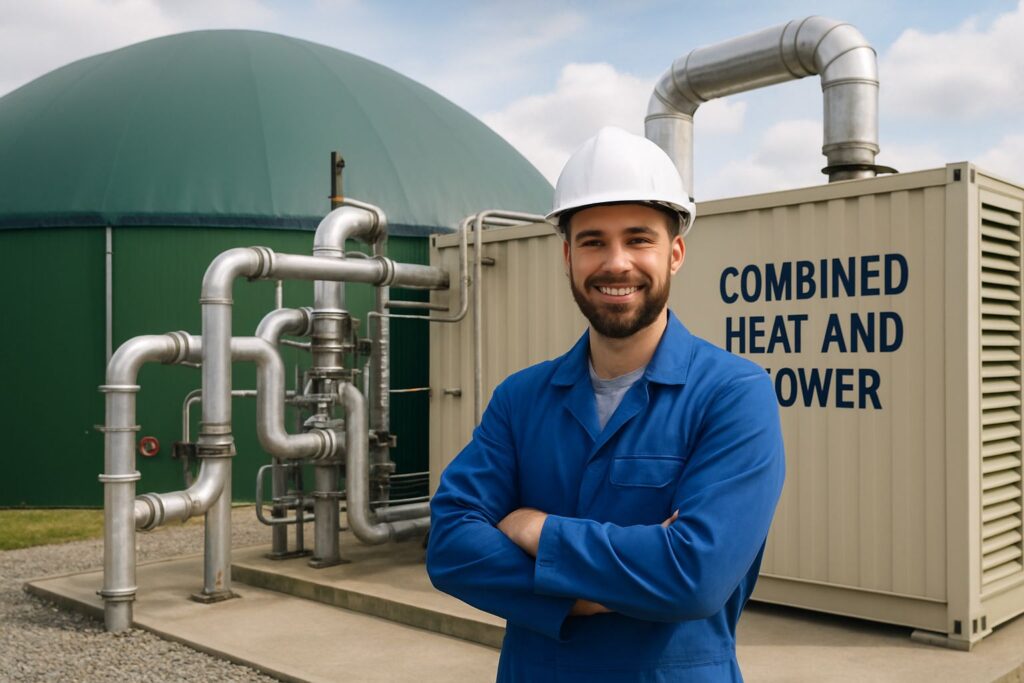
AI hasn’t got a clue how to show pipework! Just don’t ask AI to do any plumbing design for you!
Conclusion: The Best Biogas Utilisation Route Depends on What the Site Needs
Anaerobic digestion produces a versatile renewable gas, but producing biogas does not by itself determine how that gas should be used.
CHP can provide an excellent solution where electricity and useful heat are both required.
Biomethane upgrading can provide greater flexibility where renewable gas has a strong market and local heat demand is limited.
Direct heat can sometimes provide a simpler and highly effective solution where a substantial thermal load exists close to the digester.
Vehicle fuel and direct gas supply may create valuable opportunities in the right circumstances.
The correct decision therefore requires more than comparing equipment efficiencies.
It requires an assessment of the complete energy system:
how much methane is available, what energy the site and nearby users actually need, what infrastructure exists, what the alternatives cost, and which route delivers the greatest useful value with acceptable environmental performance.
That is the central principle of good biogas utilisation.
Further Reading
- Biogas CHP Systems: Benefits, Efficiency, Costs and Design – our main guide to generating electricity and useful heat from biogas.
- Biogas CHP Design: 7 Factors for Selecting and Sizing a CHP System – detailed engineering guidance on selecting and sizing CHP equipment.
- Combined Heat and Power Advantages and Disadvantages – when CHP makes sense and when its limitations become important.
- Biogas CHP Emissions: SCR Systems for NOx Control in Gas Engines – detailed guidance on CHP engine emissions and NOx control.
Biogas utilisation decisions are project-specific. Gas production, gas composition, energy demand, grid capacity, environmental requirements, market conditions and available infrastructure should be assessed for the individual anaerobic digestion project.
Featured Image Attribution: Via Flickr, Lethbridge Biogas Facility, Tonyglen14 https://www.flickr.com/photos/powerline64/33950214352/
Licence: CC BY 2.0
[Published January 2026. updated and rewritten August 2026.