



Choosing between biogas generator manufacturers is not simply a matter of comparing the number of kilowatts printed on competing quotations. A generator set that looks excellent on a datasheet can become expensive very quickly if it is poorly matched to the available biogas, difficult to service locally, sensitive to contaminants or routinely operated well below its optimum load.
The engine is also only part of what you are buying. Depending on the project, the complete package may include the generator, gas train, controls, heat recovery, exhaust treatment, container or acoustic enclosure, cooling equipment, electrical synchronisation equipment and ongoing maintenance support.
This makes comparison more complicated than asking, “Which manufacturer makes the best biogas engine?”
There is no universal answer. A better question is:
Which engine and supplier combination is best suited to this biogas, this duty and this site for the next ten or twenty years?
This guide explains how to compare biogas generator manufacturers and CHP suppliers, what information should be included in a tender enquiry, and why fuel specifications, part-load efficiency, emissions guarantees, maintenance and overhaul costs deserve as much attention as purchase price.
Key Takeaways
- Do not select a biogas generator on rated electrical output alone. Gas quality, operating load, efficiency, maintenance and support can have a greater effect on lifetime value.
- The engine manufacturer and CHP package supplier may be different companies. Establish who is responsible for the engine, generator, heat recovery, controls, commissioning, warranty and servicing.
- Obtain the manufacturer’s actual biogas fuel specification. H2S, total sulphur, siloxanes, moisture, halogenated compounds and other contaminants can affect reliability and warranty conditions.
- Compare efficiency at the load the engine will actually operate at. Full-load headline efficiency tells only part of the story.
- Ask for a maintenance schedule and lifecycle-cost estimate before placing the order. Oil, filters, spark plugs, cylinder-head work and major overhauls can materially affect generation cost.
- Local service capability matters. A highly efficient engine is of little value while it is waiting several days for an engineer or critical spare part.
- Emissions should be part of the original specification. Do not assume that an engine selected on electrical performance can subsequently meet every NOx or other emissions requirement without additional equipment.
- If CHP is required, compare useful heat as well as electricity. The temperature and form in which heat is available matter more than an impressive total thermal-output figure.
- Compare whole-life cost per useful MWh rather than simply £/kW of installed capacity.
What Is a Biogas Generator?
A biogas generator normally consists of a stationary gas engine coupled to an electrical alternator. Conditioned biogas is burned in the engine, producing mechanical shaft power, and the generator converts that mechanical energy into electricity.
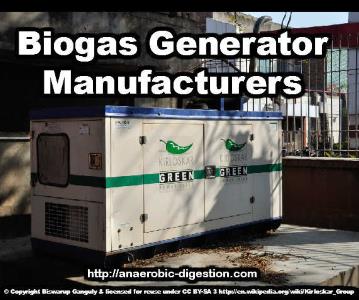 If useful heat is recovered from the engine cooling circuits and exhaust, the installation becomes a combined heat and power, or CHP, system.
We have deliberately kept that explanation brief here because this page is about selecting manufacturers and suppliers, not explaining the combustion process again.
For the engineering principles, gas quality, engine maintenance and electricity-production calculations, see our Biogas Engines and Generators: How They Turn Biogas into Electricity guide.
Who Actually Manufactures a Biogas Generator?
This apparently simple question can become surprisingly complicated.
The name on the CHP package may not be the company that manufactured the engine. A project can involve several organisations:
- the gas-engine manufacturer;
- the alternator manufacturer;
- a CHP package manufacturer or integrator;
- a UK or regional distributor;
- an electrical contractor;
- a gas-treatment supplier;
- an emissions-control supplier; and
- a maintenance and service organisation.
Some suppliers take responsibility for almost the entire package. Others supply principally the engine-generator set and leave substantial balance-of-plant work to the developer or EPC contractor.
Neither approach is necessarily wrong, but the contractual interfaces need to be clear.
Established Biogas Gas-Engine Manufacturers
Several established engine brands have been used internationally for biogas, sewage gas, landfill gas and other renewable-gas applications.
Names encountered in the sector include:
- Jenbacher;
- MWM;
- Caterpillar;
- MAN;
- Guascor; and
- Other manufacturers and engine platforms offered through specialist CHP integrators.
The available ranges, ownership of brands, distributors and individual models change over time. This article therefore does not attempt to maintain a league table of “the ten best biogas generators”.
More importantly, brand reputation alone should not decide the purchase.
A manufacturer with an excellent large-engine product may not offer the optimum machine at the output required by a smaller AD plant. Similarly, the theoretically most efficient engine may not be the best choice if another supplier provides substantially better service support in the project’s location.
Manufacturer Versus CHP Supplier or Integrator
One of the first things to establish when comparing quotations is exactly what each company is offering.
An engine manufacturer produces the prime mover. A CHP integrator may take that engine and combine it with:
- an alternator;
- gas train;
- lubrication systems;
- cooling circuits;
- heat exchangers;
- exhaust system;
- silencers;
- emissions after-treatment;
- control panel;
- grid synchronisation;
- container or acoustic enclosure; and
- remote monitoring.
The integrator may also carry out commissioning and provide the long-term service contract.
Consequently, two quotations based on engines from the same manufacturer can still represent substantially different propositions.
Start with the Biogas, Not the Engine Catalogue
Before asking manufacturers for quotations, obtain representative information about the fuel.
At minimum, the supplier will normally need to know expected gas flow and methane concentration. But that alone is not enough for a proper equipment selection.
Depending on the source of the gas, analysis may need to include:
- methane;
- carbon dioxide;
- oxygen;
- nitrogen;
- hydrogen sulphide;
- total sulphur;
- water or dew point;
- siloxanes;
- halogenated compounds;
- ammonia or other nitrogen compounds;
- particulates; and
- other contaminants relevant to the particular feedstock.
Biogas from agricultural feedstocks, sewage sludge and food waste should not automatically be assumed to have identical contaminant profiles.
Ask for the Manufacturer’s Written Fuel-Gas Specification
This is one of the most important documents in the procurement process.
Major gas-engine manufacturers publish technical requirements defining acceptable fuel quality. These can set limits for sulphur compounds, siloxanes, halogens, moisture and other substances that can damage the engine or exhaust-treatment system.
Do not rely solely on a salesperson saying that an engine “runs on biogas”.
Ask instead:
Will the manufacturer warrant this engine for continuous operation on our analysed gas, after the proposed gas-treatment system?
That is a much more useful question.
Hydrogen Sulphide Limits
Hydrogen sulphide is one of the best-known biogas contaminants. When sulphur compounds are burned, they can contribute to acidic contamination, corrosion, deposits and accelerated degradation of lubricating oil.
Manufacturers may express permissible sulphur concentrations in different ways, and allowable exposure may be linked to maintenance requirements.
This makes casual comparisons dangerous.
Do not simply take an H2S number from one datasheet and compare it directly with another unless the units, reference gas composition and associated operating conditions are equivalent.
The correct objective is to design the gas-treatment system so that the engine receives fuel consistently within its warranted specification.
Siloxanes Can Be Equally Important
Siloxanes deserve particular attention where biogas originates from sewage sludge and certain waste streams.
When burned, these silicon-containing compounds can form hard deposits on combustion and exhaust components.
A manufacturer may therefore require siloxane concentrations below specified limits.
If siloxane removal is necessary, its operating cost should form part of the generator comparison. Activated-carbon or other media does not regenerate itself for free, and frequent media replacement can become a significant operating expense.
Do Not Over-Specify Gas Cleaning Either
There is an opposite mistake.
Once engineers become concerned about contaminants, it is tempting to specify extremely elaborate gas treatment “just to be safe”. That can add unnecessary capital cost, pressure loss, electricity consumption and maintenance.
The sensible approach is:
analyse the gas → obtain the engine specification → design treatment to achieve that specification with an appropriate margin.
The objective is engine-grade biogas, not necessarily biomethane.
Compare Electrical Efficiency Carefully
Electrical efficiency has a direct effect on revenue or avoided electricity purchases. Even a relatively small difference can become significant when an engine operates for thousands of hours every year.
But manufacturers’ headline efficiency figures need to be compared on an equivalent basis.
Ask:
- Is the efficiency quoted at full load?
- What gas composition was assumed?
- Is the figure measured at generator terminals?
- Are package auxiliaries included?
- What ambient temperature and altitude apply?
- What emissions setting was assumed?
- What tolerance applies to the guaranteed figure?
Modern large gas engines can achieve electrical efficiencies above 40% under suitable conditions. Still, the relevant figure for a project is the guaranteed performance of the particular engine on the specified gas and at the expected operating point.
Part-Load Efficiency May Matter More Than the Headline Figure
A manufacturer may advertise an impressive efficiency at 100% load. That is useful if the engine genuinely spends most of its life there.
But what if the site’s methane production means it normally operates at 70%?
Ask each bidder to provide fuel consumption and electrical efficiency at several loads, for example:
- 100%;
- 75%;
- 50%; and
- the lowest continuous operating load recommended by the manufacturer.
The exact comparison points can be adjusted for the project, but the principle is important.
An engine with marginally lower full-load efficiency but better performance around the site’s normal operating load could generate more useful electricity over the year.
Size the Generator Around Real Methane Production
There is little benefit in purchasing a 1 MW engine if the digester can reliably fuel only 700 kW.
Engine sizing should be based on realistic methane production rather than optimistic peak biogas forecasts.
The assessment should consider:
- average methane production;
- seasonal variation;
- feedstock variability;
- minimum and maximum expected output;
- gas-holder capacity;
- engine turndown;
- planned downtime;
- site electricity demand; and
- export limitations.
For a more detailed discussion, see Biogas CHP Design: Selecting and Sizing a CHP System.
One Large Engine or Two Smaller Engines?
Manufacturers and integrators may propose quite different configurations for the same gas production.
One larger engine may offer lower capital cost per kilowatt, fewer auxiliaries and potentially higher electrical efficiency.
Two smaller engines can offer flexibility. When gas production falls, one unit can stop while the other operates nearer its efficient load. When one engine is being serviced, the second can continue generating.
The trade-off is additional capital equipment and more components to maintain.
Rather than assuming either configuration is inherently better, ask suppliers to model the expected annual generation and availability of both alternatives.
Generator Output Is Not Necessarily Net Export
Another common source of confusion is the difference between gross generator output and electricity available for sale.
An AD plant consumes electricity itself. Mixers, pumps, feedstock preparation, pasteurisation, gas treatment, cooling equipment, digestate processing and ventilation all contribute to parasitic demand.
The commercial calculation may therefore be:
generator output − CHP auxiliaries − AD plant electrical demand = net export.
Where electricity is consumed behind the meter, its value may instead be the grid electricity purchase that has been avoided.
Compare Thermal Output Properly When Buying CHP
If heat recovery is included, do not simply compare quotations on total quoted thermal kilowatts.
Ask where that heat is available.
Heat may be recoverable from:
- engine jacket-water circuits;
- charge-air cooling;
- oil cooling; and
- exhaust gases.
These heat sources are not necessarily available at the same temperature.
A project requiring 90°C hot water has different requirements from one that merely needs low-temperature digester heating.
The supplier should therefore state:
- recoverable heat output;
- flow and return temperatures;
- exhaust heat available;
- minimum return-temperature requirements;
- heat output at part load; and
- any effect heat recovery has on electrical output or engine operation.
Our Anaerobic Digestion Heat Exchangers guide looks at the practical transfer of this heat into the AD process.
Do You Actually Need All the CHP Heat?
This deserves a separate question because CHP proposals can look extremely impressive when electrical and thermal efficiency figures are simply added together.
But recovered heat only has value when somebody genuinely needs it.
Digester heating is normally a useful thermal load. Pasteurisation can be another. A neighbouring industrial process, greenhouse or district-heating system may provide additional demand.
Heat that is ultimately rejected through radiators should not be assigned the same financial or environmental value as heat displacing purchased fuel.
Our article on the advantages and disadvantages of CHP examines this issue in more detail.
Compare Maintenance Before Comparing Purchase Price
A biogas generator is expected to work hard. Many projects depend on it operating for a large proportion of the year.
Routine maintenance can include:
- engine oil;
- oil filters;
- gas and air filters;
- spark plugs;
- ignition components;
- valve adjustment;
- cylinder-head work;
- turbocharger inspection;
- cooling-system servicing; and
- emissions-system maintenance.
Eventually, major engine components will require overhaul or replacement.
Ask bidders to provide a maintenance schedule covering a meaningful operating period rather than simply quoting the first year’s servicing cost.
Ask for Cost per Operating Hour
A useful way of comparing service proposals is to calculate maintenance cost per engine operating hour.
Better still, combine that with expected electricity production to estimate maintenance cost per MWh generated.
For example, a cheaper engine that requires more frequent servicing may not be cheaper over 60,000 operating hours.
Likewise, a manufacturer offering longer intervals between planned services may create value through reduced downtime as well as lower parts and labour costs.
Major Overhaul Costs Must Be Included
Major overhaul is one of the easiest costs to omit from an optimistic CHP financial model.
At some point, significant engine components will require rebuilding or replacement. Depending on the engine and service regime, work may include cylinder heads, pistons, liners, bearings, turbochargers and associated components.
Ask the supplier:
- When is the first major overhaul expected?
- What work is normally included?
- What does it cost at today’s prices?
- How long will the engine be unavailable?
- Is the work carried out on site?
- Is an exchange engine or short block available?
A lifecycle model that ignores major overhaul is incomplete.
Local Service Support Can Decide the Best Manufacturer
This is an area where a spreadsheet comparison can miss reality.
Suppose Engine A is fractionally more efficient than Engine B, but the nearest qualified service engineer for Engine A is hundreds of miles away while Engine B has strong regional support and commonly required parts held locally.
The second machine may provide greater annual availability.
Ask:
- Where is the nearest service engineer?
- How many engineers are trained on this engine?
- Is 24-hour support available?
- What response time is contractually guaranteed?
- Which spare parts are stocked in the country?
- What happens at weekends and public holidays?
- Can site staff perform routine tasks themselves?
These are not secondary questions. For a plant dependent on electricity revenue, downtime has a direct cost.
Availability Guarantees
Some suppliers offer long-term maintenance agreements with defined availability targets or guarantees.
If such a guarantee is offered, read the definition carefully.
Ask what downtime is excluded. Planned servicing, lack of gas, grid outages, customer-caused faults and force-majeure events may all be treated differently.
A headline “95% availability” promise is meaningful only when both parties understand exactly how the percentage is calculated.
Engine Warranty Conditions
Biogas warranties deserve particular attention because fuel quality can become a source of dispute.
A supplier may warrant the engine provided that:
- gas composition remains within specified limits;
- approved lubricant is used;
- maintenance occurs at specified intervals;
- operating data are recorded;
- only approved parts are fitted; and
- authorised personnel perform certain work.
Those requirements need to be understood before purchase, not after an engine failure.
If the warranty depends on continuous compliance with gas-quality limits, consider how that compliance will be demonstrated. Online monitoring, routine laboratory analysis and retained operating records may all have a role.
Emissions Performance Should Be Guaranteed
Gas engines produce combustion emissions. Depending on the installation and applicable environmental requirements, these may include limits on nitrogen oxides, carbon monoxide and other pollutants.
Do not leave emissions until after engine selection.
Ask manufacturers to guarantee emissions at the operating conditions relevant to the project.
Also establish whether compliance requires:
- lean-burn engine settings;
- oxidation catalyst;
- Selective Catalytic Reduction (SCR);
- urea storage and dosing;
- continuous monitoring; or
- other exhaust treatment.
After-treatment adds capital cost, operating cost and maintenance requirements.
For more detail, see our specialist article on Biogas CHP Emissions and SCR Systems.
Methane Slip Should Not Be Ignored
Unburned methane can pass through a gas engine in the exhaust. This is known as methane slip.
Because methane is a potent greenhouse gas, this can affect the overall climate performance of biogas electricity.
When comparing modern engines, ask what methane-emissions data the manufacturer can provide at expected loads and gas compositions.
This is likely to become increasingly important as the biogas industry faces greater scrutiny of whole-system methane emissions rather than simply counting renewable electricity output.
Grid Connection Is Outside the Engine – But Can Control the Project
A generator manufacturer can supply an excellent machine and the project can still fail commercially if the electrical connection has not been properly considered.
The connection may require:
- transformers;
- switchgear;
- protection systems;
- metering;
- synchronisation;
- network studies;
- export limitation; and
- Distribution Network Operator approval.
Available export capacity can also constrain engine size.
Establish responsibility clearly. Is the CHP supplier providing equipment only up to the generator terminals, or is the grid-interface package included?
Containerised Versus Plant-Room Installation
Biogas generator sets are frequently supplied in purpose-built acoustic containers. This can simplify factory assembly, transport and installation.
A container can incorporate much of the balance-of-plant equipment and provides a defined acoustic enclosure.
A plant-room installation can offer greater flexibility, particularly for multiple engines or where an existing building is available.
When comparing proposals, consider:
- maintenance access;
- engine-removal route;
- ventilation;
- noise;
- fire detection;
- gas detection;
- hazardous-area requirements;
- crane access;
- future replacement; and
- weather protection.
It is surprisingly easy to design a beautiful engine room and then discover that removing a cylinder head or turbocharger is extremely awkward.
Remote Monitoring and Controls
Modern generator packages can provide extensive operating data remotely.
Useful parameters can include:
- electrical output;
- gas consumption;
- engine temperatures;
- oil pressure;
- knock levels;
- exhaust temperatures;
- operating hours;
- starts and stops;
- alarms; and
- maintenance status.
Remote diagnostics can allow service engineers to investigate a problem before travelling to site.
However, establish who owns the data, how long it is retained, whether the operator has full access and whether remote-monitoring subscriptions incur continuing charges.
Should You Buy a Used Biogas Generator?
Used and refurbished gas engines can offer substantial capital savings, and there is an established international market for generator sets removed from previous installations.
That can be attractive, particularly where an older engine has substantial remaining life or can be economically overhauled.
But a used generator needs more due diligence than simply checking its hour meter.
Investigate:
- complete operating-hour history;
- previous fuel;
- service records;
- oil-analysis history;
- previous major overhauls;
- reason for removal;
- emissions capability;
- control-system support;
- availability of spare parts;
- generator condition; and
- whether the manufacturer will still support the model.
A low-cost engine approaching an expensive overhaul may not be a bargain.
Should You Choose the Same Manufacturer as an Existing Engine?
For an expansion project, standardisation can have significant advantages.
Using the same engine family may reduce the number of spare parts required, simplify operator training and allow maintenance tools and knowledge to be shared.
On the other hand, it should not prevent proper competition. A newer engine platform may offer materially better efficiency, emissions performance or service support.
Give standardisation a financial value rather than treating it either as mandatory or irrelevant.
Biogas Generator Tender Information
A supplier can only provide a meaningful quotation if the enquiry contains meaningful information.
A useful tender package should normally define:
Biogas
- expected minimum, average and maximum gas flow;
- methane range;
- representative full gas analysis;
- gas pressure;
- gas temperature;
- proposed gas treatment; and
- expected variation over time.
Electrical Requirements
- required generating capacity;
- site voltage;
- frequency;
- grid-connection requirements;
- export limitation where applicable;
- expected site demand; and
- island-mode requirements, if any.
Heat Requirements
- required heat output;
- flow and return temperatures;
- expected seasonal demand;
- exhaust heat requirements; and
- backup heat arrangements.
Environmental Requirements
- NOx limit;
- carbon-monoxide limit;
- other applicable emissions limits;
- noise limits;
- stack requirements; and
- monitoring obligations.
Site Conditions
- ambient-temperature range;
- altitude;
- indoor or outdoor installation;
- space constraints;
- hazardous-area classification;
- access limitations; and
- planning or noise constraints.
Make Every Bidder Quote on the Same Basis
This sounds obvious, but it is one of the most effective ways to improve procurement.
If Supplier A includes the CHP heat-recovery package, remote monitoring and five years of maintenance while Supplier B quotes only the bare generator set, comparing the bottom-line prices is meaningless.
Create a bid-comparison schedule requiring each supplier to state clearly:
- included equipment;
- excluded equipment;
- electrical output;
- electrical efficiency;
- thermal output;
- gas consumption;
- auxiliary electrical consumption;
- emissions;
- maintenance intervals;
- maintenance cost;
- overhaul assumptions;
- warranty;
- delivery period; and
- commissioning scope.
That makes genuine differences much easier to identify.
A Practical Biogas Generator Supplier Comparison
| Criterion | Supplier A | Supplier B | Supplier C |
|---|---|---|---|
| Rated electrical output | |||
| Guaranteed full-load electrical efficiency | |||
| Efficiency at expected normal load | |||
| Permitted gas-quality range | |||
| CHP thermal output at required temperature | |||
| Guaranteed emissions | |||
| Routine service interval | |||
| Estimated annual maintenance cost | |||
| Major overhaul interval and estimated cost | |||
| Local service response | |||
| Warranty | |||
| Expected annual availability | |||
| Total installed cost | |||
| Whole-life cost per MWh |
The final row is much more informative than the purchase price alone.
Questions to Ask Biogas Generator Manufacturers
- Is this exact engine model warranted for our proposed biogas?
- What fuel-gas specification applies?
- What are the H2S and total-sulphur limits?
- What siloxane limits apply?
- What gas pressure and temperature are required?
- What methane range can the engine accommodate?
- What electrical output is guaranteed on our gas?
- What electrical efficiency is guaranteed?
- What is the efficiency at our expected normal operating load?
- What is the minimum recommended continuous load?
- What output derating applies at our altitude and ambient temperature?
- What auxiliary electrical loads are excluded from the headline output?
- What heat can be recovered?
- At what water temperatures is that heat available?
- What emissions are guaranteed?
- Is exhaust after-treatment required to achieve them?
- What routine maintenance intervals apply?
- What will scheduled servicing cost over the first five or ten years?
- When is major overhaul expected?
- What is the present estimated overhaul cost?
- How long does an overhaul take?
- Where is the nearest qualified service engineer?
- What service-response time can be guaranteed?
- Which critical spare parts are stocked locally?
- What warranty is offered?
- What gas-quality records must we retain to preserve that warranty?
- What remote-monitoring system is included?
- Who owns the operating data?
- What equipment is specifically excluded from the quotation?
- Who takes overall responsibility for commissioning the complete system?
Common Mistakes When Selecting a Biogas Generator Supplier
- buying primarily on lowest capital price;
- comparing engines of different scope as though quotations were equivalent;
- using rated biogas volume without considering methane content;
- failing to obtain a representative gas analysis;
- ignoring the manufacturer’s fuel specification;
- underestimating H2S or siloxane treatment costs;
- comparing only full-load efficiency;
- oversizing the engine;
- ignoring parasitic electrical loads;
- assuming all recovered CHP heat will be useful;
- forgetting routine service costs;
- leaving major overhaul out of the financial model;
- ignoring local service capability;
- assuming the engine can meet emissions limits without after-treatment;
- failing to define responsibility for grid connection;
- accepting vague availability guarantees; and
- failing to establish what happens to the biogas when the generator is unavailable.
Frequently Asked Questions About Biogas Generator Manufacturers
Who manufactures biogas generators?
Several established gas-engine manufacturers offer engines suitable for biogas and other renewable gases, including brands such as Jenbacher, MWM, Caterpillar, MAN and Guascor. Complete CHP packages may be supplied by the engine manufacturer, distributor or a specialist CHP integrator.
Which is the best biogas generator manufacturer?
There is no manufacturer that is best for every project. The optimum choice depends on generator size, biogas composition, expected operating load, electrical efficiency, emissions requirements, local service support and whole-life cost.
What should I compare when buying a biogas generator?
Compare guaranteed output and efficiency on the actual proposed gas, part-load performance, permitted contaminants, maintenance intervals, overhaul costs, emissions, warranty, service support and total installed scope as well as purchase price.
Can any natural-gas generator run on biogas?
No. Raw biogas has a different composition from pipeline natural gas and may contain hydrogen sulphide, moisture, siloxanes and other contaminants. The manufacturer should specifically approve and warrant the engine for the proposed fuel.
How efficient is a modern biogas generator?
Efficiency varies with engine size, model, gas composition and operating conditions. Large modern reciprocating gas engines can achieve electrical efficiencies above 40% under specified conditions. Procurement should use the manufacturer’s guaranteed efficiency for the proposed fuel and operating point rather than a generic industry figure.
Should I choose the engine with the highest electrical efficiency?
Not necessarily. A small efficiency advantage can be valuable, but availability, maintenance cost, part-load performance and local service support can outweigh it. Annual useful electricity production and whole-life cost provide a better comparison.
How important is biogas cleaning?
Very important. Gas treatment should consistently deliver fuel within the engine manufacturer’s specification. Under-treatment risks engine damage, while excessive treatment can add unnecessary cost and energy consumption.
Should I buy one large engine or two smaller generators?
One large engine may offer lower capital cost and good full-load efficiency. Multiple engines can provide better turndown and allow some generation to continue during maintenance. The best configuration depends on gas-production variability, required availability and lifecycle economics.
Is a CHP supplier the same as the engine manufacturer?
Not always. A CHP supplier or integrator may purchase the engine from a manufacturer and combine it with the alternator, heat recovery, controls, enclosure and other balance-of-plant equipment. Establish which company is responsible for each part of the installation.
How should biogas generator quotations be compared?
Issue all bidders with the same gas analysis, site conditions, electrical requirements, heat demand and emissions specification, and require them to complete a common comparison schedule. This makes differences in scope and performance visible.
Is a used biogas generator worth considering?
It can be. Used gas engines may offer substantial capital savings, but service history, previous fuel, remaining life, overhaul requirements, emissions capability, controls and continuing manufacturer support should all be investigated before purchase.
Conclusion: Buy Operating Performance, Not Just an Engine
The name on the side of a biogas generator matters, but it is only one part of a much larger decision.
A good generator installation starts with the fuel. The supplier needs to understand how much methane will actually be available, how gas quality varies and which contaminants need removing.
The next question is how the engine will really operate. Will it spend most of its life at full load, or will an oversized machine repeatedly run at part load? What electricity will actually be produced after auxiliary consumption and downtime are allowed for?
Then comes the part that is too often underestimated: keeping the machine running.
Service intervals, spare-parts availability, engineer response times, lubricating-oil requirements and eventual major overhaul can make a substantial difference to the lifetime cost of electricity.
For CHP installations, the same discipline should be applied to heat. Ask not simply how many thermal kilowatts the engine can recover, but at what temperature they are available and how many of them the site can genuinely use.
That is why the cheapest biogas generator is not necessarily the machine with the lowest purchase price, and the best manufacturer is not necessarily the one advertising the highest headline efficiency.
The best choice is the supplier and engine package that converts the site’s real biogas into the greatest dependable value over its operating life.
Further Reading
- Biogas Engines and Generators: How They Turn Biogas into Electricity – the technical guide to engine operation, gas quality, efficiency and maintenance.
- Biogas CHP Systems: Benefits, Efficiency, Costs and Design – our main guide to combined heat and power from biogas.
- Biogas CHP Design: Selecting and Sizing a CHP System – matching engine capacity to methane production and site energy demand.
- Anaerobic Digestion Heat Exchangers: Types, Uses, Fouling and Heat Recovery – putting recovered CHP heat to productive use.
- Combined Heat and Power Advantages and Disadvantages – deciding whether CHP is appropriate for a particular biogas project.
- Biogas CHP Emissions and SCR Systems – NOx control, emissions and exhaust after-treatment.
Engine models, performance, fuel specifications, emissions capability and supplier arrangements change over time. Always obtain current written technical data and warranty conditions directly from shortlisted manufacturers or their authorised suppliers before specifying equipment.




Hi there,I read your blog named “Biogas Generator Manufacturers” daily.Your humoristic style is witty, keep it up! And you can look our website about proxy list.
Wanted to say this blog is quite good. I always want to hear something totally new about cheap alternative energy because We have the same need for farm profits in my Country. So I read about the biogas subject, so this help´s me a lot. I did looking about the issue and located a large amount of blogs but nothing beats this. Thanks for sharing so much inside your blog..
I want to get across my joy in your generosity supporting biogas businesses that really want help on this issue of digesters. Your personal dedication to getting the solution around came to be quite effective. Your recommendations signifies a lot to me and my colleagues. Thanks a lot from a regular reader.
“I am just starting to learn about all of this. I’m getting my ducks lined up to start my project. Without a good biogas generator it strikes me to be a rather pointless exercise to make the gas. Thanks for your help!”
Excellent compilation! I wish to thank all readers who will ensure all biogas generators they buy are built to the highest standards and are applauded for their features like durability, reliability, optimum performance, efficiency, cost effectiveness and utility. When these are manufactured using premium quality materials and according to international quality standards it ensures the reputation of our trade.
The contents are masterly useful. Do you know MWM? These gas engines can be operated with various types of gas, such as natural gas, shale gas, mine gas, biogas, landfill gas, sewage gas, and syngas.