




A biogas engine converts the energy in methane-rich biogas into mechanical power, normally to drive an electrical generator. Put the engine and generator together, and you have what is commonly called a biogas generator or gas-engine generator set.
This remains one of the most established ways of producing electricity from anaerobic digestion. Modern gas engines can operate for many thousands of hours each year, but they are not simply ordinary natural-gas engines connected to a digester. Raw biogas brings its own challenges, particularly variable methane content, hydrogen sulphide, moisture and, with some feedstocks, siloxanes.
Those details matter. A well-selected engine supplied with properly conditioned gas can provide dependable electricity for years. An engine that is oversized, badly maintained or continually fed gas outside the manufacturer’s specification can become one of the most troublesome and expensive pieces of equipment on an AD plant.
This guide explains what a biogas engine is, how a biogas generator produces electricity, what determines electrical output and efficiency, and the practical issues that affect reliability and engine life.
Key Takeaways
- A biogas engine normally means a stationary internal-combustion gas engine designed or configured to burn methane-rich biogas.
- The engine itself does not produce electricity. It turns a generator or alternator, which converts mechanical rotation into electrical power.
- Methane flow determines the available fuel energy. Total cubic metres of biogas alone are not enough to predict electrical output.
- Raw biogas is not the same fuel as natural gas. Carbon dioxide, hydrogen sulphide, moisture and other contaminants affect combustion and equipment life.
- Gas cleaning should meet the engine manufacturer’s specification. Over-treatment wastes money; under-treatment can damage the engine and invalidate warranties.
- Engine maintenance is a major operating cost. Lubricating oil, filters, spark plugs, cylinder components and eventually major overhaul all need to be budgeted.
- Running at a sensible load usually matters more than buying the largest possible engine. Oversizing can result in poor part-load operation and unnecessary starts and stops.
- If engine heat is recovered and genuinely used, the generator set becomes part of a CHP system. The engine article and the CHP system are therefore related, but they are not the same subject.
What Is a Biogas Engine?
In the anaerobic digestion industry, a biogas engine is usually a stationary reciprocating internal-combustion engine designed to burn gaseous fuel containing methane. The pistons drive a crankshaft in much the same way as other reciprocating engines, but the combustion system, controls and materials are selected for continuous operation on gas.
The engine converts chemical energy in the fuel into mechanical rotation. When the crankshaft is coupled to an alternator, that mechanical power is converted into electricity.
The complete arrangement is often described as a:
- biogas generator;
- gas genset;
- generator set;
- biogas generating set;
- gas engine-generator; or
- CHP unit when useful heat recovery is included.
These terms are sometimes used interchangeably, which can cause confusion. Strictly speaking, the engine produces shaft power and the generator produces electricity. CHP describes the wider system when useful thermal energy is also recovered.
How Does a Biogas Generator Produce Electricity?
The operating principle is straightforward. Conditioned biogas enters the engine and is mixed with combustion air. The mixture is ignited in the cylinders, combustion pushes the pistons, and the resulting motion turns the crankshaft.
The crankshaft drives the electrical generator. Electromagnetic induction within the generator then converts that mechanical rotation into electrical energy.
In simplified form:
biogas → combustion → piston movement → crankshaft rotation → generator → electricity.
The electrical output may be used by the anaerobic digestion plant itself, supplied to other loads on the same site, or exported to the electricity network where a suitable connection and commercial arrangement exist.
Where Does the Biogas Come From?
Anaerobic digestion produces biogas when microorganisms break down biodegradable material without oxygen. Feedstocks can include food waste, sewage sludge, manure, slurry, crop and food-processing residues, and many other biodegradable materials.
The gas is primarily a mixture of methane and carbon dioxide. Methane is the combustible component that provides most of the useful energy.
This distinction is important because quoting a biogas production rate without its methane concentration gives an incomplete picture. An engine supplied with 100 cubic metres of gas containing 65% methane receives more fuel energy than one supplied with the same volume at 50% methane.
Why Methane Content Matters
It is tempting to ask, “How much electricity will one cubic metre of biogas produce?” There is no single answer because the energy content of that cubic metre depends largely on its methane concentration.
As a useful engineering approximation, methane contains about 10 kWh of chemical energy per normal cubic metre. A biogas containing 60% methane therefore contains roughly 6 kWh/Nm3 before conversion losses are considered.
If a gas engine converted, for example, 40% of that fuel energy into electricity, the theoretical electrical output would be approximately 2.4 kWh per normal cubic metre of that particular biogas.
That is an illustration, not a universal conversion factor. Actual performance depends on methane content, engine electrical efficiency, gas conditions, auxiliary loads and operating point.
For feasibility work, it is therefore better to calculate from methane flow and the selected engine’s performance data than to rely on a generic “kWh per cubic metre of biogas” figure.
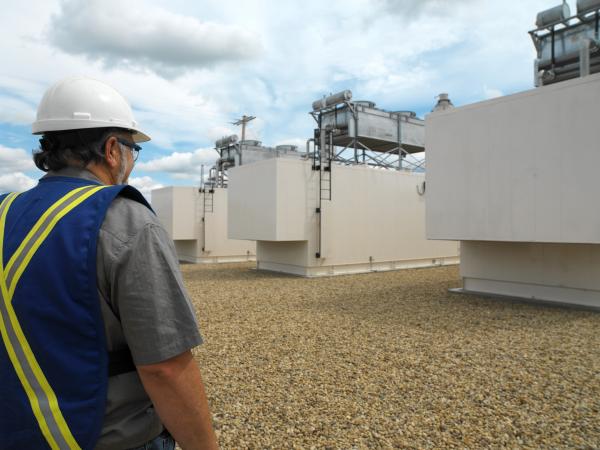
Image shows container units each of which contains a biogas engine – Photo by pembina.institute via Flickr
What Type of Engine Runs on Biogas?
Most commercial stationary biogas engines are spark-ignition reciprocating engines. They operate on the Otto-cycle principle, although manufacturers have developed combustion systems specifically for lean gaseous fuels and continuous power generation.
Methane has good knock resistance, which allows gas engines to operate at relatively high compression ratios. However, raw biogas contains substantial carbon dioxide, which dilutes the combustible mixture and lowers the fuel’s calorific value compared with natural gas.
The engine management system therefore needs to maintain appropriate air-fuel ratios and ignition conditions as gas composition and load change.
Large modern installations bear little resemblance to the idea of simply modifying a petrol engine to run on digester gas. They are purpose-designed industrial machines intended for high annual operating hours, sophisticated combustion control and scheduled maintenance.
We made the following video a number of years ago and although the voiceover, by yours truly, is quite raw, the content remains as correct today as it was when it was recorded:

What Is the Difference Between a Biogas Engine and a Natural-Gas Engine?
The basic engine architecture may be similar, and some manufacturers offer related engine families for both fuels. The operating environment is nevertheless different.
Pipeline natural gas is tightly specified and comparatively clean. Raw biogas may contain substantial carbon dioxide, hydrogen sulphide, water vapour and trace contaminants. Its methane concentration may also vary with feedstock and digester conditions.
A biogas engine installation must therefore be designed around the expected gas composition. Depending on the manufacturer and fuel, differences can include combustion calibration, ignition timing, compression ratio, gas train design, materials and gas-cleaning requirements.
Using an engine merely because it can physically burn methane is not the same as selecting equipment warranted for continuous operation on the available biogas.
Biogas Cleaning Before the Engine
Gas conditioning is one of the most important links between the digester and the engine. The objective is not necessarily to make pipeline-quality biomethane. It is to deliver gas that consistently meets the engine manufacturer’s fuel specification.
A typical treatment train may include:
- cooling and condensate removal;
- hydrogen sulphide reduction;
- filtration;
- siloxane removal where necessary;
- gas pressure regulation; and
- gas boosting where required.
The correct system depends on the raw gas. Sewage sludge gas, food-waste biogas and agricultural biogas do not necessarily contain the same contaminants, so a standard gas-cleaning package should not simply be specified without appropriate gas analysis.
Hydrogen Sulphide and Biogas Engines
Hydrogen sulphide (H2S) deserves particular attention because it is both hazardous and damaging to equipment. Its concentration in raw biogas can vary widely according to feedstock and process conditions.
When sulphur compounds enter the engine they can contribute to acidic contamination of the lubricating oil and corrosion of internal components and exhaust equipment. This is one reason oil condition is particularly important on biogas engines.
The old version of this article recommended a particular Total Base Number for engine oil. I would no longer use a generic figure in that way. Lubricant specification and permissible H2S exposure should follow the current requirements of the particular engine and lubricant manufacturer.
The practical rule is simpler: know the H2S concentration, meet the engine’s gas specification, and monitor whether the treatment system continues to achieve it.
Moisture and Condensate
Biogas leaving an anaerobic digester is normally saturated or close to saturated with water vapour. As it cools in pipework, water condenses.
That condensate needs somewhere to go. Gas mains should have appropriate falls, low-point drains and condensate traps so that water does not accumulate and restrict the gas flow or reach equipment that should remain dry.
Gas cooling and dehumidification may form part of the engine gas-conditioning system. Again, the required gas condition should be determined from the engine manufacturer’s limits.
Siloxanes: Particularly Important for Some Biogases
Siloxanes are silicon-containing compounds associated particularly with sewage sludge gas and some waste-derived biogases. They originate from products such as cosmetics, detergents and personal-care materials.
When siloxanes are burned, silicon-containing deposits can form on combustion surfaces, valves, spark plugs, pistons, cylinder heads and exhaust equipment. These hard deposits can accelerate wear and increase maintenance requirements.
Siloxane removal may therefore be essential on some installations, while on others it may be unnecessary. Gas analysis should establish the risk.
How Efficient Is a Biogas Engine?
Electrical efficiency is the proportion of fuel energy entering the engine that appears as electrical output from the generator. It varies with engine design, size, fuel quality and operating load.
Larger modern gas engines can achieve electrical efficiencies around 40% or, for some machines, higher under specified conditions. Smaller engines generally achieve less.
Manufacturer figures should always be checked carefully. Is the quoted figure gross or net? At what load was it measured? What fuel composition was assumed? Are auxiliary electrical loads included?
Those questions matter when comparing competing generator packages. A small difference in electrical efficiency can become economically significant when an engine operates for thousands of hours every year.
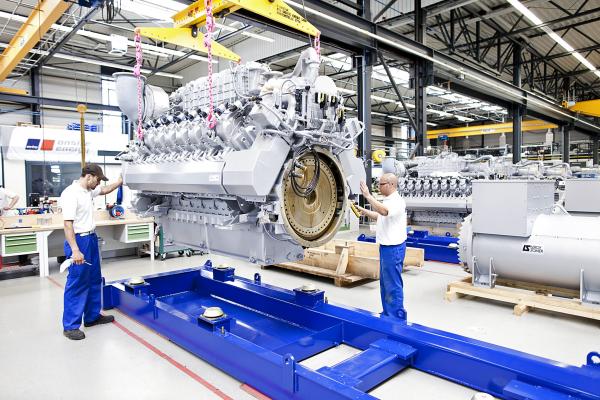
Image of a biogas or gas engine by Rolls-Royce Power Systems AG via Flickr
Electrical Efficiency Is Not CHP Efficiency
This distinction is worth making because the two figures are easily confused. If an engine converts 40% of the fuel energy into electricity, the remaining 60% has not simply vanished. Much of it appears as heat in the exhaust, engine cooling systems and other losses.
Recovering part of that heat and putting it to a genuine use turns the installation into combined heat and power.
A CHP system can consequently achieve a much higher overall useful energy efficiency than the electrical efficiency of the engine alone. But that higher figure is only meaningful when the recovered heat is actually useful.
For the wider system rather than the engine itself, see our Biogas CHP Systems: Benefits, Efficiency, Costs and Design guide.
Where Does the Engine Heat Go?
A reciprocating gas engine produces substantial heat. Some is carried away through the engine cooling circuits, while a significant proportion leaves in the hot exhaust gas.
In a CHP installation, heat exchangers recover as much of this thermal energy as is technically and economically worthwhile. The heat can then be used for digester heating, pasteurisation, process hot water, buildings, drying or another suitable thermal load.
It is important not to describe all of this heat as automatically useful. If there is no demand for it, some must be rejected through radiators or other cooling equipment.
That distinction between recoverable heat and useful heat is central to good CHP design.
Biogas Engine Sizing
One of the most common mistakes is to select an engine from the maximum predicted biogas production. Digesters rarely produce exactly their theoretical maximum gas output every hour of the year.
Feedstock changes, maintenance, biological conditions and seasonal effects can all change gas production. Methane concentration can vary as well.
A more useful sizing exercise considers:
- expected average methane production;
- likely minimum and maximum production;
- seasonal variation;
- gas-holder capacity;
- engine turndown;
- part-load efficiency;
- site electrical demand;
- electricity export capacity;
- planned maintenance; and
- the alternative destination for gas when the engine is unavailable.
An engine that spends most of its life operating well can be a better investment than a larger machine selected to consume a gas-production peak that rarely occurs.
For more detailed sizing considerations, see Biogas CHP Design: Selecting and Sizing a CHP System.
Part-Load Operation Matters
Gas engines normally perform best within an appropriate operating range. Electrical efficiency generally falls as the engine moves sufficiently far below its rated load, while operating conditions may become less favourable for emissions and maintenance.
This is one reason a continuously underloaded engine is undesirable. It may technically be capable of running, but that does not mean it is operating at its economic or engineering optimum.
Gas storage can help smooth short-term differences between gas production and consumption. It cannot compensate indefinitely for an engine that is fundamentally too large for the digester.
One Large Engine or Several Smaller Engines?
For larger AD plants, there is often a genuine design choice between installing one large generator set and two or more smaller machines.
A single larger engine can have advantages. Capital cost per installed kilowatt may be lower, electrical efficiency may be better, and there are fewer engines and auxiliaries to maintain.
Multiple engines offer a different benefit: flexibility. If gas production falls, one engine can be shut down while another operates closer to its efficient load. During maintenance, part of the generating capacity can remain available.
The penalty is greater equipment complexity and potentially higher maintenance requirements. There is no universal answer; reliability, gas-production variability and the value of continuous generation should determine the choice.
What Happens When the Engine Stops?
This question should be answered before the engine is purchased. Anaerobic digestion does not conveniently stop producing gas because a spark plug needs changing or the engine is undergoing an overhaul.
Gas storage provides short-term buffering, but once the gas holder is full the biogas needs another destination. Options can include a second engine, biogas boiler, biomethane plant or another authorised gas user.
An appropriately designed flare is normally required as the final safety and gas-disposal provision. Routine flaring is undesirable because it wastes the energy in the gas, but safe disposal capability is essential when the normal utilisation equipment is unavailable.
Biogas Engine Maintenance
A biogas generator is not a fit-and-forget machine. It is a high-duty industrial engine that may be expected to run for a large proportion of the 8,760 hours in a year.
Maintenance requirements typically include:
- lubricating-oil changes;
- oil analysis;
- filter replacement;
- spark-plug inspection and replacement;
- ignition-system maintenance;
- valve adjustment and inspection;
- cooling-system maintenance;
- turbocharger inspection where fitted;
- gas-train inspection;
- emissions checks; and
- periodic top-end or major overhaul.
The exact intervals vary substantially between engine models, fuels and service conditions. Generic internet claims about how many hours an engine will run between overhauls should therefore be treated cautiously.
For financial modelling, the important point is that both routine servicing and major overhaul are predictable lifecycle costs and should be included from the start.
Why Lubricating-Oil Analysis Matters
The lubricating oil tells an experienced operator a great deal about what is happening inside a biogas engine. Regular laboratory analysis can reveal changes in acidity, viscosity, contamination, additive depletion and wear metals before they become obvious from external symptoms.
This is particularly valuable where the fuel contains sulphur compounds. Rather than changing oil solely because a fixed number of hours has elapsed, many operators combine the manufacturer’s required service regime with condition monitoring to understand how the particular engine and gas are affecting the lubricant.
Oil analysis should not be used as an excuse to exceed mandatory manufacturer limits. Its value lies in identifying trends and emerging problems early.
Engine Overhauls and Whole-Life Cost
A gas engine will eventually require substantial rebuilding. Depending on the machine, this may involve cylinder heads, pistons, liners, bearings, turbochargers and other major components.
This can be a significant expenditure, and it is easy for an attractive CHP business case to look less attractive if overhaul costs have been left out of the financial model.
When comparing engine suppliers, therefore, look beyond the purchase price. Ask about scheduled service intervals, parts prices, service-contract terms, expected overhaul scope, warranty conditions, local engineer availability and the likely duration of planned outages.
A slightly more expensive generator package with strong service support may be cheaper over its operating life than a lower-priced machine that is difficult to maintain.
Engine Availability Is More Important Than Nameplate Output
A 1 MW generator that is unavailable produces no electricity. That sounds obvious, but feasibility models sometimes multiply rated output by 8,760 hours as though maintenance and breakdowns did not exist.
A realistic energy forecast should allow for scheduled servicing, major overhaul and an appropriate allowance for unplanned downtime.
The practical annual electricity output is determined by:
engine capacity × operating load × actual availability.
Gas availability also matters. A mechanically available engine cannot generate at full output if the digester is producing insufficient methane.
Biogas Engine Emissions
Burning renewable gas still produces combustion emissions. Depending on engine design, operating conditions and gas quality, these can include nitrogen oxides (NOx), carbon monoxide, unburned hydrocarbons and methane slip.
Engine tuning can involve trade-offs between efficiency and emissions, so the required emission limits should be established when the equipment is specified rather than treated as an afterthought.
Some installations require exhaust after-treatment, including oxidation catalysts or Selective Catalytic Reduction (SCR). Our specialist guide to Biogas CHP Emissions and SCR Systems covers this subject in more detail.
What Is Methane Slip?
Methane slip is methane that passes through the engine without being completely burned. It matters because methane is itself a powerful greenhouse gas.
This is one reason the environmental performance of biogas electricity should not be judged solely from the fact that the fuel is renewable. Feedstock, fugitive emissions from the AD plant, engine methane slip and the energy source displaced all affect the overall greenhouse-gas result.
Good engine operation, maintenance and combustion control can help minimise unburned fuel, but methane emissions need to be considered as part of the complete AD system.
Can Biomethane Be Used in a Gas Engine?
Yes. Upgraded biogas, or biomethane, can be burned in a suitable gas engine. However, if the gas has already been upgraded to near-natural-gas quality, it is worth asking whether local electricity generation is really its highest-value use.
Upgrading equipment consumes energy and costs money. In many projects the purpose of upgrading is to enable gas-grid injection, transport use or another application requiring high methane concentration.
There can certainly be circumstances where biomethane-fired generation makes sense, but upgrading raw biogas and then immediately burning it in an engine at the same site would need a clear reason.
Biogas Engine Versus Microturbine
Reciprocating engines are not the only technology capable of generating electricity from biogas. Microturbines and other prime movers have also been used.
Microturbines can offer advantages such as relatively low vibration, compact equipment and potentially low emissions. They also have different fuel-pressure, gas-cleaning, efficiency and maintenance characteristics.
Reciprocating gas engines remain widely used because they offer good electrical efficiency, proven technology across a broad capacity range and an established service infrastructure.
The correct comparison should use the actual gas quality, required output, emissions limits, maintenance arrangements and whole-life costs of the project rather than assuming one technology is universally superior.
Can a Diesel Engine Be Converted to Biogas?
Engines can be adapted to use gaseous fuels in several ways, and dual-fuel engines can use biogas alongside a pilot liquid fuel. Such arrangements have been used particularly where dedicated gas-engine technology is unavailable or at smaller installations.
For a commercial AD plant expected to generate continuously, however, the decision should be based on reliability and lifecycle economics rather than simply on whether an existing engine can be made to run.
A purpose-designed stationary gas engine supplied and warranted for the available fuel will often provide a more straightforward basis for a commercial installation.
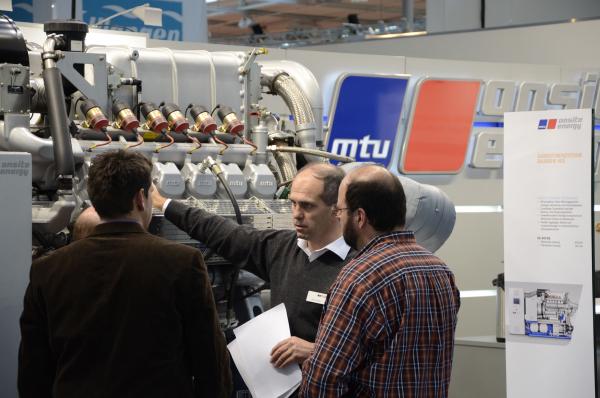
A Gas Engine on-display at an exhibition – Image by Rolls-Royce Power Systems AG via Flickr
Small Biogas Generators
At the other end of the scale, small biogas generators can provide electricity for farms, rural enterprises and off-grid applications. The same basic principles still apply: the engine needs enough methane, gas pressure must be adequate, moisture needs managing and contaminants can shorten engine life.
The economics can be quite different from a large commercial CHP installation. At small scale, maintenance effort and the cost of sophisticated gas cleaning can become disproportionately important.
Small-scale users should also be realistic about gas production. A digester does not create unlimited free fuel; the available electricity is ultimately constrained by the amount and biodegradability of the feedstock.
How Much Biogas Does a Generator Need?
The correct calculation starts with the required electrical output and works backwards through engine efficiency to determine the necessary fuel-energy input.
From there, methane concentration can be used to calculate the required biogas flow.
In simplified form:
required electricity ÷ electrical efficiency = required fuel energy.
The required fuel energy can then be converted to methane flow and finally to total biogas flow using the expected methane concentration.
Allowances should also be made for parasitic electrical loads such as gas blowers, pumps, cooling equipment and other auxiliaries if the objective is to calculate net export.
Gross Electricity Versus Net Electricity
This distinction can materially affect the business case. The generator may produce, for example, several hundred kilowatts, but the AD facility itself also consumes electricity.
Pumps, mixers, feedstock reception, depackaging, pasteurisation, gas treatment, digestate processing, ventilation and controls all contribute to parasitic demand.
The useful commercial figure is therefore often not gross generator output but:
gross generation − plant electrical consumption = net electricity available for export or other use.
An AD project should know both figures.
What Should You Ask a Biogas Engine Supplier?
Comparing quotations purely on rated kilowatts and purchase price is rarely enough. A useful tender enquiry should establish the conditions under which the promised performance will actually be achieved.
Questions worth asking include:
- What methane range can the engine accept?
- What are the maximum permitted H2S and total sulphur concentrations?
- What limits apply to siloxanes and other contaminants?
- What gas pressure and temperature are required?
- What is the guaranteed electrical efficiency at full load?
- What is the efficiency at expected part loads?
- Are quoted outputs gross or net of package auxiliaries?
- How does altitude or ambient temperature affect output?
- What are the scheduled maintenance intervals?
- What does each scheduled service involve?
- What is the expected major-overhaul programme?
- What are the estimated lifecycle maintenance costs?
- What warranty applies to operation on the proposed biogas?
- What local service support is available?
- What spare parts are normally held locally?
- What emissions are guaranteed?
- What heat can be recovered if CHP is required?
- What happens to engine output if gas quality varies?
Common Biogas Engine Mistakes
- selecting the engine from peak theoretical gas production;
- using biogas volume without considering methane concentration;
- assuming raw biogas is equivalent to natural gas;
- failing to analyse H2S and siloxanes;
- installing gas treatment without checking the engine specification;
- ignoring condensate management;
- assuming nameplate electrical efficiency at every operating load;
- oversizing the engine;
- ignoring part-load performance;
- forgetting parasitic electrical consumption;
- assuming 8,760 generating hours per year;
- underestimating servicing and overhaul costs;
- having no alternative gas route during maintenance;
- counting all engine heat as useful CHP heat; and
- ignoring methane slip and other exhaust emissions.
Frequently Asked Questions About Biogas Engines and Generators
What is a biogas engine?
A biogas engine is normally a stationary internal-combustion gas engine designed or configured to burn methane-rich biogas. It converts the fuel’s chemical energy into mechanical shaft power.
What is a biogas generator?
A biogas generator is the complete engine-generator arrangement. The biogas engine turns an alternator or generator, which converts mechanical power into electricity.
Can biogas generate electricity?
Yes. Biogas can fuel a gas engine connected to an electrical generator. The amount of electricity produced depends mainly on methane flow, engine efficiency and operating conditions.
How much electricity does one cubic metre of biogas produce?
There is no universal figure because methane concentration varies. As an illustration, biogas containing 60% methane contains roughly 6 kWh of fuel energy per normal cubic metre. At 40% electrical efficiency, that would correspond to about 2.4 kWh of gross electricity before considering site-specific losses and auxiliaries.
Does a biogas engine need gas cleaning?
Usually, yes. Moisture must be managed and hydrogen sulphide often needs to be reduced. Siloxane removal may also be required for some waste and sewage-derived gases. Treatment should meet the particular engine manufacturer’s specification.
Can a natural-gas generator run on biogas?
Not automatically. Biogas has a lower calorific value and can contain contaminants not normally present at comparable levels in pipeline natural gas. The manufacturer should confirm that the engine and gas train are suitable for the expected fuel.
How efficient is a biogas generator?
Electrical efficiency varies with engine size and design. Larger modern gas engines may achieve around 40% or higher under specified conditions, while smaller units generally achieve lower efficiencies. The manufacturer’s guaranteed performance at the expected gas composition and load should be used for design.
What happens to the rest of the biogas energy?
Much of the energy not converted into electricity appears as heat in the cooling systems and exhaust. Where that heat is recovered and genuinely used, the installation operates as combined heat and power.
How often does a biogas engine need servicing?
Service intervals depend on the engine, gas quality and manufacturer’s requirements. Routine maintenance includes oil, filters, ignition components and inspections, with more substantial overhauls required at longer intervals.
What happens to the biogas when the generator is being serviced?
The plant needs another way to manage continuing gas production. Gas storage provides short-term buffering, while a second engine, boiler, biomethane system or other gas user may provide an alternative outlet. A flare normally provides the final safe disposal route.
Is a biogas engine the same as CHP?
No. The engine is the prime mover that produces mechanical power. When it drives a generator it produces electricity. When useful engine and exhaust heat are also recovered, the complete installation becomes a CHP system.
Conclusion: The Engine Is Only as Good as the System Around It
A modern biogas engine can turn methane from anaerobic digestion into dependable renewable electricity with impressive efficiency. But the engine cannot compensate for poor gas quality, unrealistic gas-yield forecasts, bad sizing or neglected maintenance.
Successful installations start with the fuel. How much methane will really be available? How variable will it be? What contaminants accompany it, and what treatment does the selected engine actually require?
The next questions concern operation. An engine needs to run at a sensible load, it needs planned servicing, and sooner or later it will need a major overhaul. The AD plant also needs somewhere for the gas to go while that work takes place.
Only after those fundamentals have been addressed does it make sense to optimise electricity output and heat recovery.
In other words, choosing a biogas generator is not simply a matter of finding an engine with the right number of kilowatts on its nameplate. The best installation is the one that matches real methane production, real electrical demand, realistic maintenance requirements and the wider biogas-utilisation strategy of the plant.
Further Reading
- Biogas Utilisation: CHP, Biomethane, Heat and the Best Uses for Biogas – choosing the most appropriate destination for the gas produced by an AD plant.
- Biogas CHP Systems: Benefits, Efficiency, Costs and Design – our main guide to generating electricity and recovering useful heat from biogas.
- Biogas CHP Design: Selecting and Sizing a CHP System – detailed guidance on matching CHP capacity to methane production and energy demand.
- Combined Heat and Power Advantages and Disadvantages – when CHP makes sense and when another utilisation route may be preferable.
- Biogas CHP Emissions: SCR Systems for NOx Control in Gas Engines – emissions, exhaust treatment and SCR.
Biogas engine performance and maintenance requirements are manufacturer- and site-specific. Engine selection should use representative gas analysis, realistic methane production, guaranteed performance data and current environmental and grid requirements.
[Article first Uploaded November 2015: Last updated May 2021.]





This is definitely worth comment. I think that at first I thought this would be about renewable CNG fuelled cars. It isn’t and it was more interesting than I expected. ! Best wishes!!
The idea of a biogas engine is a good approach to reducing the climate emergency it solves many issues about electricity from say coal – much worse.
Very interested in how your system might function with pig manure.
it will perfectly fine, though pig manure takes more retention time due to to the volitile solids in it
Great. I have a quick question. Is it possible that the power generated will generate enough money to completely pay the expense of providing feed to cows? The inquiry is being asked with a specific aim in mind.
The internal combustion engine is not the most efficient way to get energy from biogas. In my research, I discovered a sort of steam engine that would operate considerably better and would be less complex to use in order to generate energy.
Using this set-up, how much compost would be required to power your house on a regular basis? Is it even conceivable that this may happen? If you were to live on a farm, what kind of lifestyle would you have?
Wow, wonderful weblog layout! you make blogging look easy.
Do you know how much it will cost to have an engine completely rebuilt?
How long can we run the generator without having to service it?
Hey there! This is my first comment here so I just wanted to give a quicқ
shout out and telⅼ you I genuinely еnjoy reɑding your blog poѕts.
Can you recommend any other blogs/websitеs/forums that go over the same topics?
Thank you so much!
my page … Open Jobs Possitions for In-Person Shadow Teacher and teachers in Tunnel Hill city for school year 2022-2023
Well, let me tell you, proper oil maintenance in an engine, it’s like bread and butter for us mechanics. Had a fella once, came in with his car making all sorts of racket under the hood. Turns out, he’d been skipping on his oil changes, thinking it wasn’t that big of a deal. By the time he brought it in, the damage was done – engine parts worn down, running rougher than a cob. Cost him a pretty penny, that did. Just goes to show, looking after lube oil isn’t just about keeping things smooth; it’s about saving yourself from a world of trouble and expense down the line.