



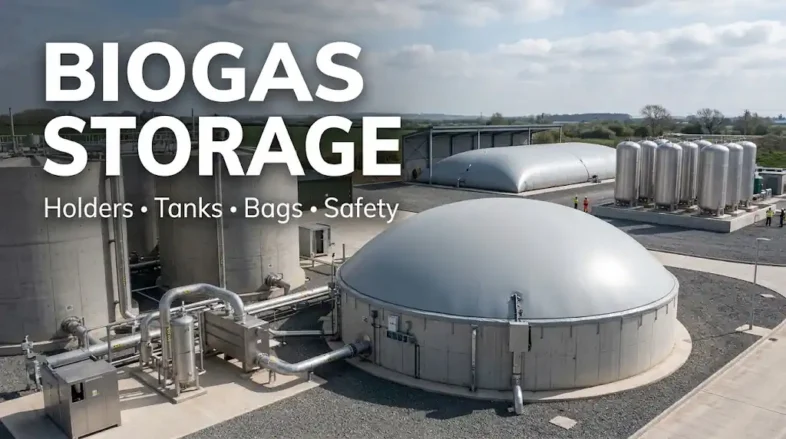
Biogas storage provides a buffer between continuous gas production and the sometimes variable demand for that gas. Anaerobic digesters normally produce biogas around the clock, while CHP engines, boilers, upgrading plants and other gas users may shut down, operate at reduced load or experience periods of higher and lower demand.
For that reason, almost every commercial anaerobic digestion plant requires some form of short-term biogas storage.
The most common systems range from large double-membrane gas holders on commercial AD plants to stand-alone flexible holders, storage tanks and small biogas storage bags or balloons used with domestic and community digesters.
However, not all gas-storage technologies are interchangeable. Raw biogas is usually stored at very low pressure and for relatively short periods, whereas cleaned and upgraded biomethane is much better suited to compression, transport and use within existing natural-gas infrastructure.
This guide explains the principal biogas storage methods, how commercial gas holders work, when storage tanks or flexible bags are appropriate, the difference between raw biogas and biomethane storage, and the safety and design factors that should be considered.
Key Takeaways
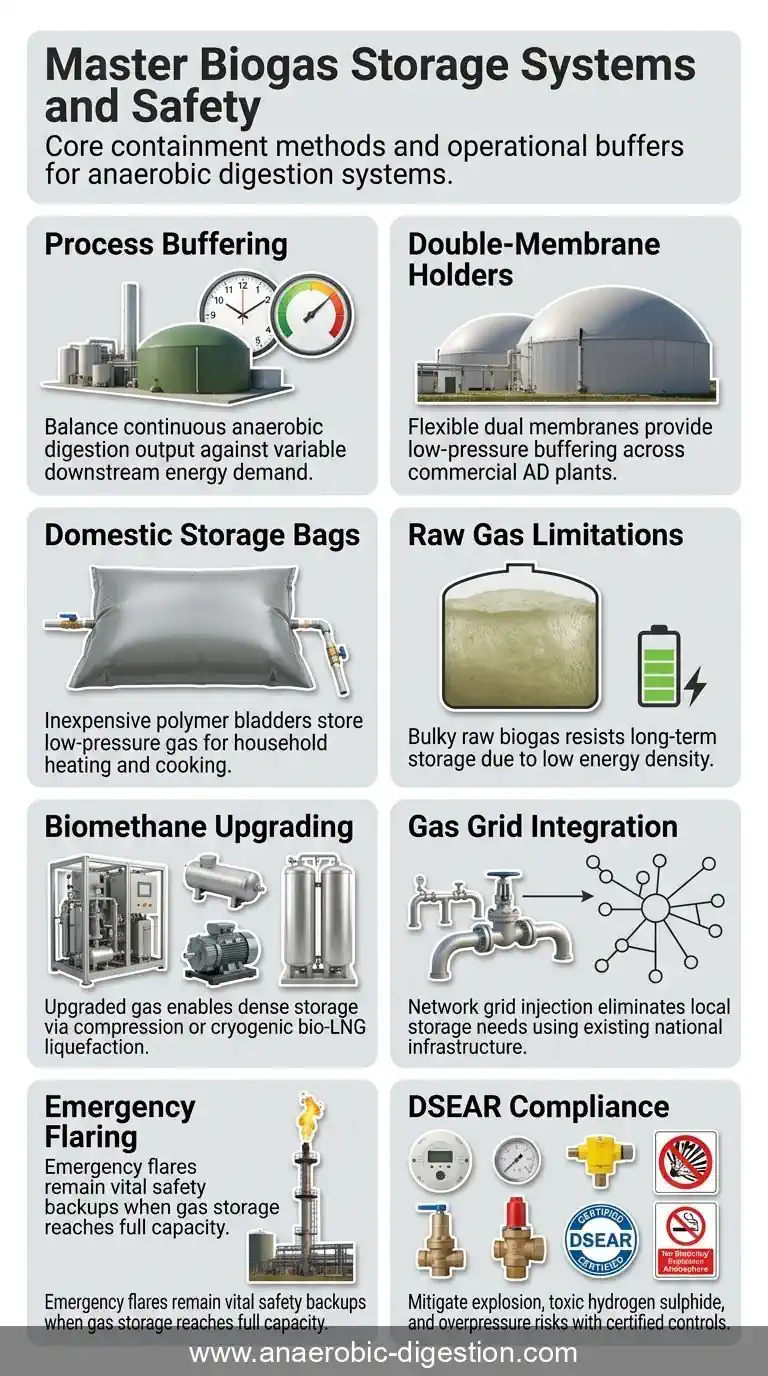
- Commercial AD plants normally store raw biogas at low pressure for short periods. Gas holders are principally process buffers rather than long-term energy stores.
- Double-membrane gas holders are widely used on modern anaerobic digestion plants because they combine flexible storage volume with low-pressure control.
- Biogas storage tanks, bags and balloons describe very different products. Their appropriate use depends heavily on gas pressure, scale and gas quality.
- Small biogas storage bags are usually low-pressure systems for domestic or community-scale digesters. They should not be confused with the large engineered gas holders used on commercial AD plants.
- Raw biogas is difficult to store economically for long periods because its energy density is low at typical gas-holder pressures and because it contains CO2, moisture and potentially corrosive contaminants.
- Upgrading biogas to biomethane changes the storage options dramatically. Biomethane can be compressed, liquefied or injected into the gas network.
- A gas holder does not remove the need for an emergency flare. If gas production continues after storage is full and downstream users are unavailable, surplus gas still requires a safe disposal route.
- Biogas storage is a safety-critical part of an AD plant. Methane flammability, hydrogen sulphide toxicity, pressure control, leak detection and DSEAR/ATEX considerations must be addressed by competent designers and operators.
What Is Biogas Storage?
Biogas storage means temporarily holding gas produced by anaerobic digestion until it can be used, treated, upgraded or transported.
Storage may be required because biological gas production and gas consumption rarely match perfectly from minute to minute.
A digester cannot normally stop producing biogas immediately just because:
- a CHP engine trips;
- a boiler shuts down;
- a biomethane upgrader reduces throughput;
- grid injection is interrupted;
- gas demand falls; or
- maintenance is taking place.
Storage therefore acts as an operational buffer between the biological process and the gas-utilisation system.
Why Do Anaerobic Digestion Plants Need Biogas Storage?
Several functions can justify storage.
Balancing Continuous Gas Production
Anaerobic digestion is a continuous biological process. Gas production fluctuates, but generally continues throughout the day and night.
Gas-consuming equipment may not.
A storage volume therefore helps prevent every short-term mismatch between production and use from immediately causing flaring.
Allowing Short Maintenance Interruptions
If a CHP engine or upgrading system is briefly unavailable, some of the biogas produced during the interruption may be accommodated in the holder.
This can give operators valuable time to restore downstream equipment.
Smoothing Gas Flow
Digesters do not always produce gas at precisely constant rates. Feed cycles, mixing, temperature and substrate characteristics can all influence instantaneous production.
Storage helps smooth these variations before gas reaches downstream equipment.
Peak-Power Generation
In some configurations, larger storage capacity allows biogas to be accumulated and then used to operate CHP equipment at periods when electricity has greater value.
This is a specialist commercial strategy rather than the normal purpose of a small process gas holder.
See our dedicated article on biogas storage and peak-power generation economics for a fuller discussion.
Main Biogas Storage Methods
| Storage Method | Typical Application | Typical Pressure | Main Purpose |
|---|---|---|---|
| Double-membrane gas holder | Commercial AD plants | Low | Short-term process buffering |
| Stand-alone membrane holder | Commercial AD / wastewater treatment | Low | Additional gas storage |
| Flexible storage bag or balloon | Home and community biogas | Very low | Small-scale temporary storage |
| Rigid pressurised storage vessel | Cleaned or upgraded gas | Medium/high | Compact gas storage |
| Bio-CNG storage | Vehicle fuel / biomethane | High | Fuel storage and transport |
| Bio-LNG storage | Transport / larger biomethane systems | Cryogenic | High-energy-density storage |
| Gas grid | Upgraded biomethane | Network pressure | Distribution and effective system-scale storage |
Commercial Biogas Holders
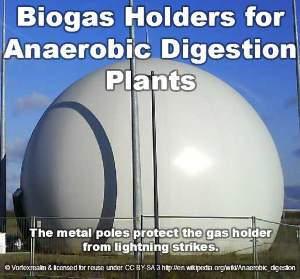
The most familiar form of commercial AD gas storage is the biogas holder.
Modern holders are commonly constructed using flexible membranes and operate at relatively low gas pressure.
They may be:
- mounted directly above a digester;
- installed over a separate storage vessel; or
- constructed as stand-alone membrane storage units.
The holder provides a variable gas volume while also helping to maintain the controlled pressure required by the downstream gas system.
For detailed coverage of holder construction, membranes, pressure control and suppliers, see our separate article:
Biogas Holder Design for Commercial CSTR Anaerobic Digestion Plants
Double-Membrane Biogas Storage
A common modern arrangement is the double-membrane gas holder.
Although designs vary, the system typically has:
- an inner flexible membrane containing the biogas;
- an outer weather-resistant membrane;
- a controlled air space between the membranes;
- support-air fans;
- pressure regulation;
- gas-level measurement; and
- safety and alarm systems.
The inner membrane rises and falls as storage volume changes.
The outer membrane provides structural support and weather protection, while controlled air pressure helps maintain the external shape of the holder.
This allows considerable gas volume to be stored without compressing the raw biogas to high pressure.
What Does a Biogas Holder Actually Do?
A biogas holder performs more than one function.
It provides:
- short-term storage volume;
- pressure buffering;
- flow balancing;
- temporary accommodation during equipment interruptions;
- a measurable indication of available stored gas; and
- part of the control interface between the digester and downstream gas users.
The gas holder should therefore be considered part of the process-control system rather than merely an inflatable storage container.
How Much Gas Does a Commercial Biogas Holder Store?
There is no universal correct storage volume.
Commercial biogas holders are commonly designed to provide only a limited number of hours of gas production rather than days or weeks of storage.
The required volume depends on:
- maximum and average biogas production;
- CHP or upgrading-system capacity;
- downstream turndown;
- maintenance philosophy;
- number of digesters;
- plant redundancy;
- acceptable flare operation;
- whether peak-power generation is intended; and
- the permitted operating-pressure range.
Our detailed biogas holder design article discusses holder sizing and design in more detail.
Biogas Storage Tanks
The phrase “biogas storage tank” is frequently searched online, but it can be misleading because several very different systems are described using that term.
A commercial digester tank may itself support a membrane gas holder above the liquid.
A separate rigid vessel may also carry a membrane holder.
Alternatively, cleaned or upgraded gas may be stored in a true pressure vessel.
Those are not equivalent technologies.
Low-Pressure Biogas Storage Tanks
For raw biogas, large low-pressure storage volumes are usually more practical than high-pressure vessels because the gas contains substantial carbon dioxide and often water vapour and contaminants.
At low pressure, however, storing large quantities requires considerable physical volume.
Pressurised Biogas Storage Tanks
Compressing raw biogas is technically possible, but it increases:
- compression energy;
- equipment complexity;
- pressure-vessel requirements;
- gas-cleaning requirements;
- safety requirements; and
- capital cost.
For that reason, high-pressure storage is generally much more attractive after the gas has been cleaned and upgraded to biomethane.
Biogas Storage Bags
Biogas storage bags are flexible low-pressure containers used mainly for small-scale, domestic and community biogas systems.
They can store gas that is surplus to immediate cooking or heating requirements.
Depending on the product, bags may be made from flexible polymer-coated fabrics or other gas-resistant membrane materials.
Their advantages can include:
- low capital cost;
- simple construction;
- very low operating pressure;
- portability at smaller sizes; and
- easy connection to small digesters.
But they also require careful protection from:
- puncture;
- UV degradation;
- fire;
- sharp objects;
- overpressure;
- poorly ventilated spaces; and
- damage during transport or handling.
For detailed coverage of this specific type of storage, see our guide:
Home Biogas Storage Bags and Balloons.
Biogas Storage Balloons
The term “biogas storage balloon” is commonly used for the same general type of flexible low-pressure container as a biogas storage bag.
The terminology varies by manufacturer and country.
A balloon may be:
- cylindrical;
- pillow-shaped;
- rectangular;
- suspended;
- placed within a protective enclosure; or
- incorporated into a small digester system.
The crucial distinction is not whether the manufacturer calls it a bag or balloon.
The important engineering questions are its material, rated pressure, gas compatibility, UV resistance, volume, connections and safety arrangements.
Biogas Storage Bag and Balloon Prices
Searches for biogas storage bag price and biogas storage balloon price are common, particularly from small-scale users.
Prices vary substantially according to:
- storage capacity;
- membrane material;
- UV resistance;
- fabric reinforcement;
- rated pressure;
- valves and fittings;
- country of manufacture;
- shipping; and
- whether the bag is supplied as part of a complete digester system.
Purchase decisions should not be based on price alone. A low-cost container intended for another gas or liquid may not be suitable for methane-containing biogas.
Always use equipment specifically rated by its manufacturer for the intended gas, pressure and operating environment.
How to Store Biogas at Home
Small home digesters usually produce gas at very low pressure.
Suitable storage methods can include:
- integral flexible gas chambers;
- purpose-made low-pressure biogas bags;
- purpose-made gas balloons; and
- other manufacturer-approved low-pressure storage systems.
The emphasis should remain on low pressure, ventilation, ignition control and suitable gas-compatible materials.
For a fuller safety-focused discussion, read:
How to Store Biogas at Home: Safety, Methods and Products.
Biogas Storage for Peak-Power Generation
Most AD plants attempt to use biogas continuously.
However, there are situations where greater storage volume can allow operators to shift electricity generation toward periods of higher power demand or stronger electricity prices.
This can potentially increase the economic value of CHP generation without changing the underlying biological gas-production rate.
For example:
Digester → continuous biogas production → temporary storage → CHP operation during higher-value periods.
That strategy requires significantly more storage than ordinary short-term process buffering and should be evaluated against:
- additional holder capital cost;
- CHP oversizing;
- generator start-stop requirements;
- electricity-price structure;
- network constraints;
- gas-holder pressure; and
- the value of dispatchable generation.
See our specialist article on biogas storage and peak-power generation.
Can Raw Biogas Be Stored for Days or Weeks?
It can be stored, but long-term storage of large quantities of raw biogas is usually unattractive at typical AD-plant pressures.
The reason is principally volume.
Raw biogas stored at low pressure occupies a very large space relative to the amount of energy contained within it.
Longer storage periods therefore require:
- very large membrane holders; or
- compression into smaller pressure vessels.
The first option can become physically and economically impractical.
The second introduces compression, gas cleaning, pressure vessels and substantially more demanding safety requirements.
That is why most commercial AD plants use raw-gas holders primarily for hours rather than long-duration energy storage.
Raw Biogas Storage vs Biomethane Storage
This distinction is fundamental.
| Characteristic | Raw Biogas | Biomethane |
|---|---|---|
| Methane concentration | Moderate | High |
| CO2 | Substantial | Mostly removed |
| Water vapour | Often saturated | Controlled / dried |
| H2S | May be significant | Reduced to specification |
| Typical storage | Low-pressure holder | Grid, compressed gas or LNG |
| Energy density | Lower | Higher |
Upgrading removes much of the CO2 and contaminants that make raw biogas bulky and difficult to handle.
For a detailed explanation, see our pillar guide to biogas upgrading technologies.
Compressed Biomethane Storage
Once biogas has been upgraded, biomethane can be compressed in much the same way as natural gas.
This enables storage for:
- Bio-CNG refuelling;
- vehicle fleets;
- transport to off-grid customers;
- buffer storage before dispensing; and
- some industrial applications.
This involves genuine high-pressure gas storage and should be engineered using appropriate pressure-vessel, gas-quality and safety standards.
Liquefied Biomethane Storage
Biomethane can also be cooled to cryogenic temperatures to create liquefied biomethane or bio-LNG.
Liquefaction dramatically increases the amount of energy that can be stored within a given volume compared with low-pressure raw biogas.
However, the equipment is more complex and includes:
- deep refrigeration;
- cryogenic storage vessels;
- boil-off management;
- specialist pipework; and
- additional safety systems.
This is principally relevant to transport fuel and larger commercial biomethane applications.
Is the Gas Grid a Form of Biogas Storage?
Once biogas has been upgraded to biomethane and meets the relevant network requirements, injection into the gas network provides a fundamentally different approach from storing raw gas at the AD plant.
The gas is no longer confined to an individual site’s holder.
Instead, it enters a much larger interconnected gas system.
In that sense, biomethane grid injection removes much of the need for dedicated long-duration raw-biogas storage at the production site.
In Great Britain, biomethane for grid injection must meet applicable gas-quality and network-entry requirements, including compliance with the Gas Safety (Management) Regulations and the network operator’s entry arrangements.
See the Environment Agency’s current biomethane-from-waste resource framework for current requirements.
Biogas Storage and Energy Security
Storage also helps illustrate one of the characteristics that distinguishes biogas from intermittent renewable electricity.
The energy exists first as a combustible gas and can be held temporarily before use.
This gives operators some ability to decouple the precise time of gas production from the precise time of energy conversion.
At individual AD plants the storage period may be relatively short, but after upgrading to biomethane the gas can use much larger gas-distribution and storage infrastructure.
This makes anaerobic digestion relevant not only to decarbonisation and waste treatment, but also to local energy production and energy-system resilience.
Biogas Storage Safety
Biogas storage should always be regarded as a hazardous-gas installation.
Raw biogas may contain:
- flammable methane;
- toxic hydrogen sulphide;
- carbon dioxide capable of displacing oxygen;
- water vapour;
- ammonia; and
- other trace gases depending on feedstock.
Important hazards include:
- fire;
- explosion;
- gas leakage;
- asphyxiation;
- hydrogen sulphide poisoning;
- overpressure;
- vacuum or underpressure damage;
- membrane failure; and
- lightning or other ignition sources.
In the UK, biogas installations may fall within requirements associated with the Dangerous Substances and Explosive Atmospheres Regulations (DSEAR), and appropriate hazardous-area assessment may be required.
Environment Agency standard rules for biogas storage similarly require risk-control measures including HAZOP/DSEAR provisions, continuous gas-pressure monitoring, leak detection and documented accident-management arrangements. See the Environment Agency generic risk assessment.
Pressure Control in Biogas Storage
Low-pressure does not mean zero-risk.
Gas holders usually operate within a relatively narrow pressure range.
Excessive pressure can damage membranes and associated equipment.
Excessive vacuum can also damage a holder or tank.
Systems may therefore include:
- pressure transmitters;
- high-pressure alarms;
- low-pressure alarms;
- pressure-relief devices;
- vacuum protection;
- blower controls;
- gas-level measurement;
- automatic flare controls; and
- shutdown interlocks.
Why a Biogas Holder Does Not Replace an Emergency Flare
A gas holder has finite capacity.
If gas production continues while:
- CHP engines are unavailable;
- boilers cannot use the gas;
- a biomethane upgrader is offline; and
- the holder has reached its maximum safe volume,
then surplus gas still needs to be dealt with.
An emergency flare provides a controlled means of combusting surplus biogas rather than releasing methane directly to atmosphere.
Combustion converts most of the methane to carbon dioxide and water.
Because methane is a much more powerful greenhouse gas than CO2 over relevant climate timescales, controlled flaring is normally preferable to uncontrolled venting where gas cannot otherwise be beneficially used.
Biogas Storage and Methane Leakage
Gas-storage systems should also be designed and maintained to minimise fugitive methane emissions.
Potential sources include:
- membrane seams;
- flanges;
- pressure-relief devices;
- valves;
- pipework;
- inspection ports;
- failed seals; and
- temporary venting during maintenance.
Leak detection and repair should therefore form part of the plant’s maintenance programme.
A storage system that routinely leaks methane is both an economic loss and an avoidable environmental burden.
Materials Used for Biogas Holders
Raw biogas can be corrosive, particularly when moisture and hydrogen sulphide are present.
This is one reason older metallic gas-holder designs can suffer significant corrosion if surfaces and condensate management are not adequately protected.
Modern flexible holders commonly use coated technical fabrics selected for:
- methane resistance;
- weather resistance;
- UV resistance;
- temperature range;
- mechanical strength;
- low gas permeability; and
- resistance to the expected gas contaminants.
Membrane suitability should be confirmed for the actual gas composition and intended service life.
Older Types of Biogas Holder
Before flexible membranes became widespread, gas storage often used traditional steel gas-holder concepts.
These included:
- floating-drum holders;
- bell-over-water gas holders;
- telescopic steel holders;
- rigid gas domes; and
- separate fixed-roof tanks with associated gas storage.
Some remain in service, particularly at older wastewater-treatment installations.
They can be mechanically robust but may involve substantial:
- steelwork;
- painting;
- corrosion protection;
- water-seal maintenance; and
- structural maintenance.
Modern membrane systems have therefore replaced many older steel-holder designs in new AD installations.
How Much Biogas Storage Does an AD Plant Need?
Storage should be sized from the actual operating philosophy of the plant.
Important questions include:
- What is the maximum hourly gas-production rate?
- What is the normal gas-production rate?
- How quickly can CHP or upgrading equipment respond?
- What minimum and maximum gas pressures are acceptable?
- How long should the plant ride through a downstream interruption?
- Is standby gas-use equipment available?
- How much routine flaring is acceptable?
- Is peak-power generation planned?
- Are multiple digesters connected to the same holder?
- What is the expected turndown of the biomethane or CHP system?
There is no responsible rule of thumb that replaces a proper gas balance.
Choosing a Biogas Storage System
A storage-system specification should consider:
- gas production rate;
- required storage duration;
- raw gas composition;
- operating pressure;
- gas-use technology;
- site space;
- planning considerations;
- wind and snow loading;
- membrane life;
- corrosion;
- pressure control;
- flare capacity;
- maintenance access;
- leak detection;
- hazardous-area classification;
- fire and explosion protection;
- future plant expansion; and
- whole-life cost.
For larger AD plants, gas storage should be designed as part of the complete process rather than purchased as an isolated item.
Biogas Storage: Frequently Asked Questions
What is the best way to store biogas?
The best method depends on scale and end use. Commercial anaerobic digestion plants usually use low-pressure membrane gas holders for short-term raw-biogas storage. Small home systems may use purpose-made flexible bags. For longer-term or compact storage, biogas is normally better cleaned and upgraded to biomethane before compression or liquefaction.
How long can biogas be stored?
Raw biogas can technically be stored for extended periods, but commercial AD gas holders are generally intended for short-term buffering measured in hours rather than long-term energy storage. Longer storage is usually more practical after upgrading to biomethane.
What is a biogas storage tank?
The term can refer to several systems. It may describe a tank fitted with a membrane gas holder, a stand-alone low-pressure gas-storage structure or a true pressure vessel used for cleaned or upgraded gas.
What is a biogas storage bag?
A biogas storage bag is a flexible low-pressure container used to hold gas from small anaerobic digesters. Bags are commonly used for domestic, farm or community-scale systems.
What is a biogas storage balloon?
Biogas storage balloon is another common term for a flexible gas bag. The precise shape varies, but the gas is generally held at very low pressure in a purpose-made membrane enclosure.
Are biogas storage bags safe?
Purpose-made bags can be used safely when installed and operated in accordance with their design limits, but biogas is flammable and may contain toxic H2S. Bags should be kept away from ignition sources, protected from damage and used in suitably ventilated locations.
Can raw biogas be compressed into a tank?
Yes, but compression increases equipment, cleaning, pressure-vessel and safety requirements. In many applications it is more practical to upgrade the gas first and compress the resulting biomethane.
Can raw biogas be stored long term?
It can, but storing large quantities at low pressure requires very large volume. This generally makes long-term raw-biogas storage uneconomic compared with biomethane upgrading, grid injection or compressed storage.
How much gas does a biogas holder store?
The capacity is project-specific. Many commercial holders are intended to store only several hours of gas production, although larger storage can be provided where process or peak-power requirements justify it.
What happens when a biogas holder is full?
Gas consumption should normally balance production before the holder reaches maximum capacity. If downstream users are unavailable and storage becomes full, excess gas may need to be combusted in an emergency flare.
Why does a biogas plant need a flare if it already has a gas holder?
Because a holder has limited volume. Biological gas production cannot be stopped instantly, so a flare provides a controlled disposal route if the holder is full and normal gas-use equipment is unavailable.
Can biomethane be stored more easily than raw biogas?
Yes. Upgrading removes most of the carbon dioxide and contaminants, increasing energy density and making the gas much more suitable for compression, liquefaction and gas-network use.
Is the gas grid a form of biomethane storage?
The grid is primarily a transmission and distribution network rather than an individual storage vessel, but grid injection effectively allows biomethane production to be decoupled from immediate on-site use and gives access to the much larger gas system.
What is the difference between a biogas holder and a storage bag?
A commercial biogas holder is an engineered part of an industrial gas system with pressure control, level monitoring and safety equipment. A storage bag is normally a much smaller flexible low-pressure container intended for domestic or community-scale applications.
Further Reading
- Biogas Holder Design for Commercial CSTR AD Plants – detailed coverage of membrane holders, sizing, pressure and supplier systems.
- Biogas Storage and Peak-Power Generation – how larger gas storage can influence CHP economics.
- Home Biogas Storage Bags and Balloons – small-scale flexible gas storage.
- How to Store Biogas at Home – small-scale storage methods and safety.
- Biogas Upgrading Technologies – converting raw biogas into biomethane for grid, compressed and liquefied uses.
- Environment Agency: Capture, Treatment and Storage of Biogas.
Conclusion
Biogas storage is primarily about matching a continuously operating biological process with gas-use equipment that cannot always consume gas at exactly the same rate.
For most commercial anaerobic digestion plants, this means relatively short-term storage in a low-pressure membrane gas holder.
Small domestic systems can use purpose-made bags and balloons, while cleaned and upgraded biomethane opens up much more compact options including compression, liquefaction and gas-grid injection.
The correct solution therefore depends on a fundamental question:
Are you trying to buffer raw biogas for a few hours, or store renewable methane as an energy product for much longer?
Those are very different engineering problems and should not be treated as though they require the same equipment.
[Published November 2014. Rewritten October 2026.]




We updated this article today, and added a new video to replace a video which was no longer available on YouTube.
I would like to buy a bio gas compressor( 1 m3/hr ; suction pressure : 6″ WC & delivery pressure : 50″ WC ) along with a holder. Kindly suggest the supplier of your system in south India.
I am based in the United Kingdom, and I don’t work on any projects in India, so I don’t have any knowledge of suppliers in South India. I notice that there are biogas compressor suppliers in China which offer a wide range of compressor types and sizes via the AliBaba website, but I don’t know whether you would be able to buy from that website in your location.
Sorry. I do not have any knowledge of suppliers in India.
We need 1000 m3 capacity Biogas holder. Can you give the supplier of the Biogas holder in India.
Dr. Retna Raj – I am sorry. I am in the UK. All I could do would be to search Google, and I think that you would get better results, assuming that you are in India at the moment.
Good luck with your project.
It’s a decent web site you’ve got here.. It’s hard to find original writing these days. I truly appreciate people like you! Take care!!
Very informative, hope to get more help. I work in a university and hope to help farmers manage their waste