



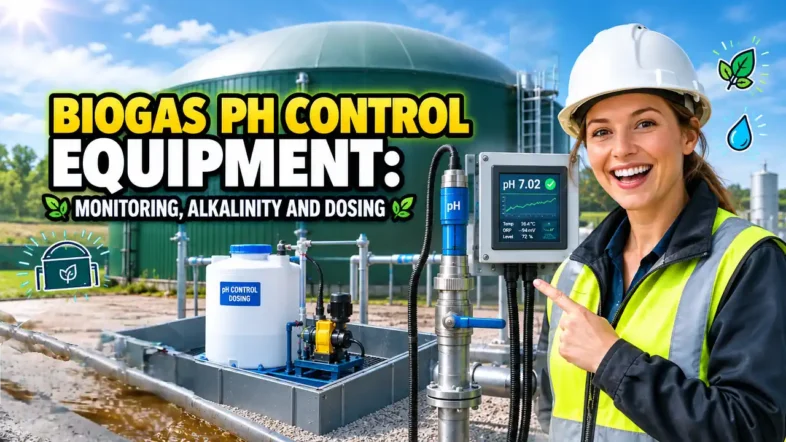
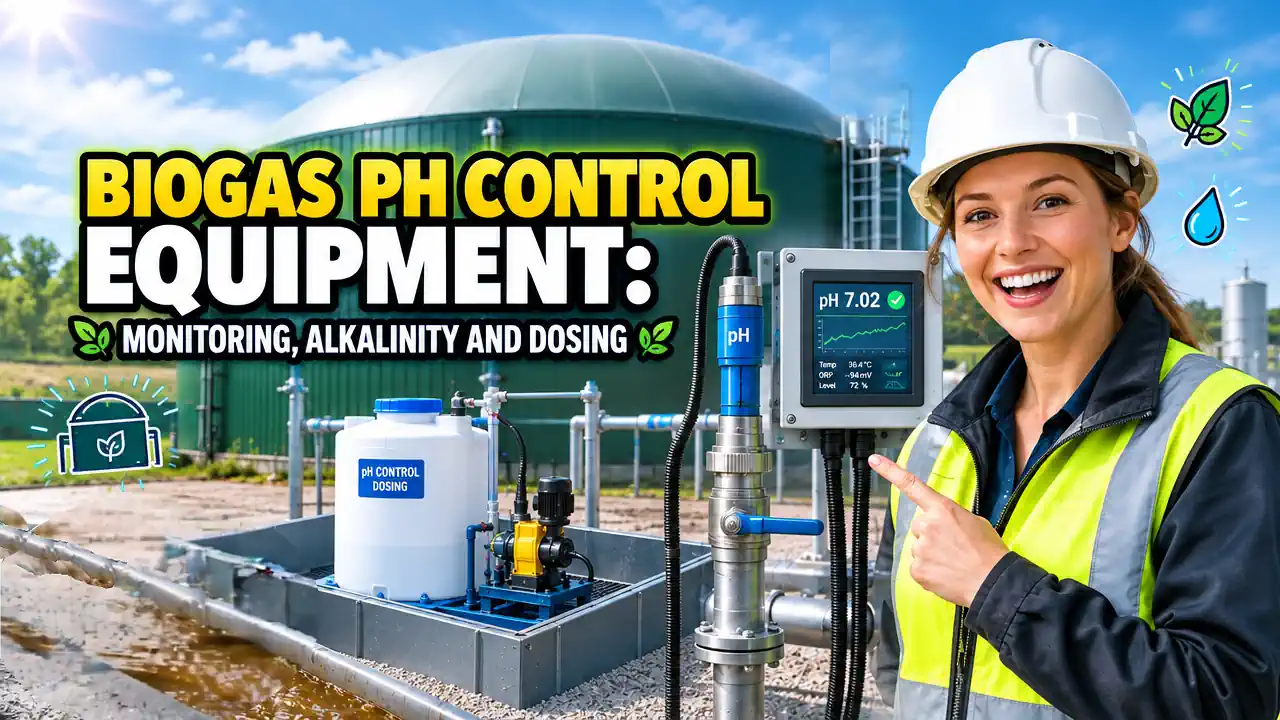
Biogas pH control equipment is used to monitor and, where necessary, correct the acid-base conditions within anaerobic digestion systems. But good digester pH control involves considerably more than installing a pH probe and automatically adding alkali whenever the reading falls.
An anaerobic digester is a biological process involving several groups of microorganisms. The methane-producing microorganisms – the methanogens – are particularly sensitive to unsuitable operating conditions. If volatile fatty acids (VFAs) accumulate faster than they can be converted to methane, the digester’s buffering capacity can become depleted and its pH may eventually fall.
However, pH can remain apparently satisfactory while an anaerobic digester is already moving towards instability. This is why experienced operators look at pH alongside alkalinity, VFA concentrations or ratios such as FOS/TAC, gas production, methane concentration, loading rate, temperature and other process indicators.
This article explains how anaerobic digester pH control works, the equipment used to measure and control it, why alkalinity matters, when chemical dosing may be justified and why prevention is usually preferable to correcting a seriously acidified digester.
Key Takeaways
- Methanogens generally favour near-neutral conditions. Many conventional digesters operate successfully around pH 6.8 to 7.5, although the appropriate range depends on the particular process, feedstock and operating conditions.
- pH alone is not an adequate early-warning system. A well-buffered digester may accumulate VFAs without showing an immediate large fall in pH.
- Alkalinity describes the digester’s capacity to resist acidification. It is therefore different from the pH reading itself.
- Automatic chemical dosing is not essential on every AD plant. Many stable digesters maintain adequate buffering naturally through their feedstock and biological chemistry.
- If alkali dosing becomes necessary, the cause of the instability should also be investigated. Adding chemicals can restore buffering but may not solve organic overloading, feedstock shock, inhibition or another underlying problem.
- Industrial pH probes require cleaning, checking and calibration. Fouling or ageing sensors can provide misleading readings and should never simply be assumed to be correct.
- For more detailed diagnosis using volatile fatty acids and alkalinity, see our guide to FOS/TAC anaerobic digestion process control.
What Is the Correct pH for Anaerobic Digestion?
There is no single pH value that can be described as universally correct for every anaerobic digester.
Different microorganisms involved in anaerobic digestion have different preferences. The organisms responsible for hydrolysis and acidogenesis can tolerate more acidic conditions than the methanogenic archaea responsible for the final methane-producing stages.
Methanogens generally perform best under approximately neutral conditions. In many conventional single-stage digesters, operation around pH 6.8 to 7.5 is commonly associated with satisfactory methanogenic activity.
 That should be regarded as an operating guide rather than an absolute specification. Feedstock, temperature, ammonia concentration, alkalinity, loading rate and microbial acclimation all influence what a particular digester will tolerate.
When pH falls substantially below the range to which the methanogenic population is adapted, methane production can slow. Acid-producing organisms may nevertheless continue producing organic acids.
This can create a damaging feedback mechanism:
VFA accumulation → falling pH → methanogen inhibition → slower VFA conversion → further VFA accumulation.
If allowed to continue, the digester may become seriously unstable or, in traditional terminology, “go sour”.
Why Does Anaerobic Digester pH Fall?
A falling pH is normally a symptom of a change in the balance between acid production and acid consumption.
Possible causes include:
- excessive organic loading;
- a sudden increase in readily biodegradable feedstock;
- rapid VFA production;
- insufficient alkalinity or loss of buffering capacity;
- sudden changes in feedstock composition;
- temperature disturbance;
- inhibition of methanogenic microorganisms;
- toxic or inhibitory substances;
- poor or inadequate mixing;
- short hydraulic or solids retention time; and
- process disturbances following plant shutdown or restart.
Food waste can require particular attention because highly biodegradable substrates can acidify rapidly if the acid-forming stages of digestion temporarily outrun methanogenesis.
The correct response to falling pH is therefore not automatically to add chemicals. Operators should first consider why the biological balance has changed.
What Does It Mean When an Anaerobic Digester “Goes Sour”?
A “sour” anaerobic digester is one in which the balance between acid production and methane formation has substantially deteriorated.
During normal digestion, volatile fatty acids are important intermediates. Their presence is not itself evidence of failure. The problem develops when VFAs are produced faster than acetogenic and methanogenic microorganisms can process them.
If the digester has adequate alkalinity, its buffering system initially neutralises much of the increased acid load. The pH may therefore move surprisingly little.
As the buffering reserve is consumed, however, pH begins to fall. Methanogens may then become increasingly inhibited, while acid-producing microorganisms continue to operate.
This is why a serious fall in pH can be a relatively late indication of process instability.
Why pH Alone Is Not Enough for Anaerobic Digestion Process Control
It is tempting to think of digester health in simple terms:
“The pH is 7, therefore the digester is healthy.”
Unfortunately, that conclusion is not always justified.
A digester with substantial bicarbonate alkalinity can absorb increasing VFA production while its pH remains within an apparently satisfactory range.
For this reason, good process monitoring may also consider:
- total and partial alkalinity;
- volatile fatty acid concentration;
- VFA-to-alkalinity ratios;
- FOS/TAC;
- individual VFAs where detailed diagnosis is required;
- ammonia;
- biogas flow;
- methane concentration;
- carbon dioxide concentration;
- organic loading rate;
- temperature; and
- feedstock characteristics.
Monitoring trends is particularly important. The direction and rate of change can provide more useful information than one isolated laboratory result.
For a detailed discussion of the relationship between acids and buffering capacity, read our separate guide to FOS/TAC anaerobic digestion process control.
What Is Alkalinity in Anaerobic Digestion?
Alkalinity is the capacity of the digester liquid to neutralise acid and resist a fall in pH.
This is not the same thing as pH.
A useful simplified distinction is:
- pH tells us about the current acid-base condition of the liquid;
- alkalinity tells us something about how strongly that condition is buffered against additional acid.
In many anaerobic digesters, bicarbonate forms an important part of the buffering system. Ammonium/bicarbonate chemistry associated with degradation of nitrogen-containing material can also contribute substantially to alkalinity.
Stable digesters frequently have alkalinity concentrations measured in the thousands of mg/L expressed as CaCO3, but there is no single alkalinity concentration that should be imposed as the optimum for every AD process.
What matters is maintaining sufficient buffering capacity for the feedstock, organic loading and process conditions concerned, while observing how alkalinity and VFA measurements are trending.
Biogas pH Monitoring Equipment
The first element of biogas pH control equipment is reliable measurement.
Industrial AD plants may use a combination of online instrumentation and manually analysed samples.
In-Line pH Probes
An industrial pH probe can provide continuous measurement from a tank, recirculation pipe or other representative process location.
Continuous data has the advantage that trends, unusual changes and alarms can be incorporated into the plant control system.
However, installation location matters. A probe should measure representative digester material rather than an unusual local condition, poorly mixed pocket or the immediate vicinity of a chemical injection point.
pH Transmitters and Controllers
The electrode signal is normally transmitted to a local instrument or the plant PLC/SCADA system.
This allows:
- continuous display;
- historical trending;
- high and low alarms;
- sensor diagnostics;
- comparison with other process parameters; and
- where justified, control of chemical-dosing equipment.
An automatic dosing system should not normally depend blindly on one unverified measurement where an incorrect reading could cause substantial over-dosing.
Sample-Line and Laboratory pH Measurement
Manual measurements remain valuable even where continuous probes are installed.
A properly calibrated independent meter can provide a useful cross-check of the online instrument.
This is especially worthwhile when:
- the online reading changes unexpectedly;
- the reading remains suspiciously constant;
- chemical dosing has increased;
- process behaviour no longer agrees with the pH value; or
- maintenance is due.
Why pH Probes Can Give Misleading Readings
A pH instrument is only useful if the sensing system is working correctly.
Anaerobic digester liquor is a difficult environment for instrumentation. Depending on the application, the sensor may be exposed to:
- organic coatings;
- biofilms;
- grease;
- fine solids;
- mineral scale;
- fibres; and
- chemically aggressive material.
A coated measuring electrode or contaminated reference junction can respond slowly or provide inaccurate readings.
Typical warning signs include:
- slow response;
- unexplained drift;
- failure to calibrate properly;
- large calibration offset;
- unusually low electrode slope; and
- a reading that appears almost permanently fixed despite obvious process changes.
Why Does My Digester pH Reading Never Change?
A nearly constant value does not automatically mean the probe has failed. A strongly buffered, stable digester may genuinely show relatively little pH variation.
However, an apparently “stuck” reading should prompt checks for:
- a fouled or coated pH electrode;
- a blocked or contaminated reference junction;
- an ageing electrode;
- incorrect calibration;
- transmitter or cabling problems;
- an unrepresentative sampling location; or
- genuine strong buffering within the digester.
The reading should be compared with a freshly calibrated independent measurement before important operating decisions are made.
Cleaning and Calibrating Biogas pH Probes
pH probes need routine inspection, cleaning and calibration.
There is no universally correct calibration interval for an AD plant because fouling rate and sensor performance vary greatly between installations.
A sensible maintenance programme should be based on actual operating experience and instrument behaviour.
Typical activities include:
- visual inspection of the sensor;
- removal of deposits using a cleaning method compatible with the probe;
- rinsing before calibration;
- checking the response in recognised buffer solutions at known concentrations;
- performing calibration where the check is outside the plant’s acceptance limits;
- reviewing sensor diagnostics where available; and
- replacing electrodes whose response has deteriorated beyond acceptable limits.
Cleaning should normally take place before calibration. Calibrating a contaminated sensor can compensate for the contamination rather than correct the underlying measurement problem.
Some demanding process installations use retractable assemblies or automated systems that clean, calibrate and monitor pH sensors with less manual intervention.
Biogas pH Control Equipment and Chemical Dosing Systems
Where a digester requires chemical pH or alkalinity correction, the installation may include:
- chemical storage tank;
- appropriate secondary containment or bunding;
- dosing pump;
- chemical-resistant pipework;
- injection quill or dosing point;
- pH transmitter;
- PLC or dedicated controller;
- high and low alarms;
- chemical-level alarms;
- interlocks;
- flow verification; and
- facilities for safe calibration and maintenance.
The chemical should be introduced at a point where it can mix effectively before the resulting pH is measured.
Poor positioning of the dosing point and pH probe can cause unstable control. If the probe measures the chemical before it has mixed adequately with the process liquid, the controller may repeatedly over-correct and under-correct.
What Chemicals Can Be Used to Raise Anaerobic Digester pH?
Several alkaline materials can potentially be used to increase buffering or correct low pH, depending on the process.
Examples include:
- sodium bicarbonate;
- sodium carbonate;
- sodium hydroxide;
- calcium hydroxide or lime; and
- other alkaline materials where their chemistry and contaminants are suitable.
Sodium bicarbonate is commonly discussed as a buffering material because it increases alkalinity without the extremely aggressive pH response associated with a strong caustic such as sodium hydroxide.
That does not make any one chemical universally preferable.
Selection should consider:
- required alkalinity addition;
- speed of response;
- operator safety;
- storage requirements;
- chemical cost;
- possible sodium or calcium accumulation;
- precipitation and scaling;
- effects on downstream digestate use; and
- the chemistry of the particular digester.
Strong acids and alkalis require appropriate chemical handling, storage, bunding, PPE and risk controls.
Should Alkali Be Added Automatically to an Anaerobic Digester?
Not necessarily.
This is an important correction to an oversimplified view of digester pH control.
Many well-operated anaerobic digesters maintain sufficient alkalinity naturally and do not require routine automatic alkali dosing.
A dosing system can nevertheless be justified where, for example:
- feed alkalinity is inadequate;
- feedstock composition changes substantially;
- an industrial wastewater has little natural buffering;
- process loading creates predictable alkalinity demand;
- startup conditions require temporary assistance; or
- operating experience demonstrates a genuine routine requirement.
But when a normally stable digester suddenly needs large amounts of alkali, the question should be “what has changed?” rather than simply “how much chemical should we add?”
Chemical Dosing Does Not Cure the Cause of a Digester Upset
This distinction is fundamental.
Suppose a digester is being overloaded with readily degradable organic material. Acid-forming organisms produce VFAs faster than the methanogens can consume them.
Adding sodium bicarbonate may increase the buffering reserve and prevent an immediate collapse in pH.
But if the same excessive loading continues, the biological imbalance remains.
Corrective action might therefore involve some combination of:
- reducing organic loading;
- stabilising feed rate;
- temporarily changing feedstock proportions;
- checking digester temperature;
- checking mixing;
- investigating inhibitors;
- monitoring VFAs;
- checking ammonia; and
- restoring alkalinity where required.
Dosing can support process recovery. It should not become a substitute for process diagnosis.
Can Anaerobic Digester pH Be Too High?
Yes.
Excessively alkaline conditions can also inhibit anaerobic digestion.
One particular concern with nitrogen-rich feedstocks is the relationship between ammonium (NH4+) and free ammonia (NH3).
As pH and temperature increase, a greater proportion of total ammonia nitrogen is present as free ammonia. Free ammonia is generally regarded as the more inhibitory form for methanogenic microorganisms.
This is particularly relevant to:
- poultry manure;
- pig manure;
- protein-rich food waste;
- some sewage sludges; and
- other high-nitrogen substrates.
Increasing pH indiscriminately in a high-ammonia digester can therefore make one inhibition problem worse while attempting to solve another.
pH, Hydrogen Sulphide and Biogas Safety
Anaerobic digestion can also produce hydrogen sulphide (H2S) when sulphur-containing material is degraded.
Hydrogen sulphide must not be confused with sulphur dioxide.
H2S is a toxic, corrosive gas that can present serious health and plant-maintenance risks. Its concentration in biogas depends upon feedstock chemistry, microbial activity and sulphur management.
The balance between dissolved sulphide species and gaseous hydrogen sulphide is influenced by pH, but H2S control should be regarded as a separate biogas treatment and safety issue rather than merely a pH-control problem.
Where hydrogen sulphide is significant, appropriate gas monitoring, ventilation, hazardous-area assessment and gas-treatment systems may be required.
pH Control in Food Waste Anaerobic Digestion
Food waste can contain large quantities of readily biodegradable material.
This can be advantageous for methane production, but it can also allow acidogenesis to proceed rapidly if loading increases faster than the methanogenic population can accommodate.
Operators therefore need to pay particular attention to:
- consistent feed rates;
- organic loading;
- VFA trends;
- alkalinity;
- ammonia where protein-rich feedstocks are present; and
- changes in incoming waste composition.
Simply monitoring pH may not provide enough advance warning of deterioration.
pH Control in Agricultural Anaerobic Digestion
Agricultural digesters frequently benefit from the natural buffering associated with manure, particularly where nitrogenous compounds contribute to ammonium/bicarbonate alkalinity.
That does not mean agricultural digesters cannot suffer instability.
Changes in manure-to-crop ratios, introduction of new feedstocks, changes in silage characteristics, overfeeding and ammonia accumulation can all affect process conditions.
Feedstock changes should therefore be introduced carefully, and any change must also comply with the site’s permit or other applicable authorisation.
pH Control in Sewage Sludge Digestion
Conventional sewage-sludge digesters can have substantial natural buffering capacity, but stable pH should still be interpreted alongside:
- alkalinity;
- VFA concentration;
- gas production;
- methane concentration;
- temperature;
- solids loading; and
- digester retention time.
A significant increase in acid production may therefore be visible in VFA or alkalinity measurements before a dramatic pH change occurs.
pH Control in Industrial Wastewater Anaerobic Digestion
Industrial effluents can present some of the strongest cases for active pH control equipment.
Wastewater characteristics may vary considerably between industries and production cycles, and some streams can have:
- low natural alkalinity;
- extreme incoming pH;
- rapidly biodegradable COD;
- batch discharges;
- cleaning chemicals; or
- other compounds capable of disturbing the biological process.
Equalisation, buffering, feed control and chemical dosing can therefore be important parts of the overall process design.
pH Control in Co-Digestion
Co-digestion can improve process performance where complementary feedstocks provide a better nutrient balance, buffering or gas yield.
But adding a second feedstock can also alter:
- organic loading;
- VFA generation;
- alkalinity;
- ammonia concentration;
- trace nutrients;
- rheology; and
- inhibitor concentrations.
A new co-digestion feedstock should therefore not be introduced purely because laboratory methane-potential testing suggests a good gas yield. Process compatibility and regulatory authorisation must also be established.
Preventing pH Problems Is Better Than Correcting Them
The best pH-control strategy is usually to operate the digester so that major correction is unnecessary.
Important preventative measures include:
- consistent feed rates;
- appropriate organic loading;
- adequate hydraulic and solids retention time;
- good digester mixing;
- stable temperature;
- feedstock characterisation;
- avoiding abrupt feedstock changes;
- monitoring alkalinity and VFAs;
- monitoring ammonia where appropriate;
- maintaining essential trace nutrients;
- checking biogas and methane production trends; and
- acting on developing trends before a major pH fall occurs.
Mixing itself is another important process-control subject. For more information, see our guide to anaerobic digester mixing systems.
Biogas pH Control Equipment Maintenance Checklist
A practical maintenance routine should be adapted to each plant, but may include:
- inspect pH probes for fouling and physical damage;
- clean probes using the manufacturer’s approved method;
- check measurements against appropriate buffer solutions;
- calibrate when required;
- compare online readings periodically with an independent instrument;
- review electrode slope, offset and diagnostic data where available;
- inspect dosing pumps and tubing;
- check non-return valves and injection points;
- verify dosing-pump delivery rates;
- test low-chemical-level alarms;
- test high and low pH alarms;
- inspect chemical storage tanks;
- inspect bunding and containment;
- check chemical safety equipment; and
- review historical trends rather than relying only on the current display.
Biogas pH Control Equipment Should Be Part of Wider AD Process Control
The most important lesson is that pH control equipment should not be considered in isolation from the biology of anaerobic digestion.
The pH electrode provides one piece of information.
Alkalinity indicates buffering capacity.
VFAs indicate whether organic-acid intermediates are accumulating.
Gas flow and methane concentration show how effectively organic material is being converted to useful biogas.
Temperature, loading rate, ammonia and feedstock characteristics provide further context.
Used together, these measurements allow operators to distinguish between a minor pH fluctuation and the early stages of a potentially serious process upset.
For more information on the equipment used throughout an AD facility, see our Anaerobic Digestion Equipment guide.
For wider advice on improving methane production and process stability, see Optimisation of Biogas Production.
Biogas pH Control Equipment: Frequently Asked Questions
What is the optimum pH for anaerobic digestion?
Methanogenic anaerobic digestion generally performs best close to neutral pH. A range of approximately 6.8 to 7.5 is commonly associated with stable methane production in conventional digesters, but the optimum depends on feedstock, reactor type, temperature, ammonia concentration and microbial adaptation.
What pH is too low for a biogas digester?
There is no universal failure point, but a sustained decline below the normal operating range of a previously stable methanogenic digester should be investigated promptly. Methanogens become increasingly inhibited as conditions become too acidic. A falling pH may also indicate that the digester’s buffering capacity is already being consumed by accumulating VFAs.
How do you raise the pH of an anaerobic digester?
Low pH may be corrected by restoring alkalinity using an appropriate buffering or alkaline chemical, but the cause of acidification should also be identified. Corrective measures may include reducing organic loading, stabilising feed, addressing inhibition and restoring suitable buffering.
What chemicals are used for anaerobic digester pH control?
Depending on the application, chemicals can include sodium bicarbonate, sodium carbonate, sodium hydroxide or calcium-based alkaline materials. Selection should be based on the specific chemistry, required alkalinity addition, safety, cost and possible effects on the process and digestate.
What is alkalinity in anaerobic digestion?
Alkalinity is the acid-neutralising or buffering capacity of the digester liquid. It helps the process resist a decline in pH when volatile fatty acids are produced. It is therefore different from pH, which describes the current acid-base condition.
Why can pH remain normal while an anaerobic digester is becoming unstable?
A well-buffered digester can neutralise increasing quantities of acid without an immediate large change in pH. VFAs may therefore accumulate and alkalinity may decline while the pH still appears satisfactory. This is why alkalinity and VFA measurements can provide earlier warning of instability.
What is FOS/TAC and how is it different from pH?
FOS/TAC is a process-stability indicator based broadly on the relationship between volatile organic acids and buffering capacity. It provides different information from pH alone. See our separate guide to FOS/TAC anaerobic digestion process control.
Does every biogas plant need automatic pH dosing equipment?
No. Many stable anaerobic digesters maintain adequate alkalinity without routine chemical dosing. Automatic dosing is appropriate only where the process and operating history justify it.
Can anaerobic digester pH be too high?
Yes. Excessively alkaline conditions can inhibit biological activity. Higher pH also shifts the ammonium/free-ammonia equilibrium towards free ammonia, which can increase ammonia inhibition in nitrogen-rich digesters.
How often should an anaerobic digester pH probe be calibrated?
There is no single correct interval. Calibration and cleaning frequency should be based on the sensor type, degree of fouling, process conditions, diagnostic information and the accuracy required by the control system. Dirty sensors should be cleaned before calibration.
Why does my digester pH meter always show the same value?
A strongly buffered digester may genuinely show little pH variation, but an unusually constant reading can also indicate a fouled electrode, blocked reference junction, ageing sensor, calibration problem or transmitter fault. Compare the online value with a clean, independently calibrated instrument.
Can poor mixing cause pH problems in an anaerobic digester?
Poor mixing can contribute to uneven feed distribution, localised VFA concentrations, temperature differences and ineffective use of digester volume. Mixing should therefore be considered alongside loading, retention time and process chemistry when investigating instability.
Conclusion
Effective biogas pH control starts with reliable measurement but does not end there.
Anaerobic digestion is a buffered biological process. A pH probe can show the current condition of the liquid, but it cannot by itself tell an operator how much buffering remains, whether VFAs are accumulating or why process stability is deteriorating.
The strongest operating strategy combines good instrumentation, regular probe maintenance, alkalinity and VFA monitoring, stable feeding and informed process diagnosis.
Chemical dosing equipment has an important role where additional buffering or pH correction is genuinely required. But in a well-operated AD plant, the objective should be to understand and control the process well enough that large emergency corrections are the exception rather than routine operation.
[Published November 2014. Rewritten September 2026.]




Great information. Impressed by your website. All digesters need pH monitoring, not necessarily control. There is a website for digester recovery and methane optimisation.
They offer the services of an Aquafix chemist who explains the causes and top solutions to problems ranging from foaming, pH, and more.
Now they are offering operators solutions for biogas digester upsets and issues.
The site to see is teamaquafix.com, and they also have a neat way of showing the optimum pH range for a biogas plant substrate.
Very concise, much appreciated.
Glad I noticed this on google. Why does pH on my meter not change? Meter is not damaged, but when i got it was showing constant changes.