



An anaerobic lagoon is a basin in which microorganisms break down organic material without dissolved oxygen. Used for suitable agricultural slurries and high-strength wastewaters, the process reduces part of the organic load and produces biogas containing methane and carbon dioxide.
A covered anaerobic lagoon adds a gas collection system. Instead of allowing the biogas to escape, a suitable cover captures it for controlled treatment and use, or flaring when it cannot be used.
This relatively simple form of anaerobic digestion can suit dilute organic wastes where sufficient land is available. However, its performance depends on temperature, loading, containment, gas handling and the management of the remaining liquid and sludge.
Updated 19 October 2026. This guide replaces earlier content that included a November 2014 article and a page dated 1 August 2019.
What Is an Anaerobic Lagoon?
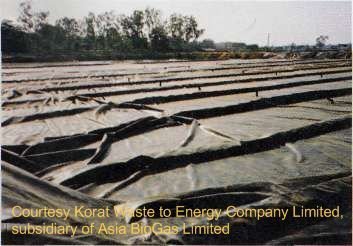 An anaerobic lagoon provides space for organic material to settle and undergo biological treatment. Solids accumulate in a sludge layer, while microorganisms break down biodegradable material in the liquid and retained sludge.
These lagoons differ from aerated lagoons, which receive oxygen through mechanical equipment, and facultative ponds, which combine oxygenated and anaerobic zones.
Anaerobic lagoons can form part of a wider treatment system. They should not be assumed to produce water suitable for direct discharge: further treatment or a properly managed agricultural outlet may be needed.
The US Environmental Protection Agency’s anaerobic lagoon fact sheet explains their role in wastewater pretreatment and the need for subsequent treatment.
Uncovered and Covered Anaerobic Lagoons
An uncovered lagoon may produce methane without recovering it. A covered lagoon incorporates a barrier and gas collection arrangements designed to capture that gas.
It is important to distinguish a general slurry storage cover from a complete biogas recovery system. A cover intended to reduce rainfall entry or ammonia emissions is not automatically suitable for collecting and handling combustible gas.
The EPA’s anaerobic system design guidance describes covered lagoons with flexible covers and gas pipework. It recognises both arrangements that separate digestion from storage and single-cell systems combining those functions.
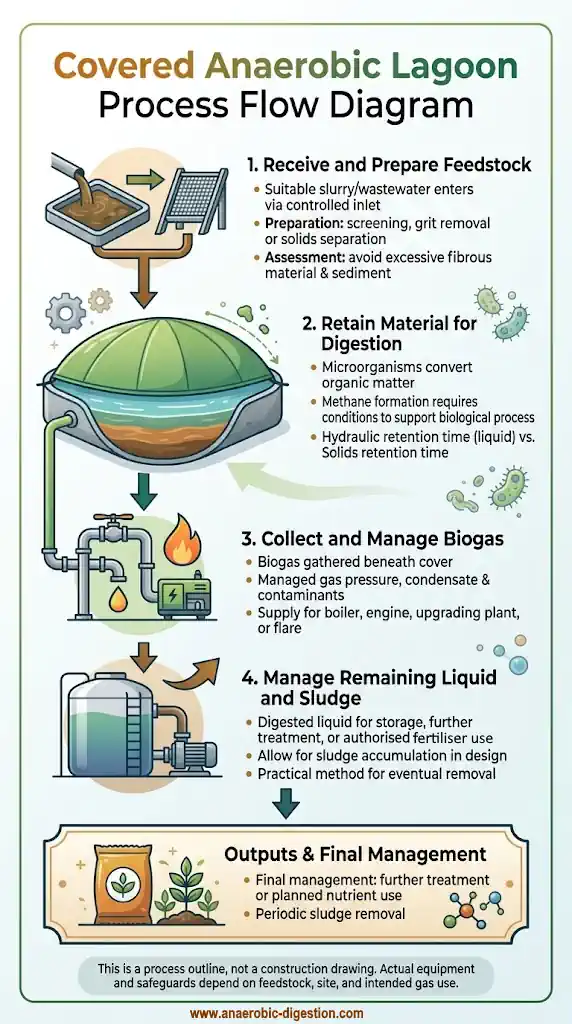
How Does the Covered Anaerobic Lagoon Process Work?
1. Receive and prepare the feedstock
Suitable slurry or wastewater enters through a controlled inlet. Depending on the material, preparation may include screening, grit removal or solids separation.
Feedstock assessment matters. Excessive fibrous material, sediment or contamination can cause accumulation, blockages and operating difficulties. A lagoon designed for dilute manure is not automatically suitable for concentrated food waste.
2. Retain the material for digestion
Microorganisms convert biodegradable organic matter through the stages of anaerobic digestion. Methane formation depends on maintaining conditions that support the biological process.
Liquid passes through the system while settled solids may remain much longer. Hydraulic retention time and the time solids remain in the lagoon are therefore different considerations.
3. Collect and manage the biogas
Biogas gathers beneath the cover and flows through purpose-designed pipework. The system must manage gas pressure, condensate and the contaminants relevant to its intended use.
Gas treatment requirements depend on whether the gas will supply a boiler, engine or upgrading plant. Appropriate arrangements are also needed when normal gas use stops.
4. Manage the remaining liquid and sludge
Digested liquid leaves for storage, further treatment or an authorised use. Sludge accumulation must be allowed for in the design, including a practical method of eventual removal.
The remaining material still contains nutrients. Read our guide to biogas and digestate production for the distinction between the two outputs of digestion.
Covered Anaerobic Lagoon Process Flow
The following simplified flow describes a two-stage arrangement:
- Slurry or wastewater reception: screening or separation where required.
- Covered digestion lagoon: biological treatment and biogas collection.
- Gas route: collection pipework, condensate management and gas treatment, followed by energy use or controlled flaring.
- Liquid route: transfer to a separate storage or treatment stage.
- Final management: further treatment or planned nutrient use, with periodic sludge removal.
This is a process outline, not a construction drawing. Actual equipment and safeguards depend on the feedstock, site and intended gas use.
Why Separate Digestion from Storage?
Separating the digestion lagoon from the storage lagoon can help maintain a more consistent operating volume in the treatment stage.
The second lagoon accommodates changes in storage demand, including periods when land application is unsuitable. However, downstream storage may still release methane and odours, so its emissions require attention too.
A single lagoon can combine treatment and storage, but its cover, pipework and operating arrangements must accommodate changing liquid levels.
Temperature, Loading and Retention Time
Many conventional covered lagoons rely substantially on ambient temperature. Biological activity slows in colder conditions, affecting treatment and gas production.
There is no single retention time suitable for every lagoon. Designers must consider:
- Wastewater flow and its seasonal variation.
- The concentration and biodegradability of the organic material.
- Expected operating temperatures.
- Required treatment performance.
- Sludge accumulation and usable treatment volume.
- Short-circuiting and the effectiveness of the lagoon’s hydraulic arrangement.
The EPA AgSTAR Project Development Handbook describes covered lagoons as particularly relevant to dilute feedstocks and suitable climates. Its example operating ranges are useful background, rather than a substitute for site-specific design.
Annual energy estimates should account for seasonal output. A summer gas production rate should not simply be multiplied across the whole year.
Advantages and Limitations
Potential advantages
- Relatively simple treatment arrangements for suitable dilute materials.
- Potentially lower construction costs than some tank-based digestion systems.
- Recovery of methane that would otherwise escape from an uncovered anaerobic lagoon.
- Opportunities to produce useful heat, electricity or upgraded gas.
- Potential reduction in odour from the covered surface.
Important limitations
- A substantial land requirement.
- Temperature-dependent treatment and gas production in unheated systems.
- Accumulation of sludge, grit and other retained solids.
- Cover inspection, maintenance and eventual replacement.
- Continued responsibility for nutrients, liquid storage and final outlets.
- Risks from leaks, overflows, flooding and uncontrolled gas releases.
A covered lagoon should not be described as maintenance-free or guaranteed to eliminate odour. Its simplicity reduces some equipment requirements, but does not remove the need for competent operation.
What Can the Recovered Biogas Be Used For?
Depending on gas quantity, quality and local demand, recovered biogas may supply heat or an engine-generator. Recovering useful engine heat creates a combined heat and power system.
Our guide to biogas engines and generators explains electricity production and gas quality requirements.
Upgrading to biomethane is another possible route, but requires additional equipment and an appropriate market. It should be assessed against gas flow, operating costs and delivery requirements. See our comparison of biogas upgrading technologies.
The best route is the one that makes practical use of the available gas. Our biogas utilisation guide explains the main choices.
Design, Environmental Protection and Permissions
A feasibility study should address ground conditions, liner integrity, groundwater protection, flood exposure, rainfall management and storage capacity, alongside the digestion process.
Gas collection introduces additional engineering requirements. Methane is flammable, hydrogen sulphide is toxic, and oxygen-deficient atmospheres can be fatal. Access, maintenance and gas-system work need appropriate procedures and competent personnel.
For projects in England, consult the Environment Agency’s slurry storage guidance and establish the applicable environmental permitting requirements before construction or conversion.
The Agency also publishes standard rules for specified biogas capture, treatment and storage activities involving lagoons and tanks. These have defined limits and conditions; their existence does not mean every project qualifies.
Requirements differ across the UK and internationally. Planning, waste acceptance, gas use and land application must be checked for the actual location and proposed operation.
Frequently Asked Questions
What is the purpose of an anaerobic lagoon?
It provides biological treatment for suitable organic wastewater or slurry under anaerobic conditions. A covered system can also collect the resulting biogas.
Does every anaerobic lagoon collect methane?
No. Methane can escape from an uncovered lagoon. Recovery requires a suitable cover, gas collection equipment and controlled gas handling.
Can an existing slurry lagoon be converted into a biogas digester?
Sometimes, but suitability needs assessment. The existing structure, containment, feedstock, liquid levels, gas potential and permissions all matter. Adding a cover alone does not establish a complete working system.
Do covered anaerobic lagoons work in cold climates?
Low temperatures slow digestion. Some engineered systems incorporate heating or insulation, but an unheated lagoon’s winter performance needs careful assessment before estimating energy production or financial returns.
Does a cover remove all odours?
No. It can reduce emissions from the covered surface, but reception areas, leaks, downstream storage and land application can remain sources of odour.
Can liquid leaving the lagoon be discharged into a river?
It should not be assumed suitable for discharge. Further treatment and the relevant authorisation may be necessary. Agricultural use also requires appropriate storage and nutrient management.
How much does a covered anaerobic lagoon cost?
There is no reliable universal price. Earthworks, liners, cover design, gas equipment, storage, ground conditions and the intended energy use all affect the total installed and operating cost.
Further reading:
You may also like to visit: Covered Lagoon Digester: The Low-Cost Alternative to Biogas Tanks
[Published November 2014. Updated August 2019. Rewritten October 2026.]




This is a topic that’s close to my heart…
Please feature our anaerobic digestion slurry lagoon cover system.
Agricultural slurry and waste water lagoons create anaerobic conditions where methane and carbon dioxide (biogas) are naturally produced. This is normally released into the atmosphere wasting a valuable fuel resource as well as releasing a potent greenhouse gas.
LagoonQUBE is designed to perform the dual purpose of capturing the biogas on existing slurry lagoons with the added benefit of also collecting rainfall and so reducing storage volume. The collected biogas can then be used for heat and power generation.
LagoonQUBEs are lightweight inflatable modules designed to float on the surface of the existing lagoon and collect and capture the rainfall and biogas produced. Each lagoonQUBE is a hexagonal module measuring 94m2 and having a diameter of 11.6 metres. The hexagonal design means that the lagoonQUBE’s fit together in any number and can cover as much of the lagoon surface as required. There is more about LagoonQUBE here.
Cheers!
Yes. I will. LagoonQUBE looks like a great idea. So simple. Collect the biogas which would otherwise contribute to the greenhouse effect when it bubbles off into the atmosphere. Thanks for letting us know about this system.
I have checked your website and i have found some content about floating covers on this page,
but there is a good page about this at https://floatingcovers.wordpress.com/tag/lagoon-covers/ that can help you to understand how these work.
Readers may want to see the diagrams there.
You encourage these manure ponds. Are you not aware that after hurricanes these things which called hog lagoons, collect the animals’ feces overflow? The result is extremely high levels of dangerous bacteria in our floodwater. Clever. Huh?
I want readers to understand that in windy weather especially these large covers need constant attention or small leaks, small damage can become major. Neglect can bring severe consequences. Any damage needs to be actively identified and repaired. Operating a lagoon cover requires removing the collected biogas from below the cover regularly or continuously. The cover should be visually inspected weekly and more often during high winds for rainwater accumulation, tearing, wear, and proper tensioning of attachment ropes.