



High solids anaerobic digestion (HSAD) is the biological digestion of organic materials at substantially higher total-solids concentrations than conventional wet anaerobic digestion. It is particularly relevant to feedstocks such as source-separated organic waste, the organic fraction of municipal solid waste (OFMSW), crop residues, manures and other materials that would otherwise require large quantities of dilution water before conventional wet digestion.
High-solids digestion can reduce water demand and reactor volume and can allow relatively dense organic wastes to be processed efficiently. However, increasing the solids concentration also changes the engineering and microbiology of the process. Mixing becomes more difficult, mass transfer slows, viscosity increases and inhibitory compounds can accumulate locally.
For that reason, high-solids AD should not simply be thought of as conventional anaerobic digestion with less water added. It requires appropriate feed preparation, reactor design, mixing or percolation arrangements, process control and digestate handling.
This article explains what high-solids anaerobic digestion means, where it is useful, its principal advantages and limitations, and how it differs from conventional wet and dry anaerobic digestion systems.
What Is High Solids Anaerobic Digestion?
There is no single universally accepted total-solids percentage at which anaerobic digestion suddenly becomes “high solids”. Definitions vary between researchers, technology suppliers and sectors.
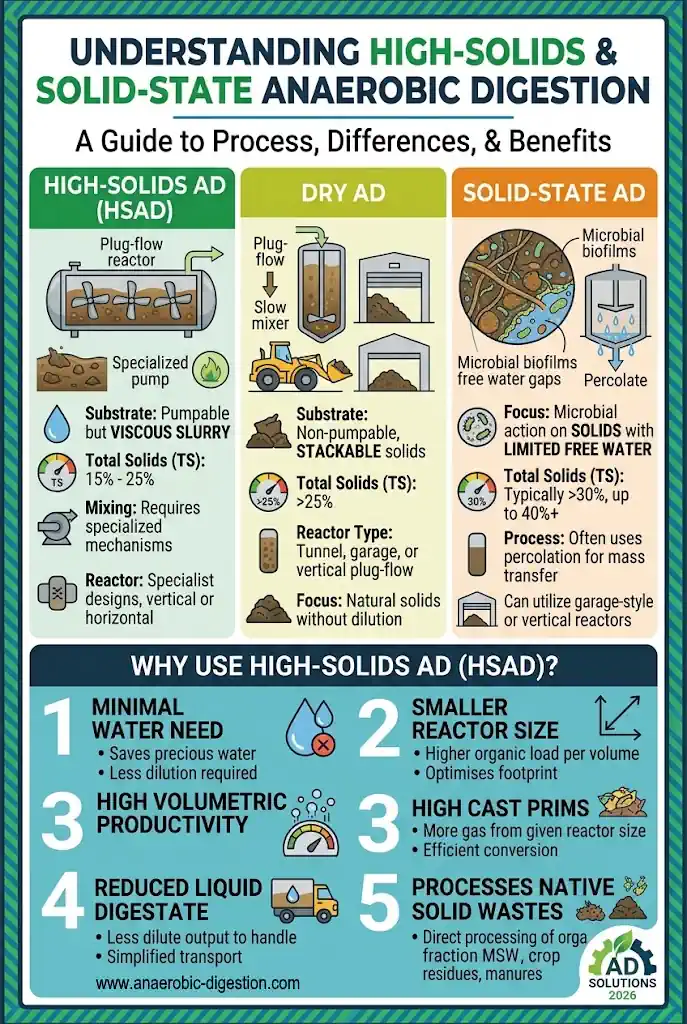
Recent technical literature commonly describes high-solids anaerobic digestion as operating at approximately 20% to 40% total solids (TS). Other published definitions place the transition from wet to dry or solid-state digestion at around 15% to 20% TS.
The exact numerical boundary is less useful to an engineer than understanding how the material behaves.
As solids concentration increases:
- the substrate becomes increasingly viscous;
- conventional pumping becomes more difficult;
- mixing energy may increase substantially;
- movement of soluble compounds through the material slows;
- microorganisms have less free water in which to move and interact;
- local concentrations of ammonia, volatile fatty acids and other compounds can become important; and
- specialised reactor and material-handling systems may become necessary.
Consequently, total solids content, rheology and pumpability all matter when defining a practical high-solids AD process.
A 2025 review published by the International Water Association describes HSAD as a solid-state form of anaerobic digestion typically operating at about 20–40% TS and highlights its potential to reduce water requirements and reactor volume. See the IWA review of advanced anaerobic digestion.
High Solids, Dry AD and Solid-State Digestion: Are They the Same?
The terminology is unfortunately inconsistent.
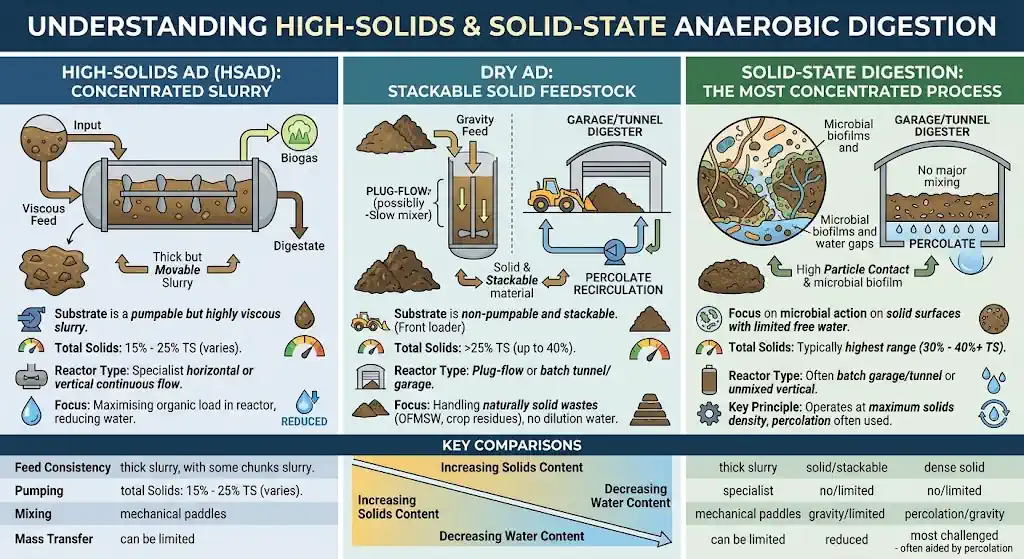
The terms high-solids anaerobic digestion, dry anaerobic digestion and solid-state anaerobic digestion are often used interchangeably in research papers and equipment literature. However, they are not always describing exactly the same engineering arrangement.
For example, some systems operate with a high-solids but still mechanically movable substrate. Others handle material that is essentially stackable and cannot sensibly be transported through normal slurry pumps.
There are also:
- batch garage or tunnel digesters, where solid feedstock is loaded using mobile plant;
- horizontal plug-flow digesters using specialised mechanical handling;
- vertical plug-flow digesters operating at high dry-matter concentrations; and
- high-solids slurry processes where specialist pumping and mixing equipment is still used.
It is therefore usually better to specify both the total solids concentration and the reactor/material-handling system rather than relying on the word “dry” alone.
For a more detailed explanation of dry-process technologies, including batch and continuous systems, see our separate guide to the Dry Anaerobic Digestion Process.
Why Use High-Solids Anaerobic Digestion?
The fundamental attraction is simple: adding water purely to make a feedstock pumpable increases the volume of material that must be heated, mixed, pumped and contained.
Where the incoming feedstock already contains a high proportion of solids, processing it at a higher TS concentration may therefore offer important advantages.
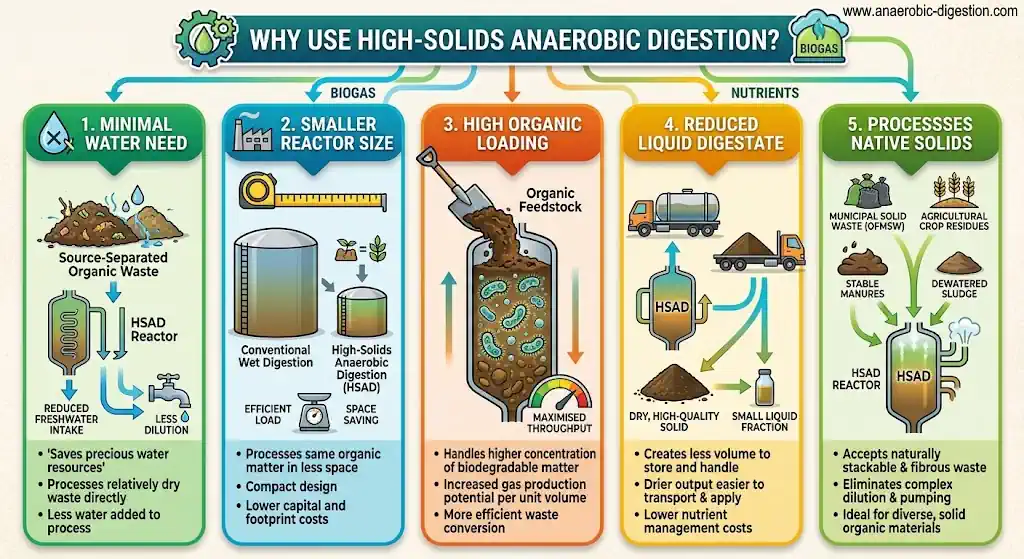
1. Reduced dilution-water requirement
HSAD can substantially reduce the amount of process water required compared with a conventional wet process treating the same relatively dry material.
This can be particularly important where water is scarce, expensive, or where additional water would later have to be removed from the digestate.
2. Smaller reactor volume
A more concentrated feed means that more biodegradable organic matter can potentially be contained within each cubic metre of digester volume.
This can reduce the tank or reactor volume required for a given mass throughput, although actual sizing must still take account of retention time, biodegradability, mixing, loading rate and process stability.
3. Reduced quantity of liquid digestate
Adding less process water may mean less dilute digestate leaving the plant.
This can reduce storage and liquid-handling requirements, although it does not eliminate the need for adequate digestate storage or responsible nutrient management.
4. Suitable for naturally solid feedstocks
High-solids systems can be particularly well suited to wastes and biomass that are naturally fibrous, stackable or relatively dry.
Which Feedstocks Are Suitable for High-Solids AD?
Potential feedstocks include:
- source-separated household and commercial organic waste;
- organic fractions recovered from municipal waste;
- food and green-waste mixtures;
- crop residues;
- straw and other lignocellulosic materials;
- solid manures;
- poultry litter in suitable mixtures;
- dewatered sludge;
- agricultural residues; and
- selected industrial organic wastes.
Being physically suitable for high-solids handling does not necessarily mean that a feedstock will digest readily.
Straw, for example, contains lignocellulosic material that is resistant to biological breakdown. Recent research continues to investigate pretreatment, microbial accessibility and reactor design as ways of improving methane production from high-solids straw digestion. See this 2025 review of high-solids straw anaerobic digestion.
High-Solids AD Versus Conventional Wet Anaerobic Digestion
Neither process is inherently “better”. The correct choice depends on feedstock properties, contamination, required throughput, water availability, downstream digestate use and project economics.
| Characteristic | High-Solids / Dry AD | Conventional Wet AD |
|---|---|---|
| Feed consistency | Thick, dense or potentially stackable | Pumpable liquid/slurry |
| Water addition | Generally lower | May require dilution |
| Reactor volume | Potentially smaller per tonne of solids | Generally larger where dilution is required |
| Mixing | More difficult | Usually easier |
| Pumping | May require specialist equipment or no pumping | Established slurry-pumping technology |
| Mass transfer | Can become limiting | Generally better |
| Feedstocks | Solid organic wastes, crop residues, OFMSW, solid manure | Slurries, liquid wastes, food slurries, sewage sludge |
The broader selection of reactor configuration should be considered as part of overall anaerobic digestion plant design, rather than selecting a process merely because it can accept a particular percentage of solids.
The Main Engineering Challenge: Mass Transfer
One of the most important differences between wet and high-solids digestion is mass transfer.
In a well-mixed liquid digester, soluble compounds, microorganisms, nutrients and intermediate digestion products are continuously redistributed throughout the reactor.
As solids content rises, movement becomes more restricted.
This can result in:
- uneven distribution of microorganisms;
- poor contact between bacteria and fresh substrate;
- local accumulation of volatile fatty acids;
- localised ammonia inhibition;
- pH differences;
- temperature differences; and
- slower overall degradation.
This is one reason why it is misleading to state simply that increasing digester solids automatically increases biogas output.
Higher volumetric loading may increase the amount of material processed per unit reactor volume, but biological stability must still be maintained.
Mixing High-Solids Digesters
Conventional propeller or pumped-recirculation mixing becomes progressively harder as viscosity increases.
Different technologies therefore use different approaches.
Mechanical mixing
Some horizontal plug-flow systems use slow-moving shafts or paddles to transport and homogenise the material.
Material recirculation
Processed digestate may be mixed with incoming feed to provide inoculation and improve consistency.
Percolate recirculation
Batch garage systems commonly circulate liquid through a stationary mass of solid feedstock.
The percolating liquid carries soluble organic compounds and microorganisms through the material and can connect the solid digestion chambers to a separate liquid-phase methanogenic process.
Gravity movement
Some vertical high-solids systems rely substantially on gravity and controlled feed/discharge rather than intensive internal mechanical mixing.
Continuous High-Solids Plug-Flow Digestion
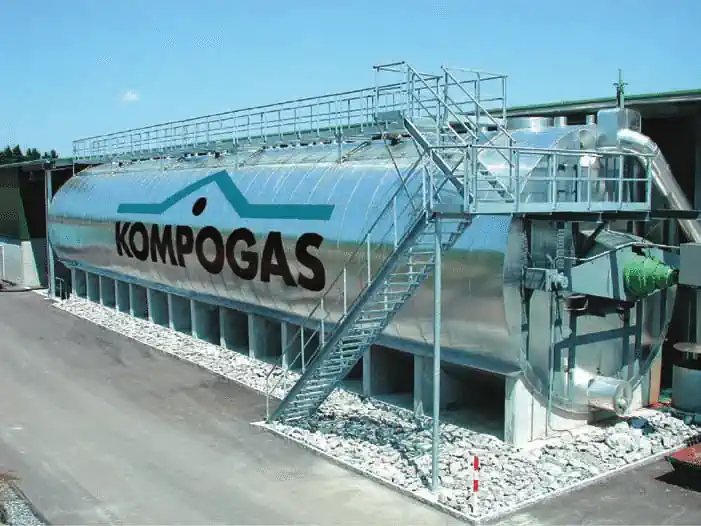
Continuous high-solids digesters may be horizontal or vertical.
Feedstock enters at one end or the top of the reactor and progressively moves through the digestion vessel before treated material is removed.
Commercial examples historically associated with this type of digestion include technologies such as DRANCO and Kompogas, although individual proprietary systems use significantly different feed preparation, temperature regimes, mixing and material-handling methods.
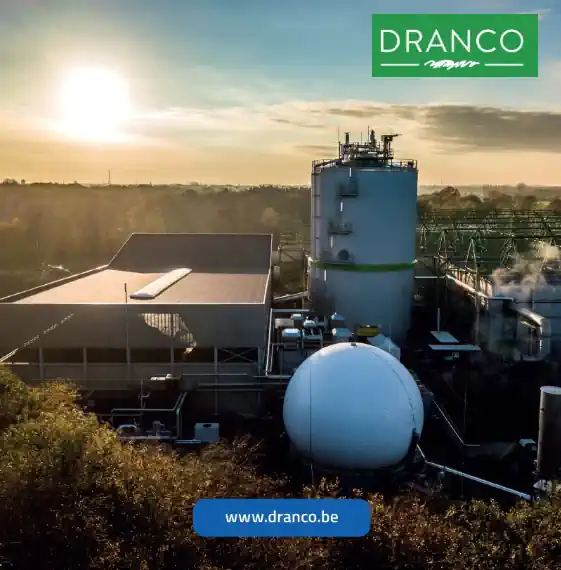
The important principle is that a high-solids continuous reactor has to achieve reliable movement of heterogeneous organic material while retaining sufficient biological activity throughout the digester.
Batch Tunnel or Garage Anaerobic Digestion
Batch dry digestion takes a very different approach.
A mixture of solid organic material and inoculum is loaded into a gas-tight chamber using a loader. The chamber is sealed and digestion takes place without continuously transporting the solids through pumps or pipes.
Liquid percolate is normally recirculated through the material.
Multiple chambers allow one batch to be loaded or unloaded while others remain in active digestion.
This approach can be particularly attractive for solid and structurally robust organic wastes that would be troublesome to pump.
Its disadvantages can include comparatively large loading areas, batch handling, the need for several chambers, management of percolate and potentially less uniform biological conditions than a thoroughly mixed wet reactor.
Does High-Solids AD Produce More Methane?
Not necessarily.
This is an important distinction between methane yield and volumetric productivity.
Methane yield is normally expressed relative to the quantity of volatile solids or organic matter fed to the plant.
Volumetric productivity expresses how much gas can be generated from a given reactor volume.
A high-solids process may be able to place considerably more organic material within a cubic metre of reactor, potentially increasing volumetric productivity.
But increasing solids concentration can simultaneously make biological conversion more difficult.
Research has identified restricted diffusion, high viscosity, poor mass transfer and accumulation of inhibitory compounds among the major challenges encountered as solids concentrations increase.
It is therefore incorrect to assume either that HSAD is intrinsically less efficient than wet digestion or that it will automatically produce more methane.
Performance depends on the feedstock, loading rate, temperature, retention time, reactor configuration, inoculation, mixing and process control.
Organic Loading Rate and Process Stability
One attraction of HSAD is the potential to operate at relatively high organic loading rates.
However, loading a reactor faster than its microbial population can convert the available substrate risks accumulation of intermediate products, particularly volatile fatty acids.
The result may be:
- falling pH;
- reduced methane production;
- increasing VFA concentrations;
- process instability; and ultimately
- digester failure.
High nitrogen feedstocks can create a different problem through elevated ammonia concentrations.
This makes feedstock characterisation and controlled loading particularly important when designing and operating high-solids plants.
Feedstock Preparation Matters
High-solids digestion does not remove the need for good feedstock preparation.
Depending on the waste stream, preparation may include:
- removal of plastics, metals, glass and grit;
- opening bags and containers;
- removal of packaging;
- size reduction;
- screening;
- blending;
- addition of inoculum;
- adjustment of moisture content; and
- removal of unsuitable contaminants.
For waste-derived feedstocks, contaminant management is especially important because anaerobic digestion destroys biodegradable organic matter but does not make plastics, glass, metals or grit disappear.
Poor front-end separation simply transfers those contaminants into the digestion plant and ultimately into the digestate or reject streams.
Digestate From High-Solids Anaerobic Digestion
The digestate from HSAD will generally contain less added water than digestate from an equivalent highly diluted process.
That can be advantageous, but the material still has to be stored, transported and used appropriately.
Digestate characteristics depend heavily on:
- the original feedstocks;
- process water additions;
- degradation achieved;
- contaminant content;
- nutrient concentration; and
- any subsequent dewatering, composting or other treatment.
For some dry digestion processes, the solid digestate is subsequently aerobically matured or composted.
Whether the final material can be beneficially used on agricultural land depends on its origin, quality, contamination and the applicable regulatory regime.
Advantages of High-Solids Anaerobic Digestion
Potential advantages include:
- lower dilution-water requirements;
- smaller reactor volumes for concentrated feedstocks;
- ability to process feedstocks that are difficult to handle in conventional wet systems;
- potentially lower heating demand associated with unnecessary process water;
- reduced volumes of dilute liquid digestate;
- high organic loading per unit reactor volume; and
- application to municipal, agricultural and commercial solid organic wastes.
Limitations and Disadvantages of High-Solids AD
The principal challenges can include:
- difficult mixing and material handling;
- reduced mass transfer;
- high viscosity;
- specialised feed and discharge equipment;
- potentially uneven biological conditions;
- local accumulation of inhibitory compounds;
- more complex monitoring because representative sampling can be difficult;
- abrasion and wear where contaminants are present; and
- greater dependence on appropriate feedstock consistency.
A recent systematic review of dry AD literature similarly identifies mass-transfer limitations, microbial contact and the treatment of heterogeneous feedstocks as important constraints on high-solids operation.
When Should High-Solids AD Be Considered?
High-solids digestion deserves serious consideration where:
- the available feedstock is naturally high in dry matter;
- large-scale dilution would provide little process benefit;
- water availability is constrained;
- feedstock would be difficult or costly to convert into a conventional pumpable slurry;
- reducing reactor volume offers a significant site or capital advantage;
- solid organic waste needs diversion from landfill or other disposal routes; or
- the chosen technology has a strong operating track record on comparable feedstock.
Conversely, a high-solids process should not be selected merely because a brochure claims a higher organic loading rate or smaller digester.
Technology selection should consider the complete system: feed reception, contaminant removal, reactor operation, gas production, parasitic energy demand, digestate management, reliability, maintenance and whole-life cost.
High-Solids AD Is a Process Choice, Not Simply a Percentage
The most useful way to view high-solids anaerobic digestion is therefore not as an arbitrary dividing line on a solids-content chart.
It is a family of anaerobic digestion approaches designed to process concentrated organic material while managing the engineering and biological consequences of having relatively little free water.
The technology can offer important advantages, particularly for solid wastes and biomass that would otherwise require substantial dilution.
However, higher solids content also means that mixing, diffusion, substrate contact, inhibition and material handling become increasingly important.
A successful HSAD project therefore requires the reactor type and feed-management system to be selected around the actual physical and biochemical characteristics of the intended feedstock.
Readers specifically interested in non-pumpable and dry-process technology should continue to our guide to the Dry Anaerobic Digestion Process. For the wider engineering choices involved in selecting an AD configuration, see Anaerobic Digestion Plant Design.
Frequently Asked Questions About High-Solids Anaerobic Digestion
What is high-solids anaerobic digestion?
High-solids anaerobic digestion is anaerobic digestion carried out at elevated total-solids concentrations compared with conventional wet digestion. Definitions vary, but many modern references describe HSAD systems operating at approximately 20% to 40% total solids.
Is high-solids anaerobic digestion the same as dry AD?
The terms are frequently used interchangeably, but not always consistently. Dry AD generally describes digestion of relatively solid or non-freely-pumpable substrates, while “high solids” may also be used for highly concentrated substrates that can still be mechanically transported. The solids content and reactor configuration should therefore always be stated.
What materials can be treated by high-solids AD?
Potential feedstocks include OFMSW, food and green waste mixtures, solid manure, crop residues, straw, agricultural wastes and selected dewatered industrial or sewage sludges.
What total-solids content is considered high solids?
There is no universal threshold. Some literature uses approximately 15–20% TS as the transition toward dry digestion, while recent reviews commonly describe HSAD reactors operating at approximately 20–40% TS.
Does high-solids AD need mixing?
That depends on the technology. Some systems use mechanical mixing, others use digestate recirculation or gravity flow, while batch tunnel systems commonly circulate liquid percolate through stationary solid feedstock.
Is high-solids AD more efficient than wet digestion?
Neither is universally more efficient. High-solids systems can reduce dilution water and reactor volume, but may suffer greater mass-transfer and mixing limitations. The optimum process depends on the feedstock and overall project requirements.
What is the main disadvantage of high-solids anaerobic digestion?
The principal technical difficulty is maintaining adequate contact between substrate and microorganisms as solids concentration and viscosity increase. Mixing, diffusion, inhibition and reliable material handling can all become more challenging.
Technical Sources and Further Reading
- Water Science & Technology – Review of Full-Scale Advanced Anaerobic Digestion in North America
- Bioresource Technology – Dry Anaerobic Digestion of Organic Waste: A Review of Operational Parameters and Their Impact on Process Performance
- Environmental Research – High-Solids Anaerobic Digestion of Straw: Performance Improvement and Circular Economy
- Biotechnology for Biofuels and Bioproducts – Current Challenges of High-Solid Anaerobic Digestion
- Environments – High-Solid Anaerobic Digestion: Strategies for Increasing Reactor Performance
This article was originally published in 2014 and extensively revised in 2019. It has been comprehensively rebuilt and updated for 2026 to reflect current understanding of high-solids, dry and solid-state anaerobic digestion.
As described on our pages about “Wet” and “Dry” anaerobic digestion the transition between the two is governed by the ability of the available pump technology to move the materials through the process reliably without blockages or high pumping costs due to rapid wear.



I think this website is a one-off gem.
Ohio, is at the forefront of “green” technology as it manages the biosolids generated from the Water Reclamation Facility. The Renewable Energy Facility, once known as the Akron Compost Facility, now uses a state of the art high solids anaerobic digestion system (ADS). Biosolids once used to make compost is now transformed into biogas that produces renewable energy in the form of electricity.