



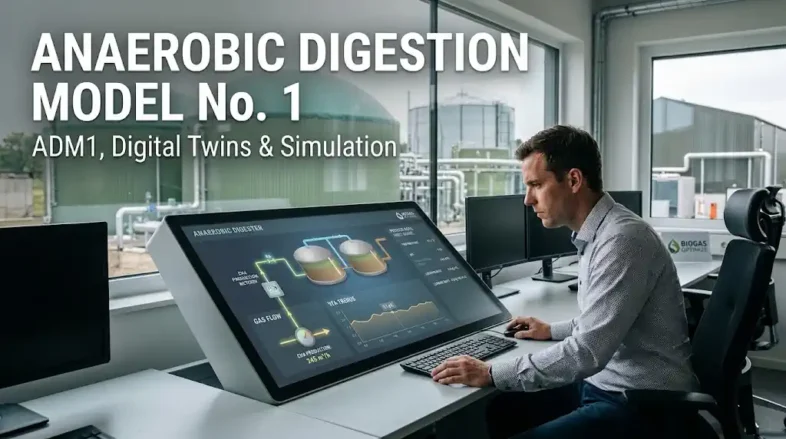
The Anaerobic Digestion Model No. 1, usually known as ADM1, remains the best-known structured mathematical model of the anaerobic digestion process.
First published by an International Water Association (IWA) task group in 2002, ADM1 was developed to provide researchers and engineers with a common mathematical framework for describing the biological and physicochemical processes occurring inside an anaerobic digester.
More than two decades later, ADM1 is still widely used. However, anaerobic digestion modelling has moved considerably beyond the original model.
Editor’s note, 2026: In 2021, a reader commented on the original 2014 version of this page that the information was “way out of date” and asked whether better anaerobic digestion computer models had appeared. That person was right to ask.
This article has now been completely rewritten to cover ADM1, simplified models, process simulation, soft sensors, digital twins and the growing use of artificial intelligence in anaerobic digestion modelling.
Today’s work increasingly includes:
- modified and simplified ADM1 models;
- process simulation;
- automatic model calibration;
- soft sensors and state estimation;
- model predictive control;
- machine learning;
- hybrid mechanistic and data-driven models; and
- digital twins of operating anaerobic digestion plants.
This article explains what ADM1 actually does, where it remains useful, why it can be difficult to apply in practice and how modern modelling techniques are extending its role in the optimisation of anaerobic digestion and biogas plants.
Key Takeaways
- ADM1 remains the best-known structured anaerobic digestion model and is still widely used in research, simulation and process analysis.
- It represents key biological stages including hydrolysis, acidogenesis, acetogenesis and methanogenesis, together with important physicochemical processes.
- Full ADM1 is not always the best practical choice. Simpler models can be easier to calibrate, faster to run and more suitable for real-time control.
- Modern anaerobic digestion modelling increasingly includes soft sensors, digital twins, machine learning and hybrid mechanistic/data-driven models.
- The quality of feedstock characterisation and plant data is often more important than model complexity.
- For plant operators, the best model is usually the simplest one that answers the engineering question reliably.
What Is the Anaerobic Digestion Model No. 1?
ADM1 is a mathematical representation of the major biological and physicochemical processes taking place during anaerobic digestion.
The International Water Association’s Anaerobic Digestion Modelling Task Group was established in 1997 and developed ADM1 with the aim of creating a generalised model that could provide a common platform for research, design, process simulation and optimisation.
The landmark model was published in 2002 by Batstone and colleagues.
See: Batstone et al. – The IWA Anaerobic Digestion Model No. 1 (ADM1).
Rather than treating the digester simply as a “black box” producing a certain quantity of biogas from a particular feedstock, ADM1 attempts to represent the different stages through which organic material passes.
What Processes Does ADM1 Model?
The anaerobic digestion process is often explained as four broad biological stages:
- hydrolysis;
- acidogenesis;
- acetogenesis; and
- methanogenesis.
ADM1 represents these processes in substantially greater detail.
Disintegration
Complex particulate organic material is first represented as being broken into simpler fractions including carbohydrates, proteins and lipids.
Hydrolysis
Those complex materials are then converted into soluble compounds such as:
- sugars;
- amino acids; and
- long-chain fatty acids.
Acidogenesis
These soluble compounds are fermented by microorganisms to form intermediates including volatile fatty acids, hydrogen and other products.
Acetogenesis
Long-chain fatty acids and other intermediate volatile fatty acids are converted largely into acetate, hydrogen and carbon dioxide.
Methanogenesis
Methanogenic microorganisms then produce methane through principal routes including:
- conversion of acetate to methane; and
- conversion of hydrogen and carbon dioxide to methane.
ADM1 also includes important physicochemical processes such as acid-base reactions and gas-liquid transfer.
That is important because anaerobic digestion performance depends not only on microbial conversion rates but also on parameters such as pH, alkalinity, dissolved gases and inhibition.
What Can an Anaerobic Digestion Model Predict?
Depending upon the model, its configuration and the quality of the input data, modelling may be used to estimate variables including:
- biogas production;
- methane production;
- biogas composition;
- volatile fatty acid concentrations;
- pH;
- ammonium and ammonia concentrations;
- substrate degradation;
- microbial population behaviour;
- organic loading response;
- hydraulic retention effects; and
- responses to changes in operating conditions.
A model can therefore be much more than a tool for predicting how much methane a tonne of feedstock might produce.
Properly calibrated models can potentially help engineers investigate why a digester behaves as it does and how the process might respond to operational changes.
Why Is ADM1 Still Important?
ADM1 remains important because it created a common structured description of anaerobic digestion that could be used, compared and extended by researchers around the world.
A major 2023 review in Water Research described ADM1 as the most commonly used structured anaerobic digestion model.
The review also documented the large number of modifications that have subsequently been made to the original model, including:
- additional biochemical processes;
- modified inhibition functions;
- changed kinetic parameters;
- different substrate characterisation methods;
- model simplification;
- applications beyond conventional digestion; and
- integration with biogas upgrading and resource-recovery models.
See: Mo et al. – Modifications to ADM1: A Comprehensive Review.
The Biggest Practical Problem: Calibration
A mathematical model is only as useful as its inputs and calibration.
This is particularly important for anaerobic digestion because real feedstocks are highly variable.
Food waste, manure, sewage sludge, crop silage and industrial residues have very different:
- carbohydrate contents;
- protein contents;
- lipid contents;
- biodegradability;
- inert fractions;
- nitrogen contents;
- trace element concentrations; and
- potential inhibitors.
Even two nominally similar food-waste streams may behave differently.
Before ADM1 can produce useful results, the incoming material must therefore be represented appropriately within the model.
That requires feedstock characterisation and often estimation or adjustment of kinetic and stoichiometric parameters.
The danger is obvious: a highly sophisticated model can create very precise-looking predictions from poorly characterised input data.
Complexity does not compensate for poor data.
Do AD Plant Operators Actually Need Full ADM1?
Not necessarily.
Full ADM1 is extremely useful for research and detailed process analysis, but it can be unnecessarily complex for some operational purposes.
A plant operator may primarily want answers to questions such as:
- What will happen if feed rate increases by 10%?
- Will a new feedstock increase gas production?
- Is VFA accumulation likely?
- How quickly will the plant recover from an upset?
- Can loading be increased without compromising stability?
- Is the observed gas decline caused by feedstock change or process inhibition?
A simpler model that answers these questions reliably may be more useful operationally than a highly detailed model requiring large numbers of difficult-to-measure inputs.
Simplified Anaerobic Digestion Models
This is why simplified models remain important.
They deliberately represent fewer biological states and reactions, which can provide several practical advantages:
- fewer parameters to estimate;
- less demanding calibration;
- lower computational requirements;
- faster simulation; and
- easier integration into real-time control systems.
A particularly interesting 2026 study compared ADM1 with the simpler AM2 anaerobic digestion model using 15 years of operating data from a full-scale multi-substrate digester.
The researchers assessed their suitability for real-time digital twins and reported that the simpler AM2 model achieved substantially lower computational cost while performing strongly for the application examined.
This does not mean that AM2 is universally “better” than ADM1.
Rather, it illustrates an important engineering principle:
The best anaerobic digestion model is not necessarily the most complicated one. It is the model that provides sufficient accuracy for the decision being made.
What Is an Anaerobic Digestion Digital Twin?
A digital twin is a computational representation of a physical system that is continuously or repeatedly updated using data from the real plant.
In an anaerobic digestion application, a digital twin might combine:
- a mathematical process model;
- online plant sensor data;
- laboratory measurements;
- feedstock information;
- historical operating data; and
- control or optimisation algorithms.
Unlike a conventional one-off simulation, a digital twin is intended to remain connected conceptually — and often electronically — with the operating plant.
Potential applications include:
- predicting digester behaviour;
- testing operating changes before applying them to the real plant;
- detecting abnormal conditions;
- estimating variables that cannot be measured continuously;
- optimising organic loading;
- predicting methane production; and
- supporting preventative intervention before process failure occurs.
Soft Sensors: Estimating What Cannot Easily Be Measured
One of the most promising developments in modern anaerobic digestion modelling is the use of soft sensors.
A soft sensor is not necessarily a physical instrument.
Instead, it is a mathematical or computational model that estimates a difficult-to-measure process variable from other data that are easier to obtain.
For example, an AD plant may continuously measure:
- temperature;
- pH;
- gas flow;
- methane concentration;
- feed rate; and
- tank level.
But other stability-critical parameters such as:
- individual volatile fatty acids;
- ammonia;
- alkalinity;
- biodegradable substrate concentration; or
- microbial-state variables
may only be measured intermittently or may be expensive to monitor continuously.
A soft sensor attempts to estimate these hidden variables from the information that is available.
A 2026 review in Process Biochemistry describes three broad approaches to AD soft sensing:
- observer-based models derived from mechanistic process descriptions;
- data-driven models using statistical or machine-learning methods; and
- hybrid models combining mechanistic knowledge with data-driven learning.
Applications now include state estimation, fault detection and process optimisation.
See: Soft Sensors in Anaerobic Digestion: Cross-Study Insights, Applications and Future Directions.
Artificial Intelligence and Anaerobic Digestion Modelling
Artificial intelligence is increasingly being applied to anaerobic digestion, but this does not necessarily mean replacing mechanistic models such as ADM1.
Machine-learning models can be useful where large quantities of operating data exist and complex relationships are difficult to represent explicitly.
Applications being investigated include:
- methane-yield prediction;
- fault detection;
- process optimisation;
- feedstock classification;
- anomaly detection;
- predictive maintenance; and
- process-control support.
However, purely data-driven models have an important weakness: they may perform very well within the range of data on which they were trained but poorly when plant conditions move outside that range.
This is particularly relevant to AD because feedstocks can change substantially over time.
Hybrid Models May Be Particularly Important
One of the most promising approaches is therefore to combine mechanistic process knowledge with machine learning.
These are sometimes called hybrid or grey-box models.
A mechanistic model such as ADM1 provides the biological framework and imposes physically meaningful constraints.
Machine learning can then potentially help:
- estimate difficult parameters;
- correct systematic model errors;
- adapt the model as feedstocks change;
- identify nonlinear relationships in plant data; and
- improve short-term forecasting.
Recent reviews of artificial intelligence in anaerobic digestion identify hybrid modelling, explainable AI, soft sensors and digital twins as important directions for future development.
ADM1 Simulation Software
ADM1 is a model framework rather than a single commercial software product.
It has been implemented in many programming and process-modelling environments.
Modern examples include WaterTAP, an open-source water-treatment modelling framework that includes an ADM1 implementation for anaerobic digestion simulation.
See: WaterTAP – Anaerobic Digestion Model No. 1.
ADM1 has also continued to appear in newer open-source implementations.
For example, ADM1jl, published in 2024, implements ADM1 using the Julia programming language and was developed with computational speed and flexibility in mind.
See: ADM1jl: A Julia Implementation of Anaerobic Digestion Model 1.
This continuing development matters because faster models are increasingly useful where simulations need to be run repeatedly for optimisation, uncertainty analysis or digital-twin applications.
Where Anaerobic Digestion Modelling Is Most Useful
For engineers and plant operators, modelling can potentially add value in several distinct situations.
Plant Design
Models can be used to investigate hydraulic retention time, organic loading, expected gas production and potential process limitations before a plant is built.
Feedstock Assessment
Modelling can help evaluate how different feedstocks or co-digestion mixtures may affect digestion performance.
Process Optimisation
Operating conditions can be tested virtually before changes are made to the real digester.
Troubleshooting
A calibrated model may help distinguish between possible causes of deteriorating performance, including overload, inhibition or feedstock changes.
Control
Models can be incorporated into advanced process-control systems, including model predictive control.
Research
ADM1 remains particularly valuable for researchers examining the behaviour and interactions of anaerobic digestion processes.
What Anaerobic Digestion Models Still Cannot Do Reliably
It is important not to oversell modelling.
A computer model does not eliminate uncertainty from anaerobic digestion.
Important limitations remain.
Feedstock Variability
Real organic wastes are highly variable and may not be characterised often enough to support detailed modelling.
Biological Complexity
The microbial ecology of anaerobic digestion is substantially more complex than any practical engineering model can represent completely.
Parameter Uncertainty
Many kinetic and stoichiometric parameters must be measured, estimated or fitted.
Scale-Up
A model calibrated using laboratory data does not automatically represent the mixing, mass transfer and spatial variability of a full-scale digester.
Sensor Reliability
Digital-twin and soft-sensor applications depend on reliable plant measurements. Sensor drift, fouling and missing data can degrade model performance.
False Precision
Perhaps most importantly, model outputs may appear much more precise than the underlying data justify.
Engineering judgement remains essential.
ADM1 Versus AI: Which Will Win?
This is probably the wrong question.
Mechanistic models and artificial intelligence have different strengths.
ADM1 attempts to represent what is happening biologically and chemically inside the digester.
Machine-learning models identify relationships within data.
Mechanistic models tend to be more interpretable but can be difficult to calibrate.
Machine-learning models can learn complex patterns without explicitly modelling every biological mechanism, but they can fail when conditions move outside their training data.
The most useful future systems may therefore combine both approaches.
A mechanistic model can provide biological structure, while machine learning adapts predictions using actual plant data.
That combination is particularly attractive for digital twins and intelligent process-control systems.
Why Interest in AD Modelling May Be Growing Again
For many years, anaerobic digestion modelling remained largely an academic and specialist engineering subject.
Several developments are now making it more practically relevant:
- much more plant data are being collected digitally;
- online gas and process sensors have improved;
- computing power has become inexpensive;
- open-source simulation tools are more accessible;
- machine-learning methods have advanced rapidly;
- operators increasingly want to maximise methane yield and plant availability;
- biomethane plants place greater economic value on every unit of methane produced; and
- digital twins are moving from a research concept toward industrial application.
The economic incentive is straightforward.
If better modelling allows an operator to increase loading safely, detect instability earlier, reduce methane losses or avoid a prolonged biological upset, the value can greatly exceed the cost of the modelling work.
The Future of Anaerobic Digestion Modelling
ADM1 is unlikely to disappear.
Its significance is not that the original 2002 formulation represents the final word on anaerobic digestion modelling.
Rather, it created a common platform that continues to be modified, simplified and incorporated into newer modelling approaches.
The direction of development now appears to be toward models that are:
- more adaptable to different feedstocks;
- easier to calibrate;
- faster to run;
- connected to real plant data;
- capable of estimating unmeasured process states;
- integrated with automated control systems; and
- combined with machine learning where this adds practical value.
The most sophisticated model will not necessarily be the most useful.
For practical anaerobic digestion engineering, the objective should be to use the simplest model that reliably answers the engineering question being asked.
That might sometimes be full ADM1.
In other circumstances, it may be a simplified mechanistic model, a soft sensor, a machine-learning predictor or a hybrid digital twin.
What has changed since this page was first published in 2014 is that these approaches are increasingly capable of moving modelling away from purely academic simulation and toward real-time plant monitoring, prediction and optimisation.
FAQs
What is ADM1?
ADM1 stands for Anaerobic Digestion Model No. 1. It is a mathematical model developed by an International Water Association task group to describe the main biological and physicochemical processes taking place inside an anaerobic digester.
Is ADM1 still used?
Yes. ADM1 remains one of the most widely used structured anaerobic digestion models. It continues to be used in research, process simulation, optimisation studies, model development and as the basis for newer simplified and hybrid models.
What does ADM1 predict?
Depending on its configuration and calibration, ADM1 can predict or simulate variables such as biogas production, methane production, volatile fatty acid concentrations, pH, substrate degradation and responses to changes in operating conditions.
Is ADM1 suitable for operating full-scale AD plants?
It can be, but full ADM1 may be more complex than necessary for some operational applications. Simpler models can sometimes provide sufficiently accurate predictions with fewer parameters, easier calibration and lower computational requirements.
What is the difference between ADM1 and a digital twin?
ADM1 is a mathematical process model. A digital twin is a broader digital representation of a real plant that may use ADM1 or another model together with live sensor data, laboratory measurements, historical operating data and optimisation or control algorithms.
Can artificial intelligence replace ADM1?
Not necessarily. AI and machine learning can be very effective for prediction and pattern recognition, but they may perform poorly when plant conditions move outside the range of their training data.
Mechanistic models such as ADM1 provide biological structure, physical constraints and greater interpretability. For many future applications, hybrid systems combining mechanistic modelling with machine learning may be more useful than either approach on its own.
What software can be used for ADM1 simulation?
ADM1 has been implemented in a range of modelling and programming environments. Modern examples include open-source frameworks such as WaterTAP and newer language-specific implementations such as ADM1jl in Julia.
What is the biggest limitation of anaerobic digestion modelling?
One of the biggest limitations is the quality of the input data. Feedstocks can vary greatly in composition and biodegradability, and poor characterisation can produce misleading model outputs regardless of how sophisticated the model is.
Key References and Further Reading
- Batstone et al. (2002) – The IWA Anaerobic Digestion Model No. 1 (ADM1)
- Mo et al. (2023) – Modifications to ADM1: A Comprehensive Review
- Industrial Validation of ADM1 and AM2 for Real-Time Digital Twins (2026)
- Soft Sensors in Anaerobic Digestion: Cross-Study Insights and Future Directions (2026)
- Artificial Intelligence in Anaerobic Digestion: Sensors, Modelling and Optimisation
- WaterTAP ADM1 Documentation
- ADM1jl – Julia Implementation of Anaerobic Digestion Model 1
This article was originally published in 2014 and substantially rewritten in September 2026 to reflect current developments in ADM1, anaerobic digestion simulation, soft sensors, digital twins and AI-assisted process optimisation.
Note: Links may appear with a strikethrough line. This is not usually provided to show a broken link, but it does indicate that you will be asked to prove you are not a bot/computer!
[Published 11 November 2014. Rewritten September 2026.]


Dear Biogas Business. You ought to be making the biogas all-day, but there will be days when there is a power failure. Keep working, with one of our portable generators, fulfill orders within committed dates. This is the first of the finest blogs on the web!
Is anaerobic digestion really the best model? If you are fortunate and have a natural source of running water on your property, then hydropower might be for you. Hydropower involves diverting a portion of the water through a turbine or a wheel in order to provide your home with power. Once you have the equipment, the power will be free and much cleaner than traditional electricity, gas, or oil.
This information is way out of date. There must surely be better anaerobic digestion process computer models than are shown here? May I make a plea for an update?