



Biogas additives can improve anaerobic digester performance, but only when the additive addresses a genuine limitation in the process. Trace elements, enzymes, iron compounds, buffering agents, antifoams and other products all have legitimate applications, but there is no universal additive that will automatically increase methane yield in every digester.
No reputable additive supplier will ever tell you that. But it is true that a digester may be suffering from one or more trace-element deficiencies, and additives that correct those deficiencies, when they occur, do tend to increase methane yield.
This is an important lesson that came from pioneering UK research into the anaerobic digestion of food waste before 2010. Researchers, and at least one pioneering AD plant operator, were finding that digesters that initially appeared to operate successfully could later suffer methanogenic failure because essential trace nutrients were gradually depleted.
Research led by Professor Charles J. Banks and colleagues at the University of Southampton helped explain why. Their work demonstrated that trace-element deficiencies could destabilise food-waste digestion and subsequently identified selenium and cobalt as particularly important under the conditions they studied.
This provides a useful principle for anyone considering biogas additives today:
Do not start by asking which additive will increase biogas production. Start by identifying what is limiting the anaerobic digestion process, and then determine whether an additive can correct that limitation.
Always: Diagnose first. Dose second. Measure the result.
Key Takeaways
- Biogas additives are not universal methane boosters. They should be selected to correct an identified biological, chemical or operational limitation.
- Trace-element deficiency can cause genuine digester failure. University of Southampton research demonstrated this in food-waste-only anaerobic digestion.
- Early failure may be delayed. Trace elements introduced with inoculum can initially mask a deficient feedstock before being progressively depleted.
- Selenium and cobalt can be critical. Southampton researchers identified deficiencies associated with propionate accumulation and unstable food-waste digestion under high-ammonia conditions.
- Different additives perform different jobs. Trace elements, enzymes, iron compounds, buffers and antifoams should not be treated as interchangeable products.
- Diagnosis should come before dosing. Analyse feedstock, digestate and process trends before deciding what, if anything, should be added.
- Economics matter. Even an additive that improves biological performance must produce benefits that justify its continuing cost.
What Are Biogas Additives?
Biogas additives are materials deliberately introduced into an anaerobic digestion system to influence biological activity, process chemistry, feedstock breakdown, gas quality or physical operating characteristics.
The term covers products performing very different functions.
Common categories include:
- trace-element supplements supplying micronutrients required by anaerobic microorganisms;
- enzyme preparations intended to assist hydrolysis of particular feedstock components;
- iron compounds used particularly for sulphide control;
- buffering or alkalinity agents used where process chemistry requires correction;
- antifoaming products used to control operational foaming;
- adsorbents and conductive materials investigated for effects on inhibition or microbial interactions; and
- microbial or biological preparations marketed for bioaugmentation or process recovery.
It is therefore misleading to ask simply whether “biogas additives work”.
The better questions are: What problem exists, what is causing it, and does the proposed additive address that cause?
Why Food-Waste Digesters Helped Reveal the Importance of Trace Elements
The history of trace-element supplementation in UK food-waste anaerobic digestion is particularly instructive.
During the development of digestion systems using source-separated food waste as essentially the sole substrate, researchers encountered an awkward problem.
The material was clearly biodegradable. Digesters could be started successfully and could produce substantial quantities of biogas.
Yet some apparently successful food-waste digestion trials subsequently became unstable.
The question was no longer simply whether food waste could be anaerobically digested. It was why a digester that had initially worked could later suffer declining methanogenic performance and potentially fail.
A note from the author: I remember this period particularly well. Those of us in the UK who saw anaerobic digestion as an essential future route for diverting food waste and other biodegradable wastes from landfill were concerned by the instability being encountered in food-waste-only digestion.
The material was obviously highly biodegradable and digesters could initially perform well, yet prolonged operation could result in deteriorating methane production and process failure. At the time, within the UK AD industry circles in which I was involved, there was no widely understood explanation for why this was happening.
The Southampton research was therefore important not simply as an academic investigation of trace elements, but because it helped explain a practical problem that was troubling people trying to establish food-waste AD as a reliable long-term waste-treatment technology.
The 2008 Climenhaga and Banks experiments
An important contribution came from M.A. Climenhaga and Professor Charles J. Banks at the University of Southampton.
In research published in 2008, they operated bench-scale single-stage anaerobic digesters using source-separated food waste collected from a university catering facility. The feedstock included fruit, vegetables, meat and fried foods.
The researchers operated duplicate digesters, with one receiving regular micronutrient supplementation and its counterpart receiving no supplementation.
The results were striking.
Unsupplemented reactors operating at hydraulic retention times of 25, 50 and 100 days experienced methanogenic failure after approximately 40, 100 and 90 days respectively.
The corresponding reactors receiving micronutrient supplementation maintained stable digestion.
This was important evidence that food waste could contain plenty of biodegradable organic matter while still failing to provide the complete micronutrient environment required for stable long-term methanogenesis.
Why Can Trace-Element Deficiency Take Months to Appear?
One reason this problem can be difficult to recognise is that a newly commissioned digester does not begin life biologically empty.
Digesters are normally inoculated with an established anaerobic biomass, often obtained from sewage-sludge digestion, animal slurry or another operating digester.
That inoculum brings trace elements with it.
A food-waste digester can therefore start successfully even where the continuing feed does not provide all the micronutrients required for indefinite operation.
As the original inoculum is progressively displaced and its trace-element reserves are depleted, the deficiency may eventually become apparent.
The University of Southampton subsequently highlighted this delayed-failure mechanism in its research programme on the stable operation of food-waste digestion.
This is an important practical lesson: successful commissioning does not prove that the long-term nutrient balance of a mono-feedstock digester is adequate.
The Southampton Research Identified Selenium and Cobalt
The Southampton work subsequently went considerably further.
Professor Charles Banks, Yue Zhang, Ying Jiang and Professor Sonia Heaven investigated why food-waste digesters operating at elevated ammonia concentrations developed characteristic accumulations of propionic acid that could lead to process failure.
Their research, published online in 2011 and in Bioresource Technology in 2012, identified selenium deficiency as particularly important.
Selenium was required for metabolic processes associated with propionate oxidation and syntrophic hydrogenotrophic methanogenesis.
At higher organic loading rates, cobalt also became limiting.
The researchers established critical feed concentrations under the conditions studied of approximately:
- selenium: 0.16 mg/kg fresh matter feed; and
- cobalt: 0.22 mg/kg fresh matter feed.
With appropriate supplementation, the researchers were able to increase organic loading to 5 g VS/litre/day while maintaining process performance and stability.
These figures should not be treated as universal dosing recommendations for commercial anaerobic digesters. Requirements depend on feedstock composition, background trace-element concentrations, loading, retention time, ammonia concentration, bioavailability and other process conditions.
The significance of the Southampton work is the principle it demonstrated: a digester can fail because an essential micronutrient required by its microbial community is deficient, and targeted supplementation can remove that limitation.
Ammonia Changed the Methane-Production Pathway
There was another particularly interesting finding from the Southampton research.
Analysis of the microbial population found only hydrogenotrophic methanogens in the high-ammonia food-waste digestion system. The researchers reported that the acetoclastic methanogens had been lost through ammonia toxicity.
This is important because it shows why trace-element requirements cannot always be understood simply by looking at the bulk chemical composition of the feedstock.
The operating environment can alter the microbial community and even the dominant biochemical route through which methane is produced.
Where direct acetoclastic methanogenesis is inhibited, acetate may instead be oxidised syntrophically, with hydrogenotrophic methanogens subsequently producing methane using hydrogen and carbon dioxide.
For a detailed explanation of the competing methane-production pathways, see our article on acetoclastic methanogenesis and acetoclastic methanogens.
This is a useful example of how apparently simple operational observations — rising VFAs, declining stability or poorer methane production — may reflect quite complex changes within the microbial ecosystem.
What Does the Southampton Research Mean for Today’s AD Operator?
 The most important conclusion is not that every food-waste digester should routinely receive selenium and cobalt at a standard dose.
The conclusion is that nutrient deficiency should be treated as a diagnosable process limitation.
If a digester is experiencing unexplained VFA accumulation, reduced conversion efficiency or deteriorating stability, the operator should consider whether the feedstock supplies an adequate and bioavailable range of essential trace elements.
This is particularly relevant where:
- the plant relies heavily on one feedstock;
- feedstock composition has changed;
- organic loading has increased;
- the plant initially operated successfully but subsequently deteriorated;
- propionate or other VFAs are accumulating;
- ammonia concentrations are high; or
- previously beneficial co-substrates have been removed from the feed mix.
Feedstock and digestate analysis, considered alongside process data, can then help determine whether supplementation is justified.
That is fundamentally different from adding a generic product simply because it is advertised as increasing biogas yield.
Trace-Element Additives for Anaerobic Digestion
 Methanogenesis and the biochemical reactions supporting it depend on numerous enzymes and cofactors containing trace metals.
Elements commonly discussed in anaerobic digestion nutrition include:
- cobalt;
- nickel;
- selenium;
- iron;
- molybdenum;
- tungsten; and
- other micronutrients required in very small quantities.
The word trace is important. These elements may be biologically essential at low concentrations yet ineffective, inhibitory or toxic if supplied unnecessarily or excessively.
More is not necessarily better.
Neither is total concentration necessarily equivalent to biological availability. Chemical speciation, precipitation and interactions with sulphide and other components of digester liquor can influence how much of an element is actually available to microorganisms.
This is why a properly formulated trace-element programme should be based on the characteristics of the particular plant rather than copied blindly from another digester.
Iron Additives for Hydrogen Sulphide Control
Iron compounds are also widely used in anaerobic digestion, particularly to control sulphide.
Iron can react with sulphide to form insoluble iron sulphides, reducing the quantity of hydrogen sulphide reaching the biogas.
This can help protect downstream equipment and reduce the burden on gas-cleaning systems.
But this illustrates why all biogas additives should not be placed in a single category.
An iron product dosed primarily for H2S control is performing a different job from selenium or cobalt supplied to correct a microbial micronutrient deficiency.
Both may legitimately be described as additives, but the reasons for using them and the measures of success are different.
Enzyme Additives
 Commercial enzyme preparations are also available for anaerobic digestion.
Their purpose is generally to accelerate or improve the breakdown of particular organic materials during hydrolysis, potentially making biodegradable material available more readily to the downstream microbial community.
Whether this produces a worthwhile benefit depends heavily on the feedstock.
If hydrolysis is genuinely rate-limiting, an appropriate enzyme treatment may have value. If another part of the process is limiting methane production, additional enzyme activity may achieve little.
Operators should therefore be cautious about transferring performance claims from one substrate or digester configuration to another.
 Some enzyme preparations are intended primarily to modify digester rheology rather than directly increase methane yield. By breaking down components that contribute to high slurry viscosity, enzyme treatment may improve pumpability and mixing and potentially reduce agitation-energy requirements.
Full-scale research has demonstrated significant reductions in apparent viscosity following enzyme addition, although in that study the reduction in viscosity did not produce a measurable increase in specific methane yield. This distinction is important: an enzyme additive may provide a worthwhile operational and energy-saving benefit without increasing the ultimate methane yield of the feedstock.
Buffers and Alkalinity Addition
Buffering agents may be used where alkalinity is insufficient to resist acidification.
Again, diagnosis matters.
Adding alkalinity can help maintain an acceptable pH while a process disturbance is corrected, but it does not necessarily remove the biological cause of excessive VFA production.
A digester can have an apparently acceptable pH while accumulating VFAs if sufficient buffering capacity is present.
Operators should therefore interpret pH together with alkalinity, VFA trends, gas production, methane concentration, loading and feed characteristics.
Antifoaming Additives
 Foaming can interfere with digester operation, reduce effective volume, contaminate gas systems and create serious housekeeping problems.
Antifoaming agents can therefore be valuable operational tools.
But an antifoam suppresses the physical symptom. It does not necessarily correct the reason the digester started foaming.
Where foaming is persistent, operators should investigate factors such as feedstock composition, overloading, mixing, filamentous material, surface-active compounds and biological instability rather than relying indefinitely on chemical suppression alone.
Bioaugmentation and Microbial Additives
Some products are intended to introduce microorganisms or stimulate selected microbial populations.
The concept is attractive, particularly during start-up or recovery from inhibition.
However, an introduced organism must survive and compete within an already complex microbial ecosystem.
If the digester environment that caused the original population to struggle has not been corrected, simply adding more microorganisms may not solve the underlying problem.
Bioaugmentation should therefore be evaluated against evidence from comparable substrates and operating conditions rather than assumed to work universally.
Can Biogas Additives Increase Methane Yield?
Yes — if an additive removes a genuine constraint that is preventing the feedstock from achieving its practically attainable conversion.
For example, correcting a trace-element deficiency may restore metabolic pathways that had become nutrient limited. Improving hydrolysis of a difficult substrate may make more biodegradable material available within the available retention time. Controlling an inhibitory compound may allow the microbial population to function more effectively.
But an additive cannot create energy that was never present in the biodegradable fraction of the feedstock.
This distinction is essential when evaluating claims of large percentage increases in gas production.
The correct comparison is not simply:
“Did gas production rise after dosing?”
Operators should also ask:
- Was feed quantity or composition unchanged?
- Did methane concentration change as well as total gas volume?
- Did VFA concentrations fall?
- Did volatile-solids destruction improve?
- Was retention time unchanged?
- Did parasitic energy consumption change?
- Was the improvement sustained?
- Would the same recovery have occurred after correcting another operating problem?
- Does the financial value of the improvement exceed the additive cost?
How to Evaluate a Biogas Additive Before Buying It
Before committing to continuous dosing, an AD operator should establish exactly what the supplier claims the product will do.
A sensible evaluation should include the following steps.
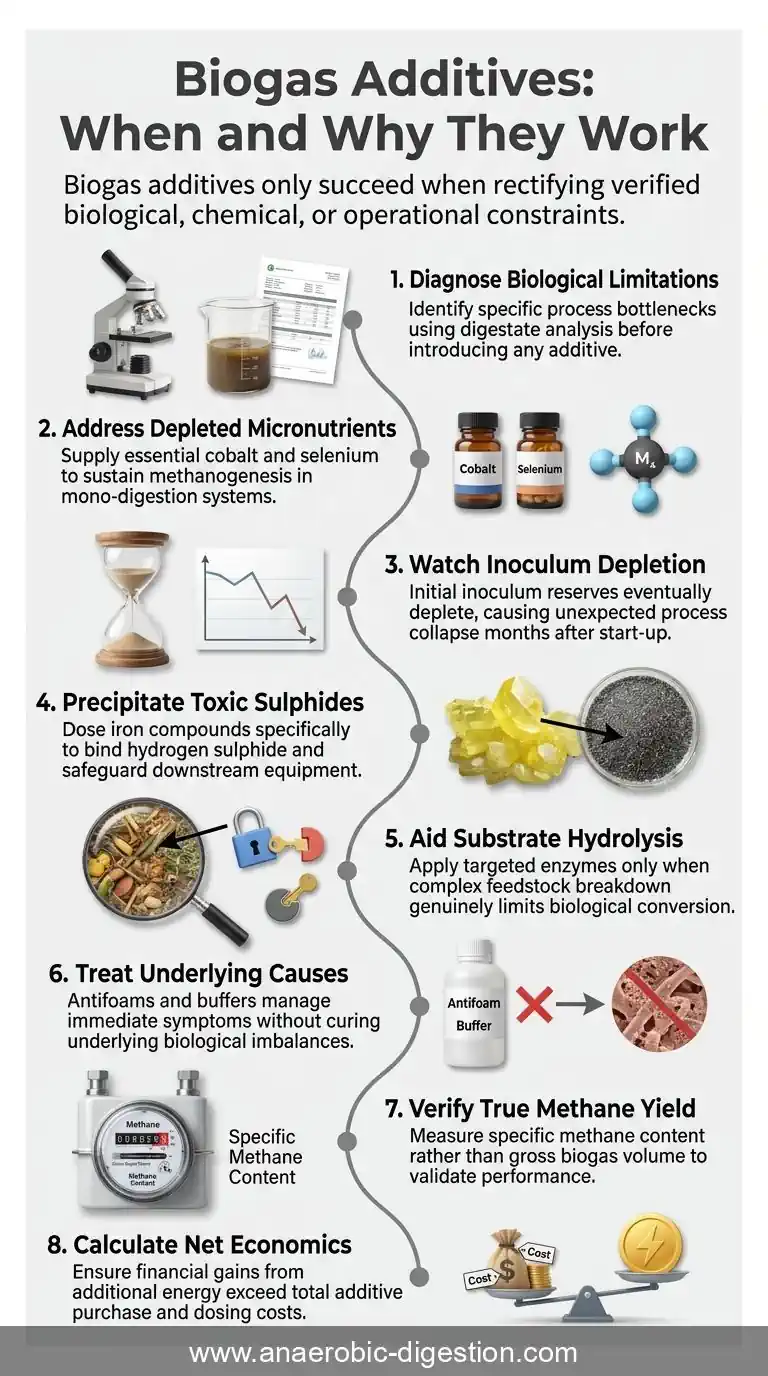
1. Define the problem
Identify the performance limitation using plant data rather than beginning with the proposed product.
2. Establish a baseline
Record gas production, methane concentration, loading, feed composition, VFAs, alkalinity, ammonia and other relevant parameters before dosing begins.
3. Understand the proposed mechanism
Ask which nutrient, reaction, inhibitor or physical property the additive is intended to influence.
4. Check whether the limitation actually exists
Where appropriate, use laboratory analysis of feedstock and digestate rather than assuming a deficiency.
5. Trial the product under controlled conditions
A useful trial needs sufficient duration and stable operating conditions to distinguish additive effects from normal plant variability.
6. Measure methane, not just biogas volume
Energy value depends primarily on methane production. An increase in total gas volume alone does not necessarily represent an equivalent increase in useful energy.
7. Calculate the net economic benefit
Include additive cost, dosing equipment, analysis, labour and any changes in parasitic energy use or maintenance.
Are Biogas Additives Snake Oil?
No — but neither should every commercial claim be accepted at face value.
The Southampton trace-element research provides particularly strong evidence that targeted supplementation can be essential where a genuine nutritional deficiency exists.
Other additives can also have valid roles in controlling sulphide, assisting hydrolysis, maintaining process chemistry or solving specific operating problems.
The mistake is to turn this evidence into the much broader proposition that every digester will produce more methane if an additive is poured into it.
The scientifically defensible position lies between those extremes.
Some additives address real biochemical or operational limitations. Their effectiveness depends on using the right material, at the right dose, for the right reason, in the right digester.
Biogas Additives: The Practical Conclusion
The most valuable lesson from decades of anaerobic digestion research is that the biology should determine the treatment, not the marketing claim.
The Southampton food-waste experiments provide an excellent example. Researchers observed apparently inexplicable long-term instability, investigated the biological mechanism, identified trace-element deficiencies and demonstrated that appropriate supplementation could maintain stable digestion.
That is how additives should be approached today.
If the digester is deficient in an essential trace element, supply it.
If sulphide is the problem, consider an appropriate sulphide-control strategy.
If hydrolysis is limiting conversion, investigate whether pretreatment or an enzyme intervention is technically and economically justified.
If the process is already stable and converting the available biodegradable material efficiently, do not assume that adding another product will somehow create additional methane.
Diagnose first. Dose second. Measure the result.
For the broader measures available to improve digester performance, see our guide to biogas production optimisation.
Frequently Asked Questions About Biogas Additives
What are biogas additives?
Biogas additives are materials deliberately added to an anaerobic digester to influence microbial nutrition, feedstock breakdown, process chemistry, gas quality or physical operating characteristics. They include trace-element supplements, enzymes, iron compounds, buffering agents, antifoams and some microbial preparations.
Do biogas additives increase methane production?
They can increase or restore methane production where they correct a genuine limitation, such as an essential trace-element deficiency or poor hydrolysis of a particular substrate. They should not be expected to increase methane yield universally.
Which trace elements are important in anaerobic digestion?
Several trace elements participate in enzymes and cofactors involved in anaerobic metabolism. These can include cobalt, nickel, selenium, iron, molybdenum and tungsten. Requirements depend on feedstock and operating conditions, and unnecessary overdosing should be avoided.
Why are selenium and cobalt important in food-waste digestion?
University of Southampton research found selenium deficiency was associated with propionate accumulation and instability in high-ammonia food-waste digestion. At higher loading, cobalt also became limiting. Supplementation allowed stable operation at higher organic loading under the experimental conditions.
Why might a food-waste digester run successfully before developing a trace-element deficiency?
The inoculum used to start the digester may initially supply trace elements that are deficient in the continuing feedstock. As those reserves are progressively depleted, instability may appear weeks or months after successful commissioning.
Are methanogens bacteria?
No. Methanogens belong to the Archaea. They are still sometimes informally called methanogenic bacteria, but that terminology is taxonomically incorrect.
What is the difference between acetoclastic and hydrogenotrophic methanogens?
Acetoclastic methanogens produce methane using acetate, whereas hydrogenotrophic methanogens principally produce methane by reducing carbon dioxide using hydrogen or another suitable electron donor. Digester conditions such as ammonia concentration can influence which pathway predominates. See our detailed guide to acetoclastic methanogenesis.
Should trace elements be added routinely to every anaerobic digester?
No. Trace-element supplementation should reflect feedstock composition, process performance and evidence of deficiency. A mixed feedstock may already provide adequate micronutrients, while some mono-feedstock systems can be deficient.
How should an operator test whether an additive works?
Establish a baseline before dosing, keep other operating conditions as consistent as practicable, monitor methane production and relevant process indicators over a sufficient period, and calculate whether any sustained improvement exceeds the total cost of treatment.
References and Further Reading
- Climenhaga, M.A. and Banks, C.J. (2008). Anaerobic digestion of catering wastes: effect of micronutrients and solids retention time. Water Science & Technology, 57(5), 687–692. DOI: 10.2166/wst.2008.092.
- Banks, C.J., Zhang, Y., Jiang, Y. and Heaven, S. (2012). Trace element requirements for stable food waste digestion at elevated ammonia concentrations. Bioresource Technology, 104, 127–135. DOI: 10.1016/j.biortech.2011.10.068.
- University of Southampton. Optimising processes for the stable operation of food waste digestion. Research programme describing work on ammonia inhibition and trace-element deficiencies in food-waste digestion.
[First posted in February 2018. Updated January 2024. Rewritten September 2026.]





I needed to write for you this little note to lastly state thanks for the useful article pages you’ve added currently. It’s actually incredibly generous of individuals like you to provide without restriction all most people could have provided as an expensive ebook in making some bucks on their own. Even more so for this author thinking that you can easily have attempted it in instance you wanted. The motivating ideas additionally served as the excellent way to completely understand that individuals online have the identical passion much like mine to learn a little much more in relation to this condition. I make certain there are many more satisfying sessions in advance for people that do take a look at your blog.
Many thanks for your comments. I always enjoy reading a comment which shows appreciation of the work involved in creating posts like this one.
I think the admin of this page is working hard in to help his web page, I applaud it because here every page is quality based data.
I like this web site so much. Do you know that nobody else is writing about these biogas digester additives. Apart from the sellers of course.
bookmarked!!, I love your website!