


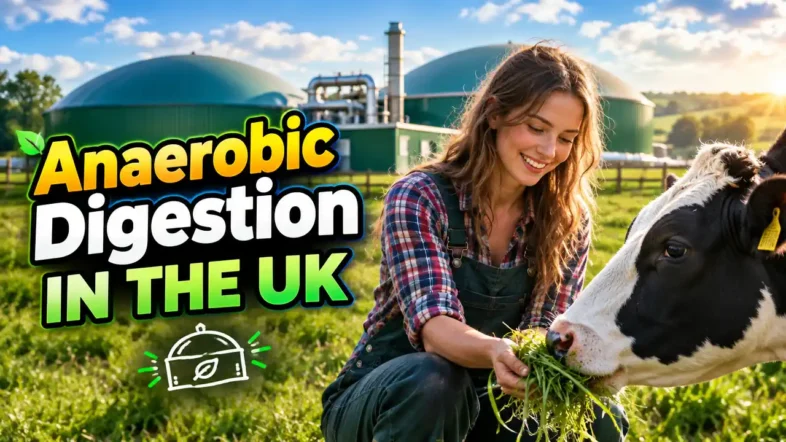
Anaerobic digestion in the UK has developed from a relatively specialised waste-treatment and farm-energy technology into an established part of the country’s waste, agricultural and renewable-energy infrastructure.
Today, UK anaerobic digestion (AD) encompasses food-waste recycling, agricultural digestion, sewage sludge treatment, industrial organic residues, biogas CHP and an increasingly important biomethane industry.
The reasons for developing AD have also broadened. Renewable electricity remains important, but the sector is increasingly associated with biomethane production, methane-emission reduction, nutrient recovery, food-waste recycling and domestic energy resilience.
This page explains how anaerobic digestion operates in the UK, including the principal feedstocks, environmental regulation, food-waste policy, biomethane, digestate, planning and the issues likely to influence future development.
If you are looking specifically for figures on the number of UK AD plants, installed capacity, electricity generation and the number of homes that could potentially be supplied, see our separate analysis of UK anaerobic digestion capacity, power generation and homes supplied.
My View: UK Ambition Still Needs to Become Delivery
In my view, UK government policy on anaerobic digestion still does not add up.
The Labour government has repeatedly spoken positively about biomethane and anaerobic digestion. Ministers addressing major ADBA events have acknowledged the industry’s potential, and in December 2025 the government announced plans to extend the Green Gas Support Scheme by two years to 31 March 2030.
Those were welcome signals. However, the problem has increasingly been one of delivery rather than recognition.
By June 2026, ADBA was warning that the available Green Gas Support Scheme budget had effectively been filled, leaving further projects unable to obtain tariff guarantees unless the budget cap was increased. In September, more than 170 businesses, farmers and organisations backed an industry letter to Downing Street warning that investment-ready UK biomethane projects were being stalled.
That is difficult to reconcile with repeated statements about the importance of domestic renewable energy, energy security and achieving net zero.
The arrival of Prime Minister Andy Burnham initially appeared to offer an opportunity for renewed momentum. He has since reaffirmed the government’s commitment to achieving net zero by 2050. Yet, from the perspective of the AD industry, much of the promised additional support still appears to remain at the level of policy discussion rather than measures capable of unlocking large numbers of new projects.
This matters because the industry has repeatedly argued that the UK will find its net-zero objectives much harder and more expensive to achieve without substantially greater deployment of anaerobic digestion and biomethane. The same technology can contribute to renewable gas production, methane-emission reduction, organic-waste recycling, nutrient recovery and reduced dependence on imported fossil gas.
I discussed this issue in more detail when reporting ADBA’s call for the Government to remove the barriers preventing British biomethane production from expanding: How UK Biomethane Could Cut Prices and Boost Energy Security.
There is also a potential contradiction emerging in planning policy. Planning reform has frequently been presented as a means of accelerating infrastructure development, yet recent AD decisions suggest that obtaining permission for substantial new rural anaerobic digestion and biomethane plants may remain difficult. See my analysis of recent anaerobic digestion planning decisions in England.
If Britain genuinely intends to expand home-grown renewable gas, it may also be worth looking across the Channel. European policy has increasingly treated biomethane as a strategic component of energy security, decarbonisation and agricultural resilience, and several EU countries are moving more rapidly to create conditions for new development. See my wider discussion of anaerobic digestion and biomethane development in Europe.
The UK has the technology, feedstocks, engineering expertise and an established AD industry. What remains less clear is whether policy, planning and financial support will now be aligned sufficiently to allow that industry to expand at the rate the country’s own climate and energy objectives appear to require.
What Is Anaerobic Digestion?
Anaerobic digestion is a biological process in which microorganisms break down biodegradable organic materials in the absence of oxygen.
Typical UK feedstocks include:
- food waste from households and businesses;
- food and drink manufacturing residues;
- livestock manure and slurry;
- crop residues;
- purpose-grown energy crops at some agricultural plants;
- sewage sludge; and
- other permitted biodegradable organic materials.
The process produces two principal outputs:
- biogas, consisting mainly of methane and carbon dioxide; and
- digestate, containing much of the nitrogen, phosphorus, potassium and organic matter present in the original feedstock.
Biogas can be burned in a combined heat and power unit to produce electricity and useful heat, or it can be cleaned and upgraded to biomethane.
Biomethane has properties similar to fossil natural gas and, after upgrading to the required specification, can be injected into the gas distribution network.
For more about electricity and useful heat production, see our guide to biogas CHP systems, benefits and cost savings.
The Different Types of Anaerobic Digestion Plant in the UK
There is no single standard UK anaerobic digestion plant. Facilities differ greatly according to their feedstocks, scale, location, energy use and regulatory status.
Food Waste Anaerobic Digestion Plants
Food-waste AD plants process source-separated organic material collected from households, restaurants, supermarkets, commercial premises and food manufacturers.
These plants frequently operate as dedicated waste-management facilities and must comply with environmental permitting requirements appropriate to the wastes they accept.
Food-waste digestion has become increasingly significant as separate collection of food waste has expanded across the UK.
Agricultural Anaerobic Digestion Plants
Agricultural AD plants commonly digest combinations of livestock slurry, manure, crop residues and, at some sites, purpose-grown energy crops.
It is important not to imagine that an energy-crop digester depends on freshly harvested crops being available continuously throughout the year. Crops such as maize are harvested seasonally, ensiled and stored in substantial silage clamps so that the digester can be supplied with a relatively consistent feed throughout the year.
Some agricultural plants remain relatively small CHP installations, while others have developed into larger biomethane facilities.
Sewage Sludge Anaerobic Digestion
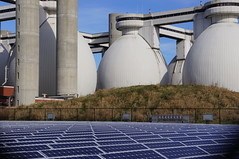 Anaerobic digestion has been used at British wastewater treatment works for many decades.
Digestion stabilises sewage sludge while producing biogas that can be used to provide heat and electricity at the treatment works or upgraded to biomethane.
Industrial Anaerobic Digestion
Breweries, distilleries, food manufacturers and other industries producing high-strength biodegradable residues may use anaerobic digestion either as a dedicated waste-treatment process or as part of an industrial wastewater treatment system.
Food Waste Policy Is Increasing the Importance of AD
One of the largest current changes affecting anaerobic digestion in England is the expansion of mandatory separate food-waste collection.
Under the government’s Simpler Recycling reforms, separate collection requirements have progressively been introduced for workplaces and households.
From 31 March 2026, household food waste in England must by default be collected separately and at least weekly.
This creates a larger and more consistent stream of source-separated organic material requiring treatment.
However, more food waste does not automatically mean that every AD plant will receive more feedstock.
Commercial factors remain important, including:
- collection contracts;
- haulage distance;
- gate fees;
- existing treatment capacity;
- plant location; and
- the reliability and composition of the waste stream.
Competition for reliable food-waste sources can therefore be intense.
Official guidance is available from Defra: Simpler Recycling – household recycling in England.
Biomethane Has Become Central to New UK AD Development
One of the most important structural changes in UK anaerobic digestion has been the transition from electricity generation towards biomethane production and gas-grid injection.
Many earlier UK plants were designed around a biogas engine producing electricity under renewable electricity support schemes.
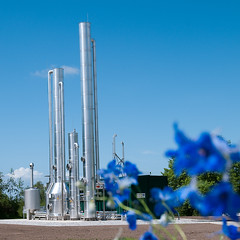 Newer large projects increasingly upgrade the raw biogas by removing carbon dioxide, water vapour and contaminants. The resulting biomethane can then be injected into the gas network where a suitable connection is available.
This matters because biomethane provides energy in a form that complements renewable electricity.
Biomethane is dispatchable and can make use of the existing gas storage and distribution infrastructure. Its production is not dependent upon sunshine or wind conditions, although the biological process itself requires stable feedstock supplies and careful operation.
This gives anaerobic digestion a growing role not only in decarbonisation but also in energy security and resilience.
Domestic biomethane can substitute for a proportion of fossil natural gas that would otherwise have to be produced domestically or imported through international energy markets.
The Green Gas Support Scheme
The principal current support mechanism for new biomethane-to-grid developments is the Green Gas Support Scheme (GGSS).

The scheme supports eligible anaerobic digestion plants producing biomethane for injection into the gas network.
Ofgem currently states that new Stage 1 applications can be submitted until 31 March 2028.
The government has also announced its intention to extend the commissioning deadline to 31 March 2030. At the time of this update, Ofgem continues to describe that extension as subject to parliamentary scrutiny and the required change to the regulations.
Prospective developers should therefore check the current rules rather than relying on historic summaries of the scheme.
See Ofgem: Green Gas Support Scheme and Green Gas Levy.
Anaerobic Digestion Regulation in the UK
There is no single UK-wide anaerobic digestion permit covering every plant.
Environmental regulation is devolved, and the requirements depend on the country in which the plant is located, its feedstocks, capacity, process configuration and the way its outputs are used.
Operators and developers therefore need to establish which regulatory requirements apply in England, Wales, Scotland or Northern Ireland.
Environmental Permitting in England
In England, anaerobic digestion facilities accepting waste commonly require an environmental permit from the Environment Agency.
The Environment Agency maintains specific standard rules for anaerobic digestion, including:
- AD installations treating more than 100 tonnes per day;
- waste-recovery AD operations below that threshold;
- on-farm AD using farm wastes; and
- related biogas and digestate activities.
The Environment Agency updated the principal AD standard rules in February 2026.
A plant that does not meet the conditions of an applicable standard rules permit may require a bespoke permit.
Current information is available from the Environment Agency’s Standard Rules Environmental Permitting guidance.
Operators should never assume that they can add a new co-digestion feedstock simply because it can physically be pumped or loaded into the digester.
The environmental permit or other applicable authorisation must allow that material to be accepted.
This is particularly important for agricultural AD. A farm plant treating qualifying farm-origin materials can operate within a materially different regulatory framework from a plant accepting commercial food waste or other controlled wastes.
Introducing a new waste stream can therefore result in significant additional requirements for permitting, storage, hygiene, record keeping and digestate management.
Animal By-Products Regulations
Food waste and many other animal-derived materials are also subject to the Animal By-Products regulatory regime.
Depending on the feedstock and process, an AD plant may require approval and may need to meet requirements relating to reception, separation, pasteurisation, hygiene and record keeping.
Current guidance is available at GOV.UK: Animal by-product categories, site approval, hygiene and disposal.
Digestate Is a Major Part of the UK AD System
Biogas attracts most of the public attention, but digestate is equally important to the environmental and commercial performance of an anaerobic digestion plant.
Digestate contains much of the nitrogen, phosphorus, potassium and organic matter that entered the digester with the original feedstock.
Where suitable for agricultural use, these nutrients can be returned to land and can reduce demand for some manufactured fertilisers.
However, digestate cannot simply be assumed to be a fertiliser product because it has passed through an anaerobic digester.
Where waste-derived feedstocks are used, the resulting digestate may remain legally classified as waste unless applicable end-of-waste requirements are satisfied.
In England, the Environment Agency’s Anaerobic Digestate Resource Framework sets out when qualifying digestate produced from source-segregated biodegradable waste can cease to be waste.
The framework requires eligible inputs and processing conditions and incorporates compliance with PAS 110 and independent certification requirements.
See Environment Agency: Anaerobic Digestate Resource Framework.
Good digestate management also requires sufficient storage, nutrient planning and appropriate application rates and timing.
Planning Permission Is a Separate Requirement
Environmental permitting and planning permission serve different purposes.
Obtaining an environmental permit does not remove the need for planning permission where planning consent is required, and a planning approval does not replace environmental permitting.
Planning applications for new AD facilities commonly need to address:
- traffic and vehicle movements;
- site access;
- landscape and visual impact;
- odour;
- noise;
- effects on nearby residents;
- feedstock and digestate storage;
- drainage and pollution prevention; and
- the scale and appearance of tanks and associated infrastructure.
Recent English planning decisions demonstrate that superficially similar anaerobic digestion proposals can receive very different outcomes depending upon location, transport implications, landscape impact, community concerns and the evidence submitted with the application.
Planning therefore needs to be considered during site selection and project development, rather than treated as an administrative exercise after the plant has already been designed.
Why Some UK Anaerobic Digestion Plants Use Crops
The use of maize and other purpose-grown crops for anaerobic digestion has been debated for many years.
Energy crops can offer predictable composition and high biogas yields, helping operators maintain stable biological loading.
However, their use also raises legitimate questions about land use, crop rotation, food production and the overall environmental performance of individual projects.
Modern biomethane developments may use combinations of:
- food-processing residues;
- livestock manure;
- slurry;
- crop residues;
- other permitted organic wastes; and
- purpose-grown crops where appropriate.
The important point is that feedstock selection is both a biological and a regulatory decision.
A feedstock that looks attractive because of its methane yield must also be compatible with the site’s permit, storage facilities, handling equipment, contracts, digestate outlet and applicable sustainability requirements.
Co-Digestion Can Improve Performance – But Only Where Authorised
Anaerobic co-digestion involves combining two or more organic feedstocks within the digestion process.
Done properly, this can improve nutrient balance, biological stability, feedstock security and biogas yield.
However, operators must not assume that an existing plant can start accepting new materials simply because co-digestion offers a technical advantage.
Any new feedstock must fall within the site’s environmental permit or other applicable authorisation.
This distinction can be particularly significant when a plant originally developed around agricultural materials considers accepting food waste or another material legally classified as waste.
Methane Leakage and Plant Performance
Producing renewable methane only delivers its intended climate benefit if that methane is effectively captured and used.
Fugitive emissions can arise from:
- tank seals;
- pressure-relief devices;
- valves;
- pipework;
- biogas upgrading equipment;
- digestate storage; and
- other components of the gas system.
Methane leakage also represents lost product and lost income.
Good plant design, preventive maintenance and systematic leak detection are therefore increasingly important.
For more detail, see our guide to fugitive emissions testing and methane leak detection in the biogas industry.
Anaerobic Digestion, Fertiliser and Nutrient Security
Anaerobic digestion should not be viewed solely as an energy technology.
It is also a nutrient-recycling process.
Nitrogen, phosphorus and potassium contained within feedstocks largely remain within the digestate.
Where digestate is suitable for agricultural use, these nutrients can be returned to productive land.
This has become increasingly important because the manufacture and price of nitrogen fertiliser are closely connected to international natural-gas markets.
AD can therefore provide two forms of resilience: domestic renewable gas production and the recovery of plant nutrients that would otherwise be lost from the productive economy.
That does not remove the need for careful nutrient management. Poorly timed or excessive digestate application can result in nutrient losses and water pollution just as inappropriate application of manure or manufactured fertiliser can.
The Growing Energy-Security Role of Anaerobic Digestion
The energy-security contribution of anaerobic digestion received relatively little attention when many early UK plants were developed.
That is changing.
Biogas can be produced from materials continuously arising within the domestic economy, including:
- food waste;
- livestock manure;
- sewage sludge;
- food-industry residues; and
- agricultural materials.
These resources cannot supply all of Britain’s energy demand, but converting suitable organic materials into useful gas can reduce waste while producing energy close to where it is consumed.
Unlike imported fossil gas, the feedstocks for this proportion of energy production arise predominantly within the UK’s own waste, wastewater and agricultural systems.
This means that the case for anaerobic digestion increasingly spans several objectives simultaneously:
- waste recycling;
- renewable energy production;
- methane-emission reduction;
- nutrient recycling;
- fertiliser substitution;
- local energy production; and
- greater resilience to disruption in international energy markets.
From the 2018 UK AD Investment Opportunity to the 2026 Market
The history of anaerobic digestion in the UK reveals an industry that has repeatedly demonstrated substantial technical potential, while facing changing economic conditions and government support arrangements.
In October 2018, the Anaerobic Digestion and Bioresources Association (ADBA) made a strong case to HM Treasury for greater government support for anaerobic digestion.
The association argued that wider deployment could support renewable energy generation, food waste recycling, agricultural diversification, nutrient recovery and the development of British environmental engineering expertise.
What the Industry Predicted in 2018
ADBA’s submission included several ambitious projections, including:
- The potential for approximately 35,000 jobs, many associated with rural areas.
- A contribution towards UK household energy demand far beyond the sector’s deployment at that time.
- The opportunity for British companies to participate in a global biogas industry potentially worth £1 trillion.
- Economic and environmental benefits from introducing widespread separate food waste collections in England.
These were industry forecasts and statements of potential, not independently verified outcomes or guarantees. The projections were conditional on suitable government policy, investment, infrastructure and technological development.
The original 2018 article on this website reproduced ADBA’s contemporary arguments. That article’s useful historical context has now been incorporated into this updated history of UK anaerobic digestion.
What Changed Between 2018 and 2026?
The years following those forecasts brought several important changes.
First, the market increasingly shifted towards biomethane. Earlier developments frequently relied on electricity generation through combined heat and power engines. Biomethane upgrading and gas-grid injection subsequently became increasingly important for developers seeking to produce a renewable replacement for fossil natural gas.
Second, the economics of older installations became more challenging. Plants developed under earlier renewable electricity support arrangements must consider what happens when their original subsidy entitlement ends. Continued operation, equipment replacement, feedstock procurement and possible conversion to biomethane require individual financial assessment.
Third, waste policy created new expectations. The progressive introduction of separate food waste collection requirements increased interest in the availability of source-separated feedstocks. Nevertheless, successful projects still depend on contracts, transport distances, gate fees and suitable treatment capacity.
Fourth, the environmental performance expected from AD plants became more demanding. Methane leakage, digestate management, ammonia emissions, odour, feedstock sustainability and local environmental impacts require careful engineering and regulatory control.
Finally, planning permission and grid connections continued to influence project viability. A technically feasible digester is not necessarily a consentable or commercially bankable development.
Where Is the UK Investment Opportunity Now?
By 2026, the most credible anaerobic digestion investment opportunities cannot be identified simply by assuming that building more plants will always be profitable.
Opportunities instead require detailed evaluation of:
- Repowering and upgrading existing anaerobic digestion installations.
- Converting suitable biogas CHP installations to biomethane production.
- Developing new facilities with reliable feedstock and energy offtake contracts.
- Improving digester process efficiency and gas yields.
- Reducing fugitive methane emissions and other environmental losses.
- Improving digestate quality, handling and nutrient recovery.
- Replacing ageing mechanical, electrical and process-control equipment.
- Reducing operating costs through better maintenance and plant optimisation.
In addition, the expiry of older support arrangements may create acquisition, refurbishment or closure decisions for existing plant owners. Each case should be assessed on its own merits.
The original optimism surrounding anaerobic digestion was not without justification. The technology continues to offer a valuable combination of renewable energy generation, organic waste treatment and nutrient recycling.
However, the experience of the intervening years has demonstrated that sound project economics, appropriate feedstocks, environmental compliance and long-term operational reliability matter as much as the underlying technology.
For examples of operational facilities and the historical development of the sector, see our UK Anaerobic Digestion Plants Guide.
Historical note: This section incorporates and updates material from our article of 20 October 2018, “AD Plants Are a Huge Opportunity Right Now!”, including ADBA’s original investment expectations. The forecasts are presented as historical industry positions rather than verified achievements.
What Will Drive the Next Phase of UK Anaerobic Digestion?
The next phase of UK anaerobic digestion is unlikely to look exactly like the first.
1. More Biomethane
Large new projects are increasingly centred on upgrading biogas to biomethane rather than simply generating electricity.
2. Greater Competition for Feedstocks
Food waste, agricultural residues and other suitable organic materials increasingly have commercial value.
Long-term feedstock security can therefore be as important to project viability as the digester technology itself.
3. More Separately Collected Food Waste
The implementation of Simpler Recycling in England is increasing the quantity of separately collected household food waste available for treatment.
4. Increasing Attention to Methane Losses
Fugitive methane reduces both environmental performance and revenue, creating a stronger incentive for measurement, maintenance and leak prevention.
5. Greater Recognition of Digestate Value
Digestate management is increasingly being recognised as an integral part of nutrient recovery and project economics rather than simply a residual disposal problem.
6. More Demanding Site Selection and Community Engagement
Large rural AD and biomethane proposals can face concern over traffic, odour, landscape impact and the perceived industrialisation of the countryside.
Site selection and early engagement are therefore becoming increasingly important.
7. Energy Security Alongside Decarbonisation
Locally produced biomethane is increasingly relevant not only as a means of reducing greenhouse-gas emissions but also as a way of reducing some exposure to volatile international fossil-energy markets.
Text in panel
The Future of Anaerobic Digestion in the UK
Anaerobic digestion is now an established component of Britain’s waste-management, agricultural and renewable-energy infrastructure.
The challenge is no longer demonstrating that the biological process works. Anaerobic digestion has been successfully operated for decades.
The future development of the sector will depend increasingly upon whether projects can secure:
- suitable long-term feedstocks;
- appropriate sites;
- planning permission;
- environmental permits;
- gas or electricity connections;
- acceptable digestate outlets; and
- commercially viable long-term markets for their outputs.
A modern anaerobic digestion project may simultaneously function as:
- a waste-treatment facility;
- a renewable-gas plant;
- a source of renewable electricity and heat;
- a potential carbon-dioxide recovery source;
- a nutrient-recycling system;
- a producer of agricultural biofertiliser; and
- a piece of local energy infrastructure.
That wider perspective is becoming increasingly important.
The role of anaerobic digestion in the UK is no longer simply about generating electricity from organic waste.
Its broader value lies in converting unavoidable organic materials into renewable gas, usable nutrients and locally produced energy while reducing the environmental burden associated with those materials.
UK Anaerobic Digestion Capacity and Statistics
This page has deliberately concentrated on the way the UK anaerobic digestion sector operates, rather than duplicating detailed industry-capacity statistics.
For figures covering plant numbers, installed capacity, power generation and the potential number of homes supplied, see our dedicated article:
Anaerobic Digestion UK Capacity, Power Generation and Homes Supplied
Authoritative Sources and Further Reading
- Defra – Simpler Recycling: Household Recycling in England
- Ofgem – Green Gas Support Scheme and Green Gas Levy
- Environment Agency – Standard Rules Environmental Permitting
- Environment Agency – Anaerobic Digestate Resource Framework
- GOV.UK – Animal By-product Categories, Site Approval, Hygiene and Disposal
This article replaces an earlier UK anaerobic digestion overview originally framed as a 2021 update. It has been substantially rewritten to provide an evergreen guide to the UK regulatory, policy, waste-treatment and biomethane context.
[Published October 2021. Rewritten September 2026.]