


Biogas upgrading technologies increase the methane concentration of raw biogas so it can be supplied as biomethane. The main choices include membranes, water scrubbing, pressure swing adsorption, chemical absorption and physical solvent systems. The right choice depends on the gas stream, product specification and whole-life operating requirements.
This guide compares the technologies. For the production sequence, see how biomethane is produced. For conversion steps, see how upgrading biogas to biomethane works.
Biogas Cleaning and Upgrading Serve Different Purposes
Cleaning removes unwanted components such as moisture and hydrogen sulphide. Upgrading additionally removes much of the carbon dioxide. A procurement specification should cover the complete treatment train rather than assuming that the main CO2 separator can accept any untreated gas.
Comparison of the Main Biogas Upgrading Technologies
| Technology | Main Separation Principle | Main Advantages | Main Considerations |
|---|---|---|---|
| Membranes | Selective gas permeation | Compact, modular, no solvent | Compression, pretreatment, membrane life, methane slip |
| Water scrubbing | CO2 dissolves in water | Mature, simple chemistry, proven | Water, compression, dissolved methane management |
| PSA | Selective adsorption at pressure | Dry process, established, flexible | Adsorbent, compression, valve complexity, tail gas |
| Amine scrubbing | Chemical absorption | High purity and methane recovery | Heat demand, solvent management, process complexity |
| Physical solvent | Physical absorption | Can remove several contaminants | Pressure and solvent circulation requirements |
| Cryogenic | Low-temperature phase separation | High purity, possible bio-LNG integration | Higher capital cost and complexity |
How the Main Technologies Work
1. Membrane Biogas Upgrading
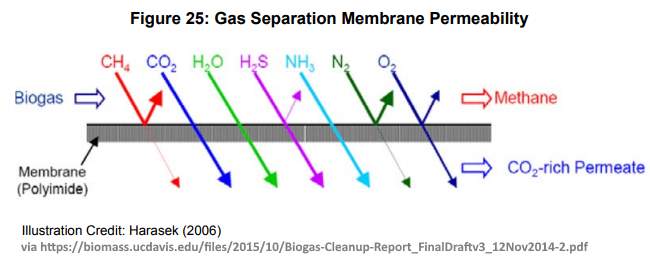
Membrane separation uses differences in the permeation rates of gases through selective membrane materials.
Most commercial systems compress pretreated biogas and pass it across one or more membrane stages. Carbon dioxide permeates through the membrane more readily than methane in the commonly used systems, leaving a methane-enriched product stream.
Multi-stage designs are often used to improve both methane purity and methane recovery.
Advantages can include:
- compact equipment;
- modular construction;
- no liquid solvent inventory;
- relatively simple operation;
- good suitability for packaged systems; and
- ease of capacity expansion by adding modules.
Potential disadvantages include:
- compression energy demand;
- sensitivity to contaminants;
- need for effective pretreatment;
- membrane replacement over time; and
- the need to manage methane in permeate or reject streams.
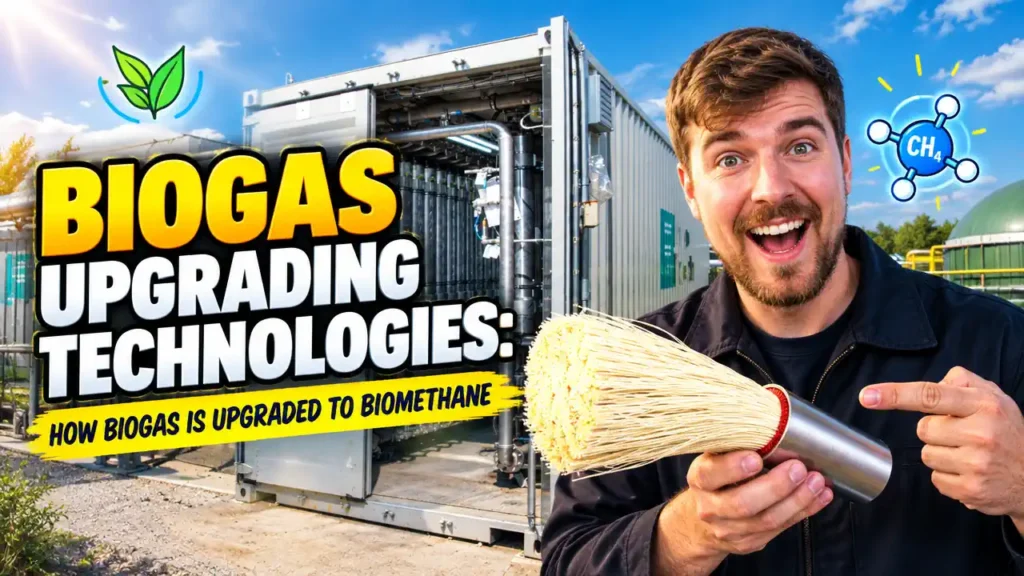 This guy holds a sample of one type of gas purification membrane.[/caption]
2. Water Scrubbing
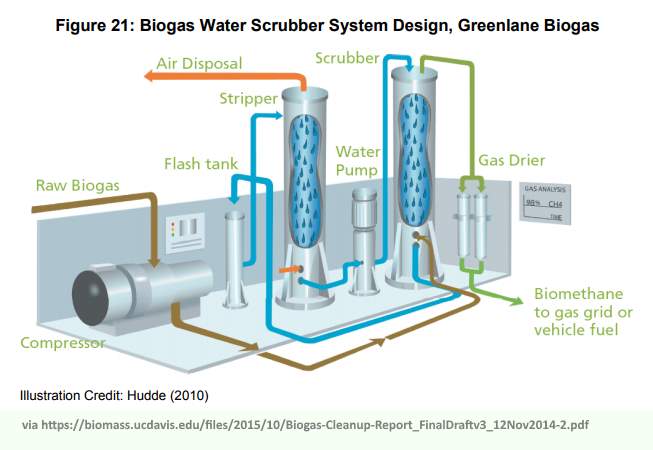
Water scrubbing exploits the fact that carbon dioxide is much more soluble in water than methane.
Compressed biogas is contacted with water in an absorption column. Carbon dioxide dissolves preferentially into the water while methane passes through as the methane-rich product gas.
The water can then be regenerated by reducing pressure or using stripping air and recirculated through the process.
Advantages include:
- mature technology;
- relatively simple process chemistry;
- no specialist chemical solvent;
- simultaneous removal of some hydrogen sulphide; and
- good methane recovery when properly designed.
Disadvantages can include:
- water requirement;
- pumping and compression energy;
- need to manage dissolved gases;
- possible cooling requirements; and
- methane losses through process water or off-gas if poorly controlled.
3. Pressure Swing Adsorption (PSA)
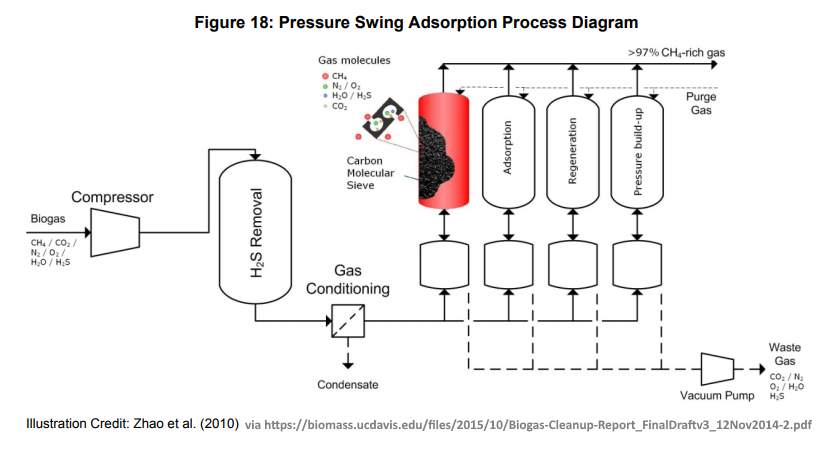
Pressure swing adsorption uses solid adsorbents that retain carbon dioxide and certain other gases more strongly than methane.
Raw gas is compressed and passed through adsorption vessels. Carbon dioxide, water and other selected components are adsorbed while methane passes through as product gas.
When an adsorption bed becomes loaded, pressure is reduced and the adsorbed gases are released. Several vessels normally operate in sequence so that gas production can continue while individual beds regenerate.
Advantages can include:
- dry separation process;
- no liquid solvent;
- high product methane concentration;
- potential removal of nitrogen and other contaminants depending on design; and
- commercial maturity.
Potential disadvantages include:
- compression demand;
- adsorbent replacement;
- complex valve sequencing;
- sensitivity to some contaminants; and
- methane in tail gas if recovery is not optimised.
PSA remains one of the major proven technologies for biomethane production.
4. Chemical Absorption – Amine Scrubbing
Amine scrubbing removes carbon dioxide through reversible chemical reaction with an amine solution.
Biogas passes through an absorber where the solvent captures CO2. The CO2-rich solvent is then heated in a regeneration stage, releasing the carbon dioxide so that the amine can be reused.
Advantages can include:
- very high methane purity;
- high methane recovery;
- low methane concentration in the CO2 off-gas when well operated; and
- good suitability where heat is available for solvent regeneration.
Disadvantages can include:
- thermal energy requirement;
- chemical management;
- solvent degradation;
- corrosion considerations; and
- greater process complexity than some dry systems.
5. Physical Solvent Scrubbing
Physical solvents also absorb carbon dioxide preferentially, but without the same chemical reaction used in amine systems.
Performance generally improves at higher pressures because gas solubility increases.
These processes may remove several contaminants simultaneously and can be appropriate for some larger gas streams, although solvent circulation and regeneration still require energy.
6. Cryogenic Biogas Upgrading
Cryogenic upgrading separates gas components by cooling them to very low temperatures.
Carbon dioxide and methane have different condensation and freezing behaviour, allowing separation under controlled pressure and temperature conditions.
Cryogenic processes can offer:
- high biomethane purity;
- potential integration with bio-LNG production;
- high methane recovery; and
- potential recovery of relatively pure CO2.
However, the equipment is more complex and capital-intensive and is generally more relevant to larger or specialist projects.
Why Methane Slip Matters
Methane slip is methane that is lost from the upgrading process instead of becoming product biomethane.
It can occur in:
- membrane permeate;
- PSA tail gas;
- water-scrubber regeneration gas;
- solvent systems; or
- other reject streams.
Methane slip matters for two reasons.
First, it is lost product. Every cubic metre of methane emitted from the plant is methane that cannot be sold or used.
Second, methane is a potent greenhouse gas, so uncontrolled emissions can materially weaken the climate benefit of biomethane production.
Require bidders to state the methane recovery, reject-gas treatment and monitoring boundaries behind their guarantees. IEA Bioenergy’s 2025 report explains that methane-containing waste gases can require oxidation treatment.
Biogas Upgrading Cost
There is no useful single answer to the question “how much does biogas upgrading cost?”
Capital and operating costs vary significantly according to:
- raw biogas flow rate;
- methane concentration;
- H2S concentration;
- siloxanes and other contaminants;
- required biomethane specification;
- methane recovery target;
- plant pressure;
- electricity price;
- heat availability;
- water cost and availability;
- redundancy requirements;
- CO2 recovery;
- grid connection pressure;
- maintenance contract;
- equipment lifetime; and
- plant utilisation factor.
Smaller installations often suffer from higher unit costs because compressors, analysers, controls and safety systems do not scale down in direct proportion to gas throughput.
Technology selection should therefore be based on whole-life cost per unit of saleable biomethane rather than simply the purchase price of the upgrader.
How to Choose a Biogas Upgrading Technology
Technology selection should begin with a clear process specification rather than a preferred supplier.
Important questions include:
- How much raw biogas will be produced?
- What is the minimum and maximum flow?
- What is the methane concentration?
- How much CO2 is present?
- What are the H2S levels?
- Are siloxanes present?
- Is nitrogen or oxygen significant?
- What final gas specification is required?
- What methane recovery is guaranteed?
- What methane slip occurs at normal and turndown operation?
- What electricity demand is guaranteed?
- Is process heat available?
- Is water readily available?
- What pretreatment is included?
- What happens to reject gas?
- Can the CO2 be recovered?
- What is the minimum stable operating flow?
- What redundancy is included?
- How quickly can specialist maintenance support attend?
- What are membrane, solvent or adsorbent replacement costs?
- What availability is guaranteed?
A good biogas upgrading procurement exercise compares guaranteed whole-system performance rather than headline methane purity alone.
Biogas Upgrading Equipment and Supplier Selection
Ask for a scope covering pretreatment, the separator, compressors, analysers, controls, reject-gas treatment and the interface with downstream delivery equipment. Confirm which items and services are excluded from each quotation.
A consultant can help define the gas specification, compare guarantees and identify interface risks. These tasks are different from selecting a supplier solely on headline methane purity or purchase price.
For supplier research, see our biomethane upgrading equipment suppliers guide.
Emerging Approaches
Hydrogen-based biological methanation converts carbon dioxide into additional methane instead of simply separating it. It should be assessed separately from the established separation options. For less widely deployed approaches, ask for evidence of operating installations, gas-quality guarantees and maintenance support before treating them as equivalent procurement options.
Frequently Asked Questions
Which technology is best?
There is no universal winner. Compare offers for the same gas composition, flow, product specification, methane recovery and operating conditions.
Does high methane purity guarantee low methane losses?
No. Product quality and methane recovery are different measures. Require evidence for both.
Is grid injection included in an upgrader quotation?
Do not assume it is. Check the delivery boundary and the network-entry equipment and services covered by the offer.