


Palm Oil Anaerobic Digestion is rapidly becoming one of the most important technologies for transforming the environmental impact of the palm oil industry. As global demand for palm oil continues to rise, producers are under increasing pressure to manage waste streams responsibly while improving energy efficiency and sustainability. One of the most effective ways to achieve this is through Palm Oil Anaerobic Digestion, a process that converts Palm Oil Mill Effluent (POME) into renewable biogas energy while simultaneously reducing pollution and greenhouse gas emissions.
In a typical Palm Oil Anaerobic Digestion system, the high-strength wastewater produced during palm oil processing is fed into large anaerobic digesters. Inside these sealed tanks, naturally occurring microorganisms break down organic material in the absence of oxygen.
Simultaneous Reductions in Environmental Impact While Producing Renewable Energy
The result is the production of biogas rich in methane, which can be used to generate electricity, heat, or upgraded to biomethane fuel. At the same time, the digestion process significantly reduces the environmental impact of the effluent by lowering Chemical Oxygen Demand (COD), stabilising organic matter, and helping palm oil mills meet increasingly strict environmental standards.
Anaerobic Digestion a cornerstone of Sustainable Palm Oil Production
Across Southeast Asia, and particularly in Thailand, Palm Oil Anaerobic Digestion has emerged as a cornerstone of sustainable palm oil production. Thailand’s palm oil industry generates large volumes of POME, making it an ideal candidate for biogas recovery projects.
By installing advanced digestion systems, mills can turn what was once a costly waste problem into a valuable renewable energy resource. Effective mixing inside digesters is critical to this process, ensuring that solids remain suspended, bacteria remain active, and biogas production remains consistently high.
A recent installation demonstrates how advanced digester mixing technology can support efficient Palm Oil Anaerobic Digestion in Thailand, helping palm oil producers maximise gas yields while keeping maintenance requirements low.
Palm Oil Anaerobic Digestion & Mixing – Key Takeaways
- Palm Oil Anaerobic Digestion converts Palm Oil Mill Effluent (POME) into renewable biogas energy, reducing pollution and improving sustainability.
- Dependable digester mixing systems are essential to maintain solids suspension, optimise bacterial activity, and maximise biogas production.
- In Thailand, palm oil producers are increasingly investing in biogas digesters to manage effluent and generate renewable energy.
- The installation described in the press release uses Landia’s GasMix system to thoroughly mix POME at 5% total solids inside large digesters.
- Two 6,450 m³ glass-lined bolted digesters are equipped with GasMix ejector/diffusor mixing positioned at intermediate height.
- Additional JetMix mixing nozzles near the base and a crust-breaking nozzle help maintain optimal conditions for high biogas yields.
- The system avoids internal moving parts, simplifying maintenance and reducing downtime risks.
- Previous successful installations since 2021 have built strong trust with the AD Plant Owner due to proven performance and low maintenance requirements.
- Landia has an established presence across the Asia-Pacific anaerobic digestion sector, including projects using Napier Grass as a digestion feedstock.
Press Release 12 March 2026:
Repeat project success for Landia with new biogas digester mixing systems in Thailand
Across the water from Ko Samui in Thailand, Landia has successfully completed a major installation of its biogas digester mixing systems for one of Asia’s leading producers of sustainable palm oil.

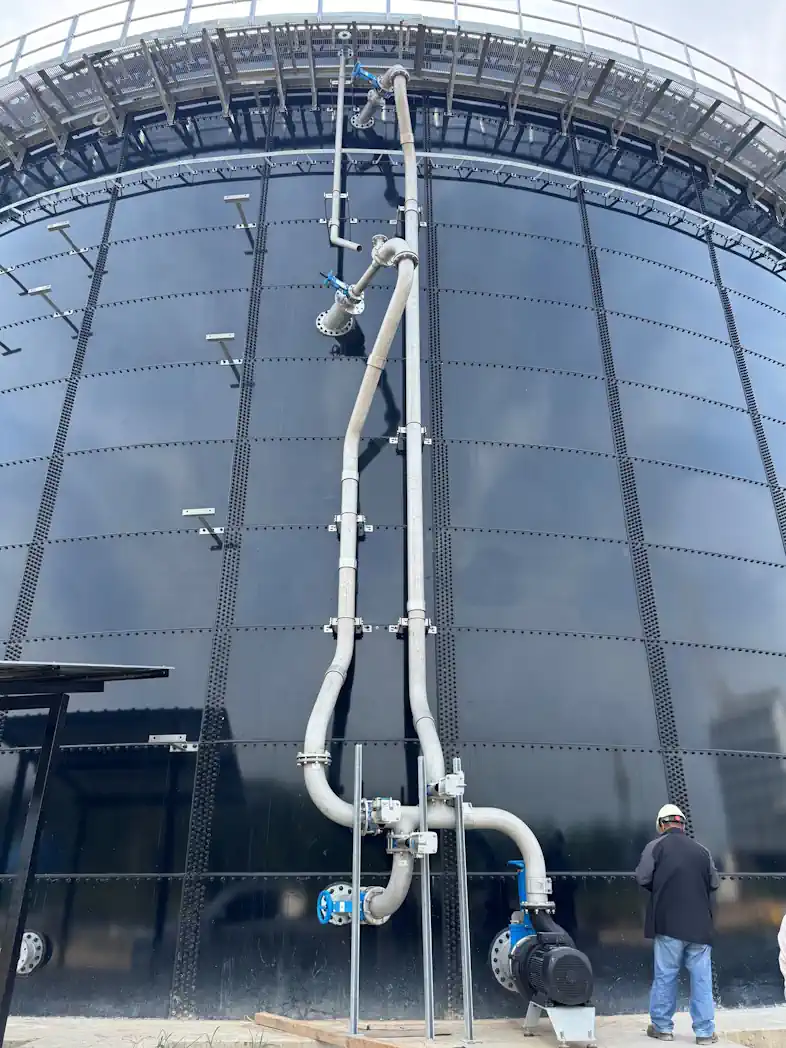
Landia’s externally-mounted GasMix system
For two 6,450m3 (28m diameter) glass-lined bolted tanks, palm oil mill effluent (POME – at 5% total solids) is comprehensively mixed by Landia’s externally-mounted GasMix system, positioned with its ejector/diffusor at an intermediate height.
Landia JetMix mixing nozzles
The set-up also includes Landia JetMix mixing nozzles near the base of the tanks, and a higher, crust-breaking nozzle, likewise strategically positioned, to maximise biogas yields.
Fergus Clark, Regional Sales Manager for Landia in the Asia/Pacific region, commented:
“Tough durable equipment with a long lifetime is a must in these rural areas, but then tough, durable equipment with a long lifetime should be the case everywhere!
“We’ve established a strong level of trust with our customer due to the proven performance and very low maintenance of the Landia GasMix that was installed on their first digester in 2021. The engineering/construction companies we have worked with have also seen that the optimum results truly speak for themselves.”
He added:
“This doesn’t just apply to the unrivalled biogas yields, but easy maintenance, with – unlike many mixing systems – no moving/wearing parts trapped inside the digesters that can cause massive headaches with downtime. There’s also the fact that even here in rural Thailand, we have firmly established contacts and the commitment to always provide proper back up.”
Landia has a firmly established track record in the Asia/Pacific region, including its first Napier Grass biogas/AD project on the east coast of Thailand, where its GasMix system is being used to replace existing submersible mixers, to ensure a fully comprehensive mix.
Contact Landia for more information on their GasMix Biogas Mixer range.
Press Release Ends
Conclusion
The continued growth of Palm Oil Anaerobic Digestion demonstrates how the palm oil industry can transform a challenging waste stream into a powerful source of renewable energy. By capturing methane from Palm Oil Mill Effluent, producers can reduce emissions, improve environmental compliance, and generate valuable energy for their operations.
However, the success of any POME biogas digester depends heavily on effective mixing.
Advanced technologies such as Landia’s GasMix system help ensure digesters operate efficiently, maintain consistent microbial activity, and maximise biogas yields while minimising maintenance demands.
Projects like this installation in Thailand highlight the growing role of industrial anaerobic digestion in sustainable palm oil production across Southeast Asia.
FAQs
What is Palm Oil Anaerobic Digestion?
Palm Oil Anaerobic Digestion is the biological process used to break down Palm Oil Mill Effluent (POME) in sealed digesters without oxygen, producing biogas rich in methane that can be used as renewable energy.
What is Palm Oil Mill Effluent (POME)?
POME is the wastewater generated during palm oil extraction. It contains high levels of organic material, making it ideal for anaerobic digestion and biogas production.
Why is mixing important in palm oil biogas digesters?
Proper digester mixing keeps solids suspended, prevents stratification, improves contact between bacteria and substrate, and maximises biogas production efficiency.
Why are palm oil biogas projects common in Thailand?
Thailand has a significant palm oil processing industry, producing large volumes of POME. Installing anaerobic digestion systems allows mills to treat wastewater while generating renewable energy.
What advantages does the GasMix system provide?
The GasMix digester mixing system provides thorough mixing without internal moving parts, which reduces maintenance, minimises downtime risk, and supports high and stable biogas yields.