
A new report published today reveals that removing global warming gases from the atmosphere can be achieved at a fraction of the current expected cost.
The Anaerobic Digestion and Bioresources Association (ADBA) states that using the tried and tested process of producing biomethane from organic matter is the cheapest and most effective way to strip carbon dioxide from the air.
This existing, ready-to-go technology could achieve carbon capture for less than half—and potentially as little as a quarter—of the cost of rival technologies currently considered in UK government plans.
Watch our video. It explains why it's important to read the ADBA report. See the link below:

ADBA PRESS RELEASE – MONDAY 8 DECEMBER
Tried and tested process is the cheapest way of removing greenhouse gases – says new report
Removing global warming gases from the atmosphere can be achieved at less than half the cost of current UK government plans, a report shows. Its conclusion could be crucial to getting global emissions back on track.
The process of removing the global warming gas carbon dioxide from the atmosphere can be achieved at a quarter to a half of the cost of rival technologies by a tried and tested process of producing biomethane from organic matter.
The report comes soon after the independent Greenhouse Gas Removals (GGRs) Review by Lord Whitehead, and demonstrates that the biogas to biomethane upgrading process delivers the cheapest and most effective way of removing carbon and of sustaining industrial jobs.
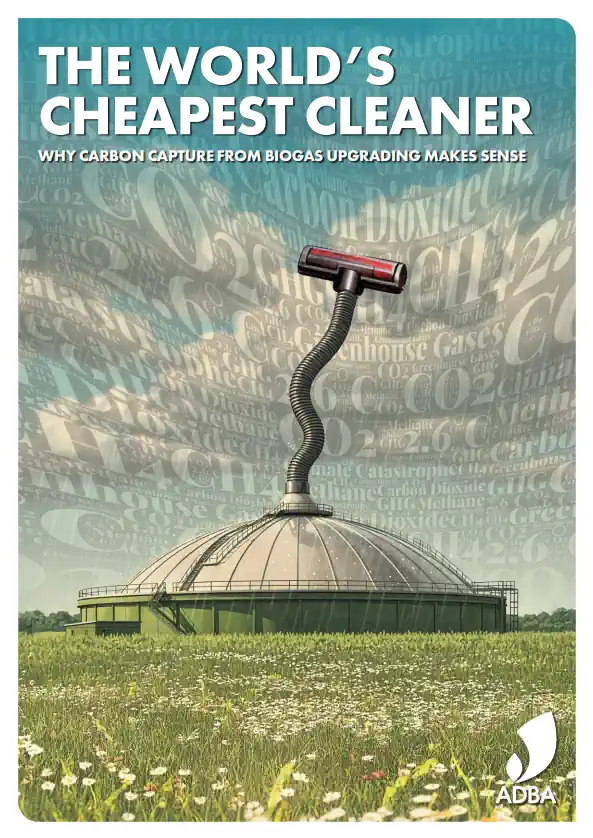
Published by Green Gas Trade Body, the Anaerobic Digestion and Bioresources Association (ADBA), the report entitled The World's Cheapest Cleaner – why carbon capture from biomethane upgrading makes sense shows that carbon capture from biogas upgrading is already happening at a fraction of the cost of alternatives put forward by the UK government.

“This is a tried and tested process of carbon removal that needs no more laboratory or development work. The biogas to biomethane process is renewable, reliable and ready,” said Chris Huhne, Chair of ADBA.
“Gas has for far too long been seen only as a cause of climate change. However, green gas is not part of the problem but a critical part of the solution, offering real hope of meeting ambitious climate goals at low cost”.
The report will be presented at the forthcoming ADBA National Conference 2025 in London on Wednesday 10 December. You can request your free media accreditation HERE.
-ENDS-
For further information, contact:
Jocelyne Bia, Head of Corporate Communications and PR
e: jocelyne.bia@adbioresources.
🌍 The Hidden Power of theUK AD Industry
Think of the Anaerobic Digestion (AD) industry as the UK’s quiet, green engine. Right now, across more than 750 operational plants, this sector is hard at work turning a major environmental problem into a clean energy solution.
Here is how the industry is making a difference today, and where it is heading tomorrow:
♻️ Turning Waste into Warmth Every year, the industry takes 36 million tonnes of organic material—waste that would otherwise rot in landfills and release harmful methane—and recycles it. Instead of polluting the atmosphere, this “green stomach” captures the gas.
⚡ Powering the Nation This process generates a massive 21 TWh of biogas annually. This isn't just theoretical energy; it’s being used right now to generate electricity, create heat, and pump green biomethane directly into the national gas grid. Currently, this effort shaves 1% off the UK’s entire greenhouse gas emissions every single year.
👷 A Growing Workforce Behind the technology are people. The sector currently employs 4,800 workers across the UK. It is a resilient industry, too—growing by 5% last year as it shifts toward larger-scale facilities that feed directly into the gas grid.
🚀 A Vision for 2050 The potential for growth is enormous. If fully deployed by 2050, the AD industry could:
- Heat 6.8 million homes by generating over 100 TWh of biomethane.
- Supply between 20% and 50% of the UK’s total gas demand.
- Support a workforce of 60,000 people (combining direct and indirect jobs).
- Slash carbon emissions by 27 million tonnes—that is the equivalent of taking one out of every three cars off British roads.