


Are your biogas EPC projects slowed by IT faults, clashing schedules and messy project data, leaving teams stuck on site? Managed Services For Construction Businesses can monitor systems, protect data and speed up project delivery.
This post shows how to outsource IT to a managed service provider, and how that frees your team to focus on construction management and value engineering. You will read clear steps on project management, cloud and data analytics, building information modelling, enterprise resource planning software, vendor management systems, supply chain controls and IT security.
We cover ways to cut costs, scale up fast, run background checks, manage assets and use pdfs and construction estimating software, all in one plan. Read on!
Key Takeaways
- Outsourcing IT to an MSP lets biogas plant EPCs offload BIM, ERP, cloud, SCADA, SIEM and VPN management, freeing teams to focus on construction.
- Managed services deliver proactive monitoring, 24/7 helpdesk, patching and backups to cut downtime and speed project delivery.
- MSPs provide predictable monthly fees, centralised vendor management and background checks to reduce payroll, liability and capital expenditure.
- Cloud, data analytics, BIM integration and IoT/SCADA links improve collaboration, reduce rework and boost productivity across EPC workflows.
- Choose an MSP with clear SLAs, regular reports and local support to tighten cyber defences and ensure reliable on-site assistance.
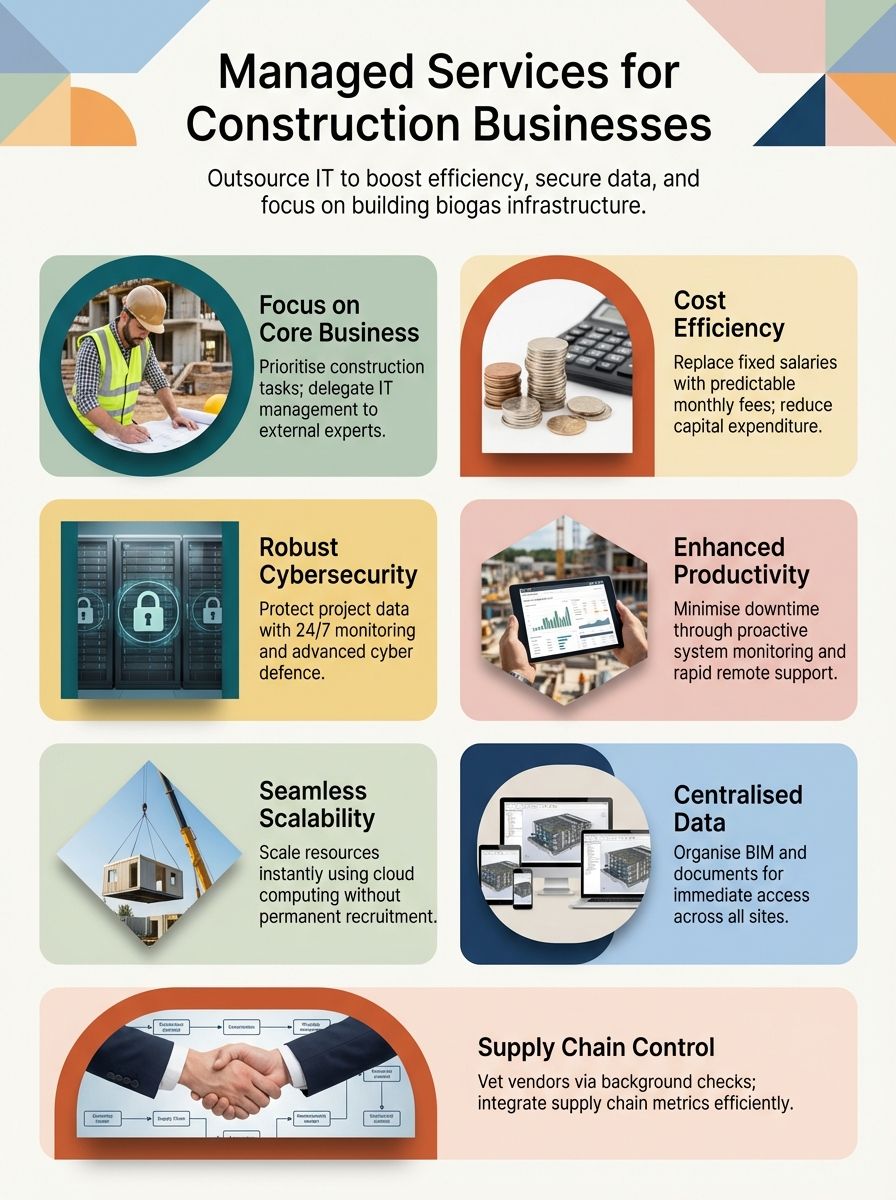
What Are Managed Services for Construction Businesses?

Managed services let construction firms, especially biogas plant EPCs, hand over IT tasks like building information modelling (BIM), enterprise resource planning (ERP) and cloud operations to a managed service provider (MSP), and free teams to focus on project delivery and asset management.
An MSP also runs security audits, background checks, supply chain IT, workforce management and continuous development, so firms cut labour market skill gaps and lift operational efficiency; read on.

What Are Managed Services and Their Scope?
A diverse group of SDA investors discussing pricing changes outside a modern office building.
As NDIS property investors, we need to pay close attention to the changes in Specialist Disability Accommodation (SDA) pricing arrangements, as from January 2024, these new prices will come into effect.
This means that as owners and investors, our focus should be on how these adjustments can affect income streams and the financial stability of SDA investments.
Let's utilise available resources like the NDIS Pricing Arrangements and Price Limits documents as they are crucial tools aiding in smooth transitions towards applying these new arrangements.
A managed service provider (MSP) runs continuous monitoring of systems to detect even minor changes swiftly. MSP teams manage LAN and WAN infrastructure, SaaS, managed print, and managed security services.
Automatic categorisation improves data storage, it makes document retrieval faster. Data analytics, cloud platform services like Azure and AWS, and cybersecurity sit inside the scope.
EPCs and firms in the construction sector use BIM and enterprise resource planning (erp) tools. MSPs integrate those tools into project delivery and supply chain processes. They run security audits and background checks, and they feed performance metrics into ERP software and workforce management systems.
They also reduce IT vacancies, so firms adapt quickly to new tools and drive continuous development of operational efficiency.
How Do Managed Services Benefit Construction Businesses?
Managed services cut workload on project teams; they take the weight off and supply extra expertise fast. This lets firms move staff and cash back to core construction tasks, like civil works on a biogas plant EPC.
Such a managed service provider runs BIM, ERP, cloud and VPN tools, and links IoT or SCADA into the supply chain. They also handle background checks, continuous development and cyber hygiene for residential construction and waste projects.
Outsourcing IT support reduces the risk from poor technology, and it speeds up digital transformation and project delivery. Teams can scale skills and capacity without hiring full-time staff, so firms stay agile, cut costs, and adapt business strategies.
These services improve efficiency, which helps hit deadlines and shape the business model or business strategy. Project delivery benefits from proactive support, as firms free up people for hands-on work.
Key Managed Services and Their Advantages
3D design files, methane detectors and PLC telemetry feed clear data to a managed service provider. These managed services use log analytics, device monitoring, supply chain checks and background checks to cut downtime, speed project delivery, and drive continuous development for site teams.

What Are Managed IT Services?
Managed IT services keep project technology running, they provide hands-on care every day and keep the lights on for site teams. A managed service provider uses proactive monitoring of IT systems, network security measures and cyber resilience strategies.
It runs data backup solutions, supports Microsoft 365, and fields a helpdesk that links field devices to office systems, for smoother field-to-office technology integration.
Biogas plant EPCs need exact data on equipment, budget, staffing and spatial needs, so managed services tie IT to supply chain and project delivery workflows. Field crews get real-time updates, control systems and enterprise resource planning tools exchange data, and technicians usually pass background checks.
The provider runs continuous development, applies timely patches, and keeps the helpdesk on call, which cuts downtime and keeps projects moving.
How Does Project Delivery Management Work?
Project delivery management uses specialists to oversee capital projects, to improve productivity, enhance value, and deliver on time and on budget. A managed service provider coordinates tools like building information modelling, project management information system, enterprise resource planning, and cloud storage, to keep teams aligned, like a conductor with a baton.
They run background checks on contractors, track the supply chain, and apply continuous development to software and processes.
These managed services ensure that all necessary project information is organised and accessible once inputted into the system. Planning sets scope and budget, stage gates stop waste, and real-time dashboards show progress.
Specialists use mobile apps, Internet of Things sensors, and document control to reduce delays and keep value high.
How Can Cybersecurity Protect Construction Firms?
Managed security services protect sensitive project and financial data from increasing cyber threats. A managed service provider runs firewalls, endpoint protection, identity and access management, and security event monitoring from a central security operations centre.
They add multi-factor authentication and strong encryption, and carry out background checks on vendor access.
Construction firms gain clear benefits from robust cybersecurity as part of managed services. It cuts risk to bids, invoices and site systems, it preserves client trust, and it keeps project cashflow moving.
A provider handles patching, continuous development of defences and 24/7 monitoring, freeing project teams to focus on building digesters and pipelines. This approach acts like a lock and a night watch, practical and low fuss, it lowers the chance of costly breaches.
What Is Cloud and Data Management?
Cloud and data management keeps biogas plant records safe, accessible and organised, often on platforms such as Autodesk Construction Cloud. Cloud storage, building information models, and application programming interfaces let teams share drawings and sensor feeds across sites, fast.
Your managed service provider runs the work. Staff pass background checks, and they provide continuous development of tools and workflows. Automatic categorisation tags drawings, photos and model revisions, so teams find the right file in seconds, not hours, like a tidy tool cabinet that speeds decisions and cuts rework.
How Do Managed Services Improve Cost Efficiency?
Managed services cut IT budgets. They give predictable monthly fees and access to modern tools without large upfront spend.
- Shift fixed IT salaries to predictable monthly fees, reducing the need for large in-house teams, letting EPCs avoid hiring multiple IT specialists and cutting payroll and benefits costs.
- Leverage cloud platforms and an office productivity suite, gain modern tools without major capital expense, and shrink expenditure on servers, storage and licence fees.
- Reduce downtime costs with remote monitoring and predictive maintenance, the managed service uses control systems and field devices to flag faults early, lowering repair bills and lost output.
- Cut vendor chaos, a managed service provider centralises patching, backups and project IT, trimming subcontractor invoices and simplifying monthly budgeting for biogas plant EPCs.
- Require background checks for third party technicians and engineers, the provider handles vetting and compliance, which lowers recruitment expenses and reduces liability exposure for construction firms.
- Predictable monthly costs improve cash flow, replace large capital buys, free funds for plant delivery, and let projects adopt new software and tools without heavy upfront investment.
How Can Managed Services Enhance Productivity?
Outsourcing IT lifts hidden burdens from project teams. It helps biogas EPCs meet deadlines and reduce downtime.
- Use BIM alongside a cloud platform and a productivity suite to centralise plans, reduce rework, speed approvals, and improve collaboration across site teams, thus streamlining workflows and boosting project delivery.
- Hire a managed service provider to run ERP, PMIS and remote monitoring for biogas plants, cutting admin burden, aligning schedules, and freeing engineers to focus on construction tasks that drive results, like a foreman with a clear checklist.
- Use IoT sensors and SCADA tied into SIEM and VPN tools to spot faults fast, stop firefighting, cut mean time to repair, and let expert support from MSP teams act before a problem halts site work.
- Automate routine reports with a project portal, polls, and analytics from a business intelligence tool so crews see task lists, change orders, and KPIs in real time, boosting productivity on tight schedules.
- Offer 24/7 remote helpdesk and scheduled patching through an MSP for quick fixes, fewer outages, and steady uptime, which construction businesses report leads to significant improvements in project outcomes.
- Train crews on digital tools, run short workshops, and hand over standard operating procedures so teams adopt new tech faster, cut delays, and raise productivity across EPC workstreams.
Why Do Construction Businesses Need Managed Services?
Managed services close tech gaps for biogas EPCs. They keep BIM, SCADA and ERP systems running, run cloud platforms, SIEM and VPNs, and free teams to tend plants not patches.

How Do Managed Services Bridge Technology Gaps?
Service teams plug tech gaps fast. They use field applications and Enterprise Resource Planning, ERP, to link site data with office systems. These services add IoT sensors, supervisory control systems, cloud platforms and data analytics.
They help construction businesses keep pace with ongoing technological advancements.
Outsourced experts run remote monitoring, patching and cybersecurity, so biogas plant EPCs stay online. This frees site teams to focus on build work, while vendors maintain software and scale resources on demand.
How Can Construction Firms Focus on Their Core Business?
Let the builders build, hand IT to a managed provider, keep crews on site, not on laptops. Outsourcing IT and related functions through managed services allows construction firms to focus on their main construction activities.
This redirection of resources improves business outcomes, cuts admin time, and raises site productivity. Project managers use building information modelling, resource planning systems, project management software, cloud platforms such as Azure and SCADA, along with connected meters, to speed delivery and lower risk for biogas plant EPCs.
How Do Managed Services Support Scalability and Agility?
Managed services let EPCs add skills and capacity, without permanent hires, so teams scale fast without headcount drama. That model uses cloud computing, virtual machines, and SaaS to expand capacity in weeks, not months.
Teams can spin up remote monitoring and tie field sensors to control systems to run extra sites with the same core staff.
This scalable setup supports business agility in response to changing project demands, so firms react to peaks and troughs with speed. Outsourced IT service desks and ERP support free construction crews to focus on building work, not IT chores.
What Does Managed Service Delivery Involve?
Managed service delivery links help desk, project platforms, BIM, control systems and field sensors, public cloud services, security logging, endpoint defence, backups and VPNs, so EPC teams keep their hands on the spade; read more.
What Is Outsourcing in Managed Services?
You delegate specific IT and project tasks to thirdâparty providers. That approach cuts the need for a big inâhouse team. It lets biogas EPCs tap external expertise, such as security information and event management (SIEM), virtual private network (VPN) setup, supervisory control and data acquisition (SCADA) integration, and enterprise resource planning (ERP) support.
Small teams gain an onâcall set of skills, from IT support desk, to cloud file storage and project delivery management under a service level agreement. Think of it as hiring an onâcall engineer for your van, without the payroll headaches.
This shifts spending from headcount to predictable fees and speeds access to specialists.
How Does Access to Expertise Benefit Construction Firms?
Managed services grant construction firms access to specialised skills and knowledge not available internally. Experts in artificial intelligence and cybersecurity raise design quality, speed delivery, and cut project risk.
An EPC working on a biogas plant can use outsourced IT, AI models for predictive maintenance, cloud platforms for data, IoT sensors, and security monitoring tools to spot faults early and reduce downtime.
What Is Proactive Support in Managed Services?
Proactive support catches faults before they can disrupt work, cutting downtime and minimising system failures. Remote tooling, an operations centre and field sensors run continuous system monitoring, spotting odd behaviour in control systems.
A security log analyser flags anomalies fast, and a staffed helpdesk dispatches fixes straight away, keeping the wheels turning on site. Operators get fixes before issues become stoppages, so crews keep delivering on schedule.
Conclusion
6. Conclusion: Managed services let biogas EPCs offload IT, so teams can build plants, not fight tech. MSPs run cloud platforms, data analytics, SaaS apps, networks and infrastructure, using monitoring tools, RMM, ticketing systems, VPNs and backup.
That work cuts delays, tightens cyber defences, and speeds project delivery. Owners save money, reduce waste, and free staff to focus on construction and compliance. Pick a partner with clear SLAs, regular reports, and local support, and skip the midnight server climbs.
FAQs
1. What are managed services for construction businesses, and why outsource IT for biogas plant EPCs?
Managed services for construction businesses mean a third party runs your IT, on call, round the clock. Outsourcing IT for biogas plant EPCs, or contractors, gives you specialist skills, faster fixes, and steadier systems. It keeps the job moving, like a pit crew for your project tech.
2. Which IT tasks can biogas plant EPCs outsource?
You can outsource network and server management, cyber security, backups and disaster recovery, cloud hosting, CAD data handling, site connectivity, and helpdesk support. These tasks free your team to focus on design and builds.
3. How does outsourcing IT help project timelines and budgets?
Outsourcing cuts surprise costs, with steady monthly fees and clear service levels. Problems get fixed sooner, so sites face fewer delays. You can scale support up or down, to match peak phases, without hiring or firing.
4. What should construction leaders look for in a managed service provider for biogas plant EPCs?
Pick a provider with construction or engineering experience and good cyber security practices. Check service level agreements, local field support, and references. Ask if they handle remote site links and IoT devices, and if they train your staff, so handovers are smooth.